I just got around to reading the communist manifesto and was surprised by the fact that it doesn’t actually advocate for getting rid of money. It includes steps like having a very progressive tax, abolishing inheritance, and nationalizing banks but those all presume that there will still be money.
It then says that it will take multiple generations under these conditions for the idea of money to disappear and it will happen naturally.
I was also surprised to see that there’s a similar argument for property. That it advocates for seizing private property (which has a particular definition in the book) but says other forms of property can be kept around and will only be abolished naturally in a few generations.
Honestly it was in a little free library box and I figured I sympathized in theory but I had never actually read the book. The actual manifesto is super super super short. More than half the book was prefaces from various authors (including Marx and engels) and it was still one of the shortest books I’ve read this year.
A lot of the “communist canon” is made up of 50 - 70 page long pamphlets. Basically long enough to read in one or two sitting, and then discuss with other workers since reading circles were really popular during the early communist movement.
Glad you found it! Makes me wanna carry some copies around with me to put into little libraries!
A few pamphlets I’d recommend would be Socialism: Utopian and Scientific, which is about Historical Materialism, Wage Labor and Capital which is a brief primer on Marxist economics, and The 18th Brumaire of Louis Napoleon which is about the ascention of Louis Napoleon in France and incidentally contains about half of Marx’s most famous quotes. It also describes conditions where the liberal democracy that was won decades earlier started backsliding into authoritarianism and semi-feudal social relations, and echoes many of our current conditions.


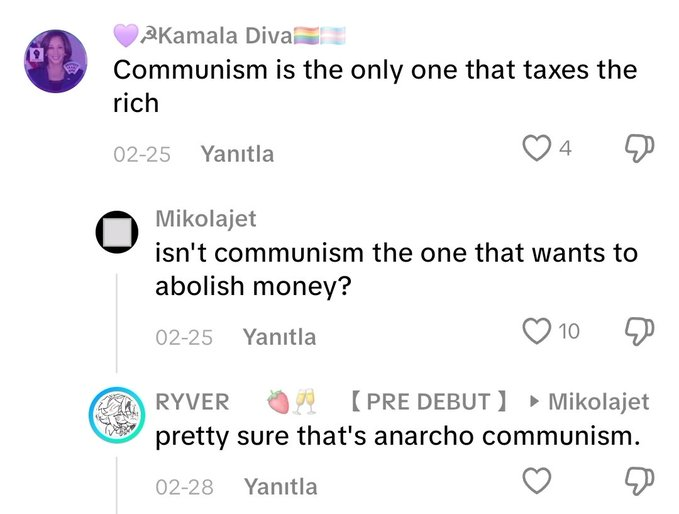
I just got around to reading the communist manifesto and was surprised by the fact that it doesn’t actually advocate for getting rid of money. It includes steps like having a very progressive tax, abolishing inheritance, and nationalizing banks but those all presume that there will still be money.
It then says that it will take multiple generations under these conditions for the idea of money to disappear and it will happen naturally.
I was also surprised to see that there’s a similar argument for property. That it advocates for seizing private property (which has a particular definition in the book) but says other forms of property can be kept around and will only be abolished naturally in a few generations.
Awesome, why did you decide to read it?
Honestly it was in a little free library box and I figured I sympathized in theory but I had never actually read the book. The actual manifesto is super super super short. More than half the book was prefaces from various authors (including Marx and engels) and it was still one of the shortest books I’ve read this year.
A lot of the “communist canon” is made up of 50 - 70 page long pamphlets. Basically long enough to read in one or two sitting, and then discuss with other workers since reading circles were really popular during the early communist movement.
Glad you found it! Makes me wanna carry some copies around with me to put into little libraries!
A few pamphlets I’d recommend would be Socialism: Utopian and Scientific, which is about Historical Materialism, Wage Labor and Capital which is a brief primer on Marxist economics, and The 18th Brumaire of Louis Napoleon which is about the ascention of Louis Napoleon in France and incidentally contains about half of Marx’s most famous quotes. It also describes conditions where the liberal democracy that was won decades earlier started backsliding into authoritarianism and semi-feudal social relations, and echoes many of our current conditions.