

61·
2 hours agoYes, these are the agents I use. I disclosed how I use them in my post.
Yes, these are the agents I use. I disclosed how I use them in my post.
I used one with a display to show the album cover of the song that currently plays next to speakers. An old pi is all the performance needed for that !
Do any of these self-hosted services offer fun/interesting visualisations of your data? I like archiving what I listen to in order to look at cool graphs every once in a while.
Hi! Late reply, I only found this thread now.
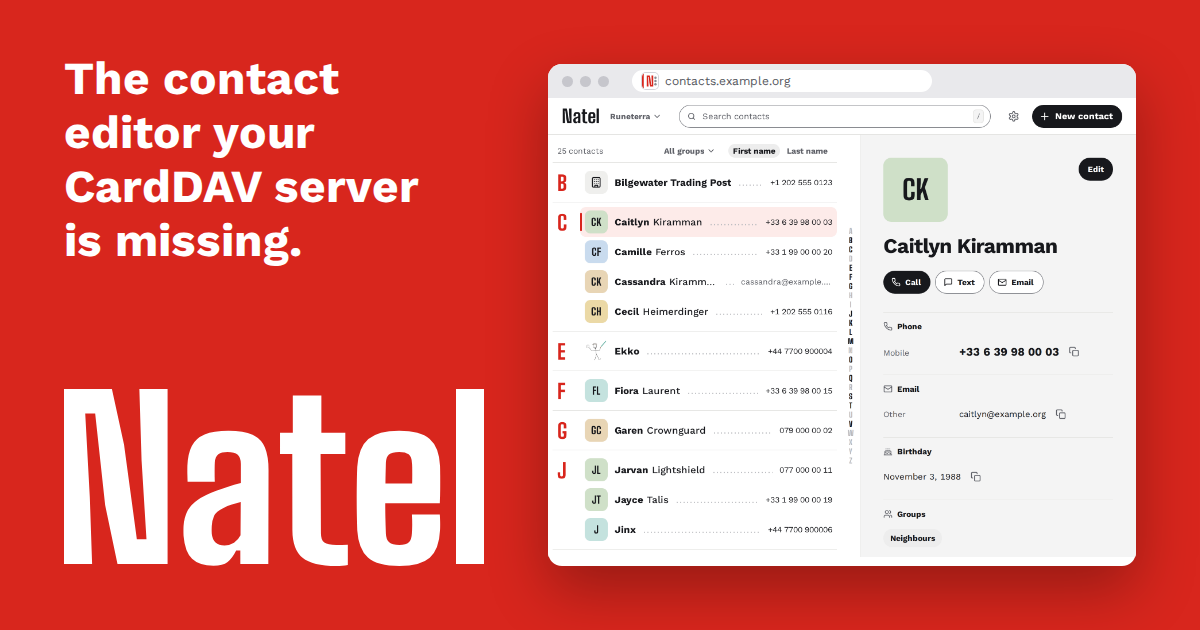
If you get tired of re-uploading the .vcf: I’ve built a web editor for the contacts on a CardDAV server, so you edit a card in the browser and it’s saved straight on your Radicale (also tested with Xandikos and Baïkal).
Code: https://github.com/KewinDousse/natel And here’s a demo with made-up contacts: https://demo.natel.app/contacts
Hi! Late reply, I only found this thread now.
You wished someone would make a modern standalone web app for this. I’ve been building one for the contacts side: it edits cards on a CardDAV server, tested against Radicale, Xandikos and Baïkal. It’s contacts only, no calendar, so it doesn’t fill the CalDAV gap you described (I agree that part is much harder), but for contacts it gives you a full editor in the browser !
There’s a demo with made-up contacts if you want to look: https://demo.natel.app/contacts Code (MIT): https://github.com/KewinDousse/natel
It’s still beta, so feedback is welcome.

Thanks! I’d be curious to hear if Natel is missing features you’ve found useful in your own solution.

Hey, thanks for answering. That’s pretty much my point of view too, and honestly I’ve become much more suspicious of any new project I see since agents showed up. What I do now before installing such a young project from anyone else, is ask an agent to review the code and write a report on how it looks and whether anything looks suspicious, but I agree that it does not carry the same weight as a human review.