It’s more a self-defense measure - while there are perfectly good counterfeit cheeses out there, if someone gets a really crappy piece or there’s food poisoning traced back to a counterfeit cheese this lets them prove it wasn’t their fault, thus avoiding a hit to the brand reputation and/or avoid liability.
Not exactly a great solution imho, but it does make sense from a certain perspective. AFAIK they’re sticking the chips in the wax/rind not the cheese itself, which does improve things slightly.
Scammer reads p-chip patent, realises there’s only a small range of laser diode wavelengths that can penetrate cheese. Buys chipped cheese, breaks the cheese. Chipped pieces found using laser excitation pulse and sensor with a notch filter. Save the wedge with the most chips to repeatedly break down to get chipped cheese crumbs, insert into bogus wedges, profit.
I’m sure the idea can be refined, but I’ll leave the fine details to the dairy delinquent curd counterfeiters.
To embed the p-Chip in a Parmigiano-Reggiano cheese wheel, the chip is inserted into a casein label on the cheese wheel, which becomes part of the cheese rind during its preparation process. Cheese buyers aren’t going to eat this embedded label.
They’re not liberally sprinkling the cheese with microchips that can be picked out, they’re sticking single chips on full wheels.
Fair enough, read the tech stack more than the implementation. It makes me wonder why not RFID or NFC instead? The only substantial difference would be antenna size and visibility, my only hinch is that it’d be an appearance thing
I’m guessing it’s down to food regulations - I don’t think there are edible NFC implementations available (I suspect it’s down to the power requirements, as far as I can tell the reason they use light stimulation for power transfer instead of the normal inductive method is so that you don’t need the large receiving antenna, which probably makes it more “edible”?), even though it’s clearly the superior option.


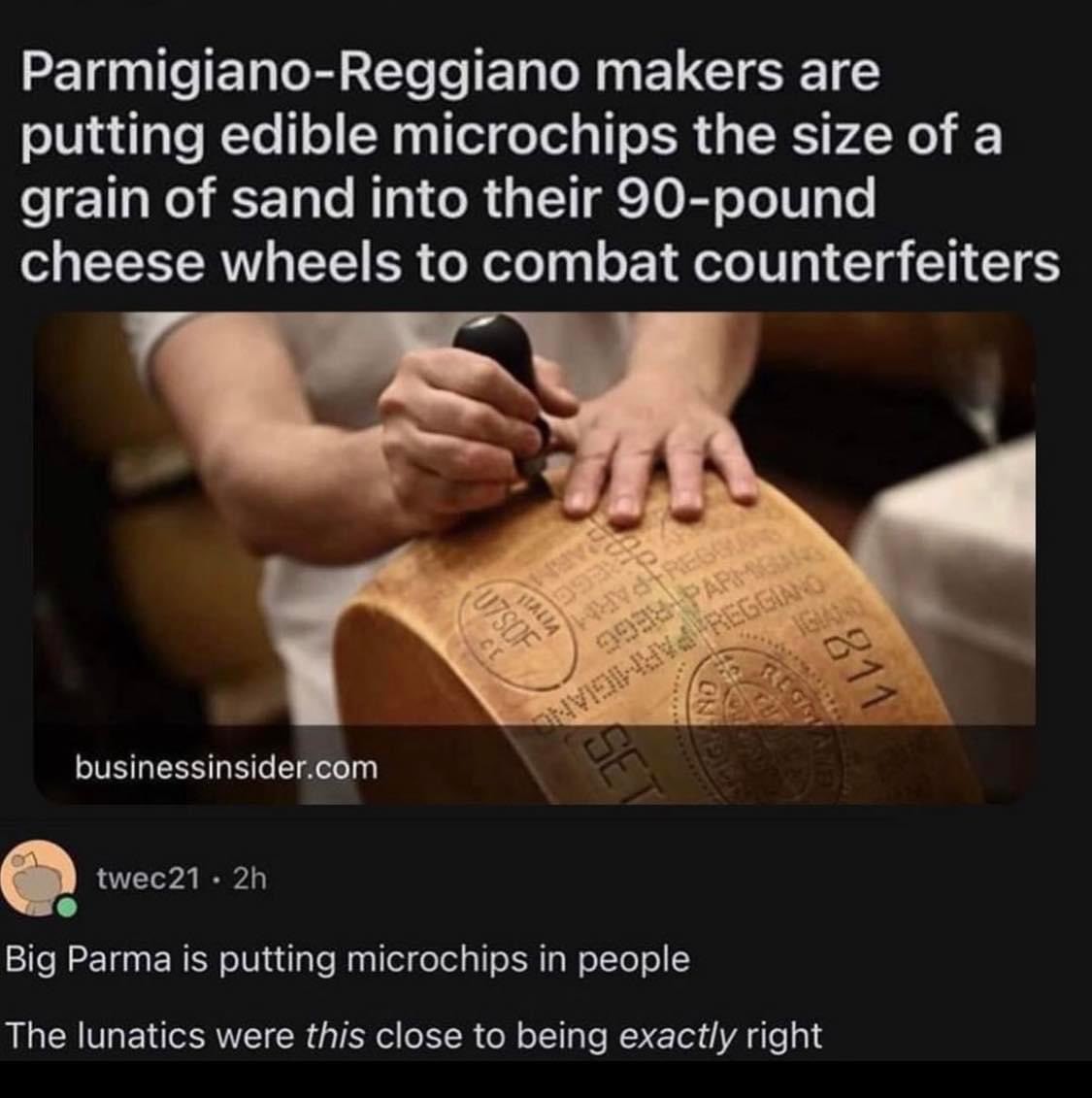
It’s more a self-defense measure - while there are perfectly good counterfeit cheeses out there, if someone gets a really crappy piece or there’s food poisoning traced back to a counterfeit cheese this lets them prove it wasn’t their fault, thus avoiding a hit to the brand reputation and/or avoid liability.
Not exactly a great solution imho, but it does make sense from a certain perspective. AFAIK they’re sticking the chips in the wax/rind not the cheese itself, which does improve things slightly.
Scammer reads p-chip patent, realises there’s only a small range of laser diode wavelengths that can penetrate cheese. Buys chipped cheese, breaks the cheese. Chipped pieces found using laser excitation pulse and sensor with a notch filter. Save the wedge with the most chips to repeatedly break down to get chipped cheese crumbs, insert into bogus wedges, profit.
I’m sure the idea can be refined, but I’ll leave the fine details to the dairy delinquent curd counterfeiters.
They’re not liberally sprinkling the cheese with microchips that can be picked out, they’re sticking single chips on full wheels.
Fair enough, read the tech stack more than the implementation. It makes me wonder why not RFID or NFC instead? The only substantial difference would be antenna size and visibility, my only hinch is that it’d be an appearance thing
I’m guessing it’s down to food regulations - I don’t think there are edible NFC implementations available (I suspect it’s down to the power requirements, as far as I can tell the reason they use light stimulation for power transfer instead of the normal inductive method is so that you don’t need the large receiving antenna, which probably makes it more “edible”?), even though it’s clearly the superior option.