Funny enough, some historians suggest that pre-modern methods of warfare, counterintuitively, actually result in lower rates of PTSD.
That being said, I recall at least three incidents in Roman histories (which were generally not very concerned about the experience of the common soldier) wherein soldiers exhibited symptoms considered to be likely PTSD - one of a veteran of Julius Caesar who experienced intermittent attacks of disproportionate rage after a head wound; one of a soldier during one of the civil wars who was said to have ‘lost his mind’ after sacking an Italian city and committed suicide; and one of the great general Gaius Marius, who suffered from war-related nightmares and alcohol abuse later in life.

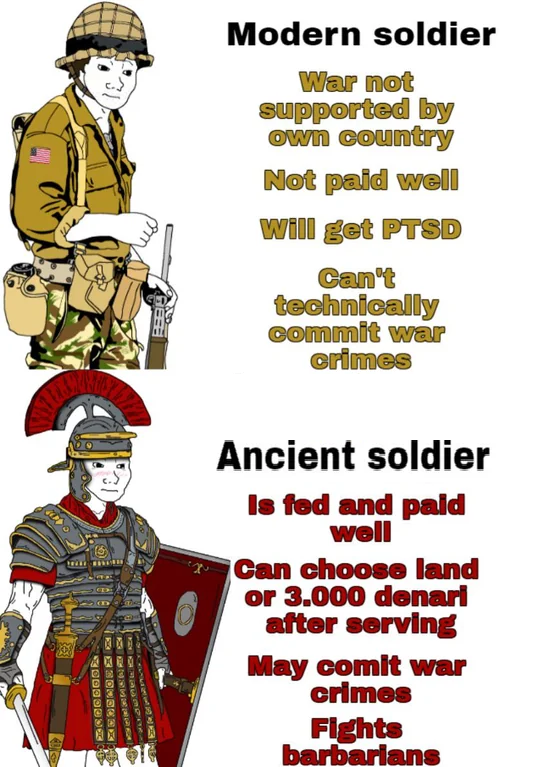
The lower ones get plenty of PTSD too. They just don’t care because everybody else is getting some too.
Funny enough, some historians suggest that pre-modern methods of warfare, counterintuitively, actually result in lower rates of PTSD.
That being said, I recall at least three incidents in Roman histories (which were generally not very concerned about the experience of the common soldier) wherein soldiers exhibited symptoms considered to be likely PTSD - one of a veteran of Julius Caesar who experienced intermittent attacks of disproportionate rage after a head wound; one of a soldier during one of the civil wars who was said to have ‘lost his mind’ after sacking an Italian city and committed suicide; and one of the great general Gaius Marius, who suffered from war-related nightmares and alcohol abuse later in life.
As someone with aphantasia that cannot really get PTSD, I wonder if more were like me.
I’d be affected by war but I wouldn’t have vivid memories popping randomly in my head afterwards.
In pre-modern warfare, the biggest threat is the one you can see. In modern warfare, the biggest threat is the one you can’t see.