If it’s not important enough to do something effective, you can try to achieve some sort of change through the political process.
And you have constantly refused to acknowledge that the tax laws aren’t consistent.
Your equivalent position: “Police brutality isnt a problem, become a policeman so you are above the law or change it with politics.”
I’ve been on all sides. I’ve been W2. I’ve been W2 with a side business. I’ve been president of a large ISP. I don’t have to be in the fight to see injustice.
And you have constantly refused to acknowledge that the tax laws aren’t consistent.
I’ve shown the consistency.
A W2 worker is, effectively, a subcontractor to a prime contractor who reimburses all normal work expenses. The subcontractor doesn’t get to deduct their travel expenses, because they are part of the normal compensation. The subcontractor doesn’t get to deduct PPE, because they are provided by the prime. The subcontractor doesn’t get to deduct clothing or laundry or tools, because all of those are provided (or reimbursed) by the prime. This arrangement between the prime and the subcontractor is functionally identical to that of the prime with a W2 employee.
The subcontractor does get to deduct atypical expenses not included in the normal, negotiated pay. So does the W2 employee.
The term for the comparison between “W2 Worker” and the type of subcontractor I described is “consistent”. They are able to make the same deductions for the same reasons. They are taxed the same. A W2 worker is a subcontractor whose normal expenditures are all reimbursed by the prime. The distinction between them has no relevant difference.
The tax scheme for a W2 employee is simplified relative to that of a 1099 worker. This is the sine qua non of W2 employment. This simplification is the explicit reason why this category exists. This category of worker incorporates all “normal” expenditures, making all of them the responsibility of the employer, and included in “normal”, negotiated pay. These “normal”, routine, recurring expenditures don’t need to be explicitly itemized on the tax return. They are already treated as reimbursed through regular pay, so they are already incorporated and not subject to deduction. The need for these expenditures is included in your pay negotiation with your employer.
This simplification does not extend to abnormal or atypical expenses incurred by the worker. Where the W2 worker incurs abnormal or atypical, non-reimbursed expenses, they can, indeed, claim these expenses. Only normal, recurring expenses are included in the pay negotiated with the employer.
What you are trying to achieve is something that already exists in the tax code. Colloquially, it’s called the “1099 Worker”. We already have the “1099 Worker”. You’re trying to reinvent the “1099 Worker”. But we already have the “1099 Worker”. Everything you are trying to achieve for the W2 employee is already present in the “1099 Worker” category. If you want the benefits of a “1099 Worker”, go ahead and become a “1099 Worker”. You can certainly hire yourself out to one or more businesses as a “1099 Worker”. Companies hire “1099 Workers” all the time for specific purposes. Yes, the overwhelming majority of jobs are filled by W2 employees, but certainly not all. There is plenty of opportunity for you to operate as a “1099 Worker” if your specific needs aren’t being met by W2 employment.
W2 worker is, effectively, a subcontractor to a prime contractor who reimburses all normal work expenses.
I already quoted the IRS webpage where it specifically states that isn’t true.
But it doesn’t matter. If you are a business and get income from a contract and that contract says “Part of this money includes travel expenses.” it doesn’t matter to the IRS. As a business, you get income and you have expenses. The details of that income do not matter to the IRS.
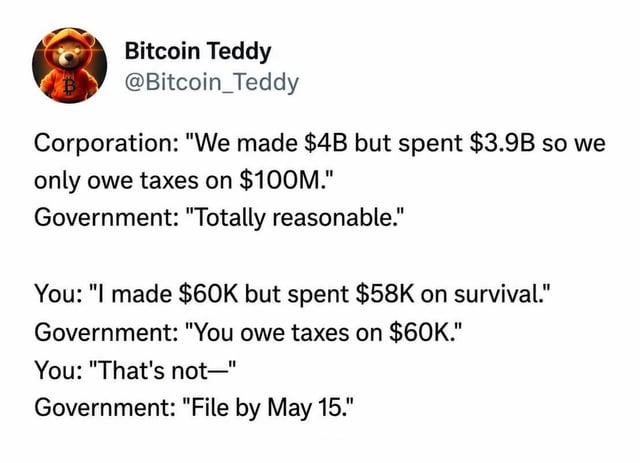
For example a business gets $50k of income from a contract that says it includes travel expenses. At the end of the year you actually spent $49k in travel expenses. You report $1k profit to the IRS.
A W2 gets $50k and has to report $50k independent of how much they had to personally spend to get that $50k.


And you have constantly refused to acknowledge that the tax laws aren’t consistent.
Your equivalent position: “Police brutality isnt a problem, become a policeman so you are above the law or change it with politics.”
I’ve been on all sides. I’ve been W2. I’ve been W2 with a side business. I’ve been president of a large ISP. I don’t have to be in the fight to see injustice.
I’ve shown the consistency.
A W2 worker is, effectively, a subcontractor to a prime contractor who reimburses all normal work expenses. The subcontractor doesn’t get to deduct their travel expenses, because they are part of the normal compensation. The subcontractor doesn’t get to deduct PPE, because they are provided by the prime. The subcontractor doesn’t get to deduct clothing or laundry or tools, because all of those are provided (or reimbursed) by the prime. This arrangement between the prime and the subcontractor is functionally identical to that of the prime with a W2 employee.
The subcontractor does get to deduct atypical expenses not included in the normal, negotiated pay. So does the W2 employee.
The term for the comparison between “W2 Worker” and the type of subcontractor I described is “consistent”. They are able to make the same deductions for the same reasons. They are taxed the same. A W2 worker is a subcontractor whose normal expenditures are all reimbursed by the prime. The distinction between them has no relevant difference.
The tax scheme for a W2 employee is simplified relative to that of a 1099 worker. This is the sine qua non of W2 employment. This simplification is the explicit reason why this category exists. This category of worker incorporates all “normal” expenditures, making all of them the responsibility of the employer, and included in “normal”, negotiated pay. These “normal”, routine, recurring expenditures don’t need to be explicitly itemized on the tax return. They are already treated as reimbursed through regular pay, so they are already incorporated and not subject to deduction. The need for these expenditures is included in your pay negotiation with your employer.
This simplification does not extend to abnormal or atypical expenses incurred by the worker. Where the W2 worker incurs abnormal or atypical, non-reimbursed expenses, they can, indeed, claim these expenses. Only normal, recurring expenses are included in the pay negotiated with the employer.
What you are trying to achieve is something that already exists in the tax code. Colloquially, it’s called the “1099 Worker”. We already have the “1099 Worker”. You’re trying to reinvent the “1099 Worker”. But we already have the “1099 Worker”. Everything you are trying to achieve for the W2 employee is already present in the “1099 Worker” category. If you want the benefits of a “1099 Worker”, go ahead and become a “1099 Worker”. You can certainly hire yourself out to one or more businesses as a “1099 Worker”. Companies hire “1099 Workers” all the time for specific purposes. Yes, the overwhelming majority of jobs are filled by W2 employees, but certainly not all. There is plenty of opportunity for you to operate as a “1099 Worker” if your specific needs aren’t being met by W2 employment.
I already quoted the IRS webpage where it specifically states that isn’t true.
But it doesn’t matter. If you are a business and get income from a contract and that contract says “Part of this money includes travel expenses.” it doesn’t matter to the IRS. As a business, you get income and you have expenses. The details of that income do not matter to the IRS.
For example a business gets $50k of income from a contract that says it includes travel expenses. At the end of the year you actually spent $49k in travel expenses. You report $1k profit to the IRS.
A W2 gets $50k and has to report $50k independent of how much they had to personally spend to get that $50k.