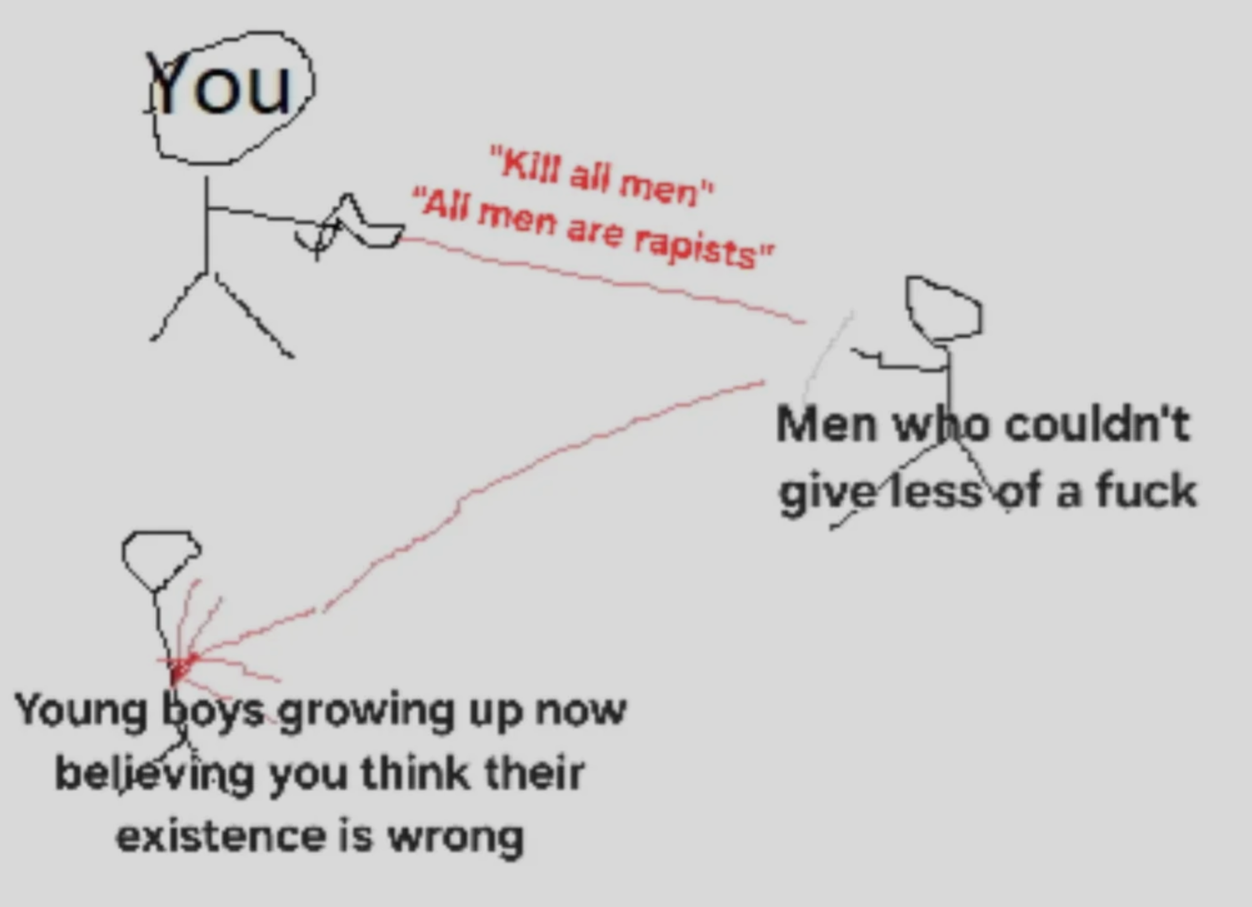
so while both the statements in the OP are hyperbole (often coming from someone who has been abused and traumatized) - if it does make men-to-be more aware of SA and lower the rates of SA then it would have done it’s job.
If OPs argument is that this turns boys to the right (eg the “manosphere”) or impacts their sense of self-worth then that’s more a comment on men not being able to explain to boys why women would feel the need to say such things (eg that they’re otherwise never heard) instead of once more victim blaming women for being too uppity for how they express their experiences of SA
I believe survivorship bias makes the entire predicament worse. Women really are harassed and abused. A lot of guys really don’t want to do that to them. A lot of them don’t approach women at all any more which means shitty men are the ones left harassing women, making the problem worse.
If before 1 in 10 we’re shitty, and 5 guys decide to stop approaching women unless there are clear unambiguous signs of interest, now 1 in 5 guys are shitty. Repeat until only shitty men are left…
I’m not saying this to blame women to be clear. It’s just how this works right now? First, identify the problem. It’s shitty men not listening… I don’t even know how to begin to fix this personally.
You’re right and I think the survivorship bias cuts both ways (please excuse the heteronormativity throughout this comment- other dating configurations are common, equally valid, and come with their own dynamics, and my husband and I are both bi, but I’m just speaking to heterosexual dating culture here, so I don’t mention them). I’m an AFAB maybe egg who’s had what in my circles is a normal amount of negative sexual attention for an AFAB person, but a really rough dating history.
That means I’ve
trigger warning
been catcalled a bunch, occasionally groped, and raped a couple of times, but not in a way that my grandmother would have considered rape (I wasn’t threatened or left with permanent injuries, luckily). I have, however dated some bizarrely bad boyfriends, including: a guy who stole my medication and resold it to me; a guy who didn’t disclose his well-managed paranoid schizophrenia and moved in with me abroad without any support network or continuation of treatment/medication; and a guy who beat his own mother to death (I met him after he got out of jail and he told me he’d been in the merchant marines for the missing time- I only found out a couple days after breaking up with him, but it still really fucked me up).
I’m now very happily married, but the effect this had on my dating behavior with men cannot be understated. I vaguely remember being attracted to muscly men when I was younger and I do like muscly women, but I’m actively turned off by men who look like they’d be able to win a fight with me one handed.
I’ve been told by multiple prospects that a first date with me is like going to a job interview, because I don’t feel safe flirting or showing that I feel a spark with strange men. I told them verbally that I enjoyed myself and liked them, but that’s obviously still not ideal. While it was a pretty good selection tool for patience, it also selects for people who see that their date is uncomfortable and push past it.
Of course, I felt uncomfortable with dating either way, so I never noticed the boundary pushing until it got worse. It was a vicious cycle that I wasn’t able to intentionally break, but I got really lucky with my husband. He has a similarly unpleasant, though very different type of dating history. He was less affected by it early in the dating process and more later than I was. The two of us theorize that that’s because the main perceived danger for heterosexual women is physical and for heterosexual men, it’s emotional (I don’t think this is an inherent biological difference, but we live in a society).
Even though my husband is a singularly gregarious person, he was still traumatized by his own experiences enough to have begun reaching out romantically a lot less by the time we met (which, given my business-like approach, was necessary for us to actually get together. In writing this comment, I remembered that I used to be the initiator a lot with men, and I always thought it was silly when women waited to be approached, and I didn’t notice that I stopped doing that until now). I can see that happening on a grand scale:
Men who understand boundaries stop reaching out and women whose boundaries have been broken in the past put up walls that can only be pushed past or come down with patience and trust. Men whose boundaries have been broken find it more difficult to trust new partners, and both sides need more time to actually develop a relationship than is really common in the age of dating apps.

I mean
so while both the statements in the OP are hyperbole (often coming from someone who has been abused and traumatized) - if it does make men-to-be more aware of SA and lower the rates of SA then it would have done it’s job.
If OPs argument is that this turns boys to the right (eg the “manosphere”) or impacts their sense of self-worth then that’s more a comment on men not being able to explain to boys why women would feel the need to say such things (eg that they’re otherwise never heard) instead of once more victim blaming women for being too uppity for how they express their experiences of SA
I believe survivorship bias makes the entire predicament worse. Women really are harassed and abused. A lot of guys really don’t want to do that to them. A lot of them don’t approach women at all any more which means shitty men are the ones left harassing women, making the problem worse.
If before 1 in 10 we’re shitty, and 5 guys decide to stop approaching women unless there are clear unambiguous signs of interest, now 1 in 5 guys are shitty. Repeat until only shitty men are left…
I’m not saying this to blame women to be clear. It’s just how this works right now? First, identify the problem. It’s shitty men not listening… I don’t even know how to begin to fix this personally.
You’re right and I think the survivorship bias cuts both ways (please excuse the heteronormativity throughout this comment- other dating configurations are common, equally valid, and come with their own dynamics, and my husband and I are both bi, but I’m just speaking to heterosexual dating culture here, so I don’t mention them). I’m an AFAB maybe egg who’s had what in my circles is a normal amount of negative sexual attention for an AFAB person, but a really rough dating history.
That means I’ve
trigger warning
been catcalled a bunch, occasionally groped, and raped a couple of times, but not in a way that my grandmother would have considered rape (I wasn’t threatened or left with permanent injuries, luckily). I have, however dated some bizarrely bad boyfriends, including: a guy who stole my medication and resold it to me; a guy who didn’t disclose his well-managed paranoid schizophrenia and moved in with me abroad without any support network or continuation of treatment/medication; and a guy who beat his own mother to death (I met him after he got out of jail and he told me he’d been in the merchant marines for the missing time- I only found out a couple days after breaking up with him, but it still really fucked me up).
I’m now very happily married, but the effect this had on my dating behavior with men cannot be understated. I vaguely remember being attracted to muscly men when I was younger and I do like muscly women, but I’m actively turned off by men who look like they’d be able to win a fight with me one handed.
I’ve been told by multiple prospects that a first date with me is like going to a job interview, because I don’t feel safe flirting or showing that I feel a spark with strange men. I told them verbally that I enjoyed myself and liked them, but that’s obviously still not ideal. While it was a pretty good selection tool for patience, it also selects for people who see that their date is uncomfortable and push past it.
Of course, I felt uncomfortable with dating either way, so I never noticed the boundary pushing until it got worse. It was a vicious cycle that I wasn’t able to intentionally break, but I got really lucky with my husband. He has a similarly unpleasant, though very different type of dating history. He was less affected by it early in the dating process and more later than I was. The two of us theorize that that’s because the main perceived danger for heterosexual women is physical and for heterosexual men, it’s emotional (I don’t think this is an inherent biological difference, but we live in a society).
Even though my husband is a singularly gregarious person, he was still traumatized by his own experiences enough to have begun reaching out romantically a lot less by the time we met (which, given my business-like approach, was necessary for us to actually get together. In writing this comment, I remembered that I used to be the initiator a lot with men, and I always thought it was silly when women waited to be approached, and I didn’t notice that I stopped doing that until now). I can see that happening on a grand scale:
Men who understand boundaries stop reaching out and women whose boundaries have been broken in the past put up walls that can only be pushed past or come down with patience and trust. Men whose boundaries have been broken find it more difficult to trust new partners, and both sides need more time to actually develop a relationship than is really common in the age of dating apps.
It’s been 40 minutes since your edit “Posted too early, one sec”
You’re scaring me.
If this is a War and Peace length comment I might need to read it tomorrow since it’s getting late where I am.
Shit, that took an hour and a half? I am wasting my morning off. I have to do laundry 🤦
Although I always worry people will think I’m using ai because of the dashes, and I guess that’s one way to substantiate that I’m not.