
cross-posted from: https://sopuli.xyz/post/48392158
I can’t decide between the SFT-25R and SFT-40 emitters. The price difference between them is negligible, and every online article seems to have differing opinions on which one has more throw, spill, etc.
Also, I am indecisive on the colour temperature. 5000K is daylight coloured apparently, while 6500K is cooler (blue tinted) and 3000K is warmer (yellow tinted, only available for SFT-40). I don’t like cooler lights, so I guess I will probably go with 5000K (unless 3000K isn’t super warm, then maybe that one?)
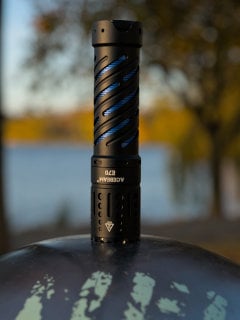
I am going with the Conway T6 as it’s compatible with regular AA batteries (like my IKEA Laddas), but as I understand, lights with built-in charging functions (e.g. Skilhunt EC150) usually don’t work with NiMH batteries, only Li-ion 14500 batteries.* I don’t think the Conway T6 has that, but I could be wrong. The T6 also cokes in a really unique purple colour!
*small edit: I meant that the charging bits don’t always work for NiMH batteries for most flashlights, the light itself would still work. The wording is a little unclear, sorry about that!
edit 2: I’m purchasing the T6 w/ the SFT-40 3000K emitter! Thanks everyone!
The SFT25R has less output and more throw because it has a smaller (and round) light emitting surface. It is usually used for applications where maximizing beam distance in a given optic size is the primary consideration.
3000K looks similar to a halogen incandescent - slightly less yellow than a traditional incandescent. With these specific LEDs, there’s another consideration: the 3000K option has a very high color rendering index, while the others have low CRI. While CRI is independent of color temperature, the SFT40 that Convoy stocks pairs 3000K with 95+ CRI, meaning that colors, especially red/brown/orange colors will look much more vivid and accurate with that LED. The Nichia 519A LED is also offered, and it has high CRI at every color temperature except 1800K.
CRI costs efficiency, and it’s especially costly with the SFT40. The high-CRI version has less output than the low-CRI version. Human perception of brightness is roughly logarithmic such that moderate differences are hard to notice, but it is enough to notice in that particular case.
This is not correct. The Skilhunt EC150, M150, and H150 can be used with NiMH batteries, but they cannot charge NiMH batteries internally. There are some lights that only work with 14500 batteries, but that’s determined by their driver electronics, not whether they have onboard charging. The Wurkkos TS10 and dual-channel versions of the Emisar D2 are examples of lights that require the higher voltage of a Li-ion battery.
Ahh OK, interesting. So I should probably go for the SFT-40 then if I want something with more output (does that mean brighter, or same brightness distributed over a larger area)?
Is the difference in output noticeable enough to negate the higher CRI? In what circumstances would you want a higher CRI over output, and vice versa?
e.g. I will just be using it to light up my path when I’m in the dark and exploring dark areas, does better CRI benefit me in this case?
Oop, yep, that was what I meant. They can’t always be charged by those bits. Sorry for the confusion!
There are three different ways to quantify brightness:
The FL1 standard for advertising flashlight performance includes a beam distance metric, which is how far away the light can illuminate an object at 0.25 lux (comparable to moonlight with the moon full and sky clear) at the most intense point in its beam. This can be computed from candela.
So more lumens with the same candela would mean a larger hotspot in the middle of the beam, a brighter spill on the outer beam, or both. In this particular case, the SFT40 will have a larger, dimmer hotspot than the SFT25R, and a brighter spill (more lumens, less candela). Here’s an exaggerated example with high lumens on the left and high candela on the right. Both lights here are far larger and more powerful than the T6. Note that while the spill angle (the outer edges of the beam) is wider with the first light in the example, it will be the same width for all LED options in the T6; the hotspot is what will change size.
Negate is the wrong term here. Imagine you have a dog who likes to bed down in fallen leaves at the edge of your property and you want to use your flashlight to find him. If he’s white and the leaves are brown, candela is the most useful attribute to maximize; as long as there’s enough light on the dog, you’ll spot him easily. If your dog is brown, then seeing color detail will matter and more light will not help if the color contrast is insufficient.
I almost always pick CRI over lumens, and I think that’s usually the right choice for people with normal color vision. Candela is a different story because there are several cases in which the high-candela LED option doesn’t exist in high-CRI, and color information is less relevant to most things I’m trying to spot at extreme distances than it is to everyday use.
Okay, I think that makes sense. So the SFT25R has a more concentrated beam (higher candela) while SFT40 has more lumens but over a larger angle and lower candela. I think I will go with SFT40 then?
Ahh, okay, I think that makes sense! So a high CRI light will make it easier to distinguish contrast between similar colours (e.g. brown on brown).
So should I go with the 3000K light w/ the SFT-40 emitter then? I have normal colour vision and like warmer lights.
3000K does look warm, which some people like and others don’t.
How far away do you need to see clearly? The Nichia 519A in 5000K (daytime sunlight) or 4000K (afternoon sunlight) might be a good fit.
Enough to see the path clearly when the environment is dark. I like warm lights, and from your description, it’s not super orangey or anything, so I will go with the 3000K! Thanks for all the help!
I can always return the flashlight if I find 3000K to be too warm :D
I’m not sure Convoy takes returns for non-defects. Shipping between China and presumably-not-China for a sub-$20 item just isn’t worth it.
Even if they do, Convoy is a small business, not Amazon.
Returns from a local retailer, I’m not buying directly from Convoy.