
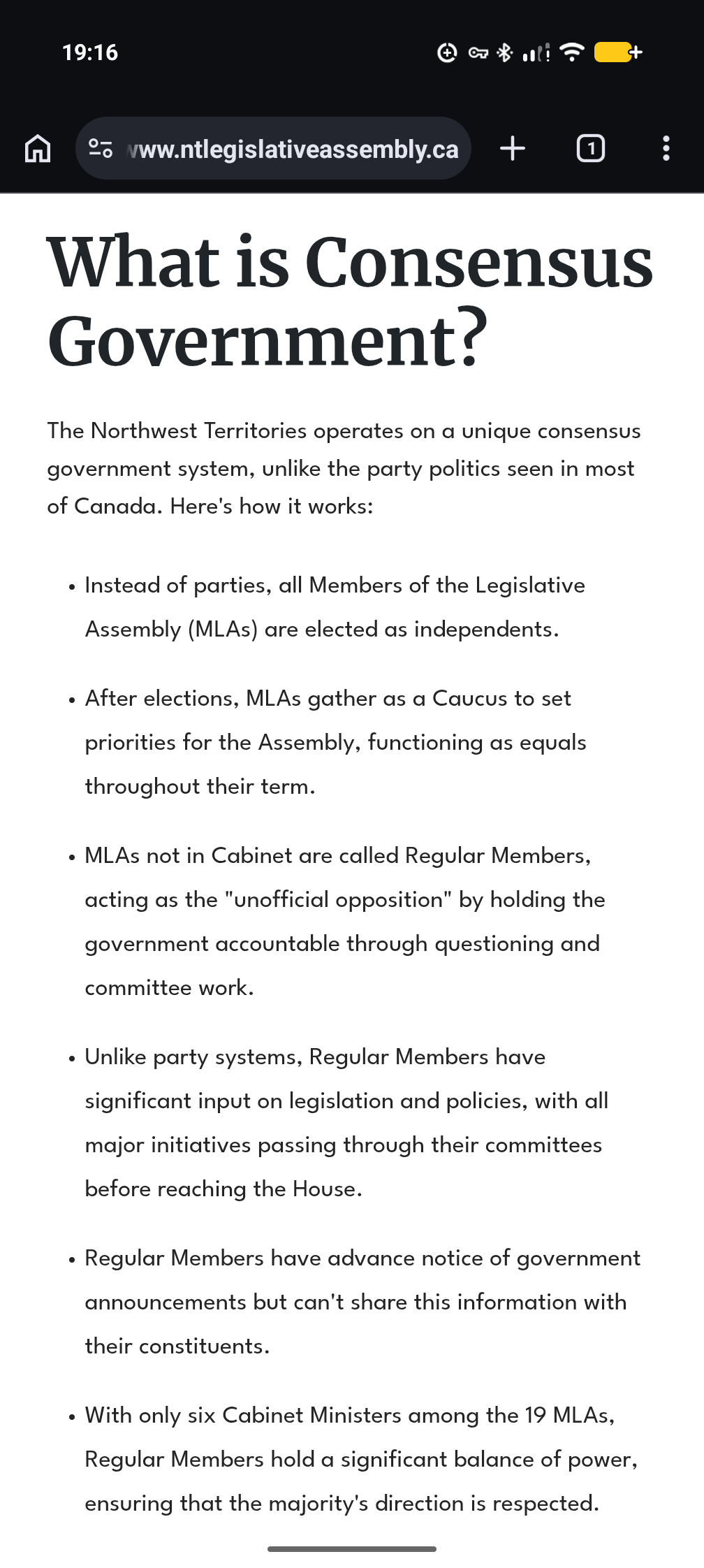
The Northwest Territories operates on a unique consensus government system, unlike the party politics seen in most of Canada. Here’s how it works:
Instead of parties, all Members of the Legislative Assembly (MLAs) are elected as independents. After elections, MLAs gather as a Caucus to set priorities for the Assembly, functioning as equals throughout their term.
MLAs not in Cabinet are called Regular Members, acting as the “unofficial opposition” by holding the government accountable through questioning and committee work.
Unlike party systems, Regular Members have significant input on legislation and policies, with all major initiatives passing through their committees before reaching the House.
Regular Members have advance notice of government announcements but can’t share this information with their constituents.
With only six Cabinet Ministers among the 19 MLAs, Regular Members hold a significant balance of power, ensuring that the majority’s direction is respected. Despite the name, consensus government doesn’t require unanimous agreement; decisions are made by a simple majority vote.
Election of the Speaker, Premier, and Ministers After elections, Members gather for a Territorial Leadership Committee (TLC) meeting. Here’s how it unfolds:
Election of the Speaker: Members vote by secret ballot for the Speaker, who oversees the Assembly and enforces rules.
How does the cabinet get (s)elected?