Instead of replying to a couple of comments in here that would make my comment sound like a personal attack, I will just say that I personally find those that can’t tell the difference between legit non-work links suspicious or not are generally lacking in skills.
If I get a link to a survey site that otherwise sounds like it might be legit, it’s usually not difficult to google up the domain or company and see if it looks legit. And you can always check with your manager. If they say it’s legit and it turns out not to be legit, you can point to them. And if that fails “you should know better”, then you ask what your company wants you to do and follow those guidelines.
My comment is mostly a reaction to those that think it’s clever to report all legit third-party emails that are clearly legit as phishing. I’m not saying there can’t even be doubts - not at all. It’s a complex topic and we’re all talking generally generic here, not specific examples anyway, so it’s all generalizzations. i.e. don’t take my arguments TOO seriously… heh
No, I’m not going to go play detective for every potentially valid solicitation for something my employer might want that didn’t look important, and certainly was not important enough to do in a way that more clearly wouldn’t be spam.
Can I investigate and determine it is probably legit despite looking suspicious? Sure, but I’m not going to waste my attention on such stupid BS.


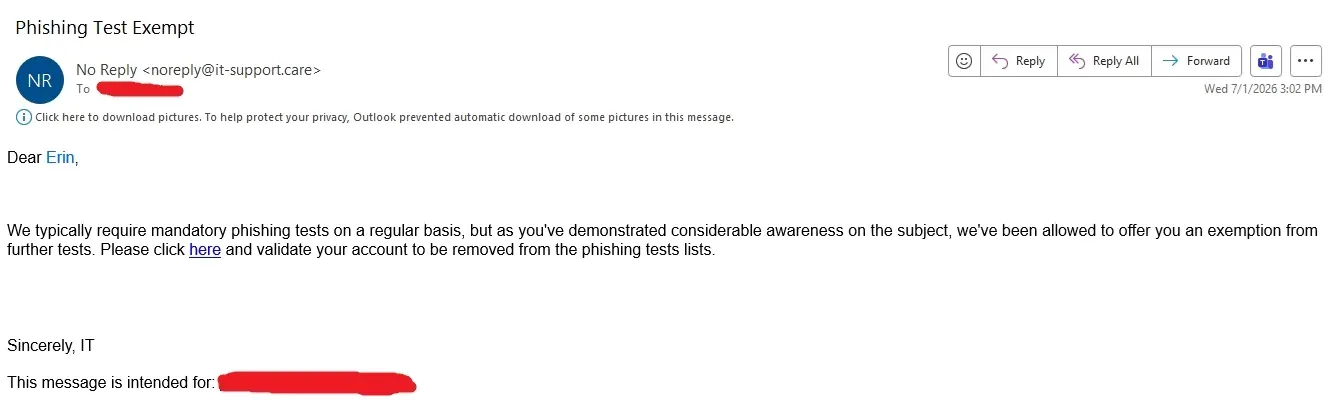
Instead of replying to a couple of comments in here that would make my comment sound like a personal attack, I will just say that I personally find those that can’t tell the difference between legit non-work links suspicious or not are generally lacking in skills.
If I get a link to a survey site that otherwise sounds like it might be legit, it’s usually not difficult to google up the domain or company and see if it looks legit. And you can always check with your manager. If they say it’s legit and it turns out not to be legit, you can point to them. And if that fails “you should know better”, then you ask what your company wants you to do and follow those guidelines.
My comment is mostly a reaction to those that think it’s clever to report all legit third-party emails that are clearly legit as phishing. I’m not saying there can’t even be doubts - not at all. It’s a complex topic and we’re all talking generally generic here, not specific examples anyway, so it’s all generalizzations. i.e. don’t take my arguments TOO seriously… heh
No, I’m not going to go play detective for every potentially valid solicitation for something my employer might want that didn’t look important, and certainly was not important enough to do in a way that more clearly wouldn’t be spam.
Can I investigate and determine it is probably legit despite looking suspicious? Sure, but I’m not going to waste my attention on such stupid BS.
I think spam is enough reason to report. We might have had a different spam and report button but honestly I can’t remember.