Outside of town is high speed rail also less of a headache to build. Sure, you need more tunnels and bridges but for example the LGVs in France have surprisingly high gradients, so they can follow the landscape better than many people believe.
I am not saying that HSR is easy to build I am merely saying that they are not such an existential challenge as US Americans make it out to be. Even developing countries manage to build them, highly developed ones manage it and everyone in between. The problem in the US is not that that the technology is so challenging. The problem is legislation that is extremely hostile towards such projects, creating overhead costs that are multiple times the entire project costs in other high cost countries. The problem is a lack of political will and the problem is especially ideology, the idea that rail infrastructure has to be profitable to be justifiable (road infrastructure interestingly is not having that requirement more often than not).
PS: “extreme breaking distance” and “inability to turn independently or operate off track” are not an issue at all, why would they be?
The braking distance and inability to turn is why greater physical barriers are required to separate rail. If a cow walks onto a road, the car drivers can stop or swerve. And even if they hit the cow, the entire network isn’t shut down during the cleanup because people can drive around the wreck.
The inability to operate off track means the system is less flexible because it requires rail everywhere, and the rail spec has to match the train.
Cars operate better on nicer roads, but they’re capable of driving on any pavement, on gravel, dirt, and more. A car has no issues transitioning from one type of road to another, can be more easily re-routed, and is just generally more adaptable.
Rail is great. It can move a lot at once between designated points, and as long as that’s all you want to do and it’s all working that’s great. It works really well in specific circumstances that happen to match the needs of much of the world. But the thing with a lot of the US is that it wasn’t really settled until there were air conditioners and cars, and so it was development with both in mind, and is very difficult to adapt rail to those developments. For rail to work in the South, the whole system from first mile to last must be solved at once because none of it works in isolation.
Houston tried. They put in a light rail system and it super duper sucks because you still have to drive to Houston, pay to park in a giant lot, pay to board the rail, then walk the last 3/4 mile in 110° heat or wait 20 minutes to pay to take a bus in 110° heat. The alternative is just to drive to your destination and pay to park in the garage for less money. And even that shitty system uses up half of Houston’s sales tax.
The system needs commuter lines going into and out of the city, but those need the light rail. There also needs to be a way to get from your house to the commuter train. It’s a 4-part system (first mile, commuter train, light rail, last mile) that ALL needs to be in place for any of it to make sense, and that’s extremely difficult to implement.
“The braking distance and inability to turn is why greater physical barriers are required to separate rail.”
That’s nonsense. HSR does not require any extraordinary barriers. Nothing more than you commonly find at modern highways in Europe.
Your “inability to operate off track” argument still doesn’t make any sense. I think you fundamentally do not understand how rail works. They don’t need to be able to operate on roads and for pure transportation purposes, they can be moved across any freight rail track of the same gauge. The US is full of those and even where there is no network at all, units can be transported also by ship and even via road if need be. If there are reasons why a HSR can’t be operated, well, it doesn’t operate. Easy as that. Same as if an airport is blocked due to bad weather. My experience with HSR is that it operates much more reliable than aviation.
Houston lilght rail sucks because it is an inferior system in a city completely designed for the car, with a barebone light rail tapered on at the side. Singapore is a hot city too, yet it has a well working rail system. And much of China is also hot and humid with great working rail systems, HSR as well. I know there are a lot of excuses that the US can’t have any of that because it is so big, so hot, so cold and what not. Those are excuses with countless real world examples proving that they are.
I find it rather bewildering how people don’t seem to think that airports can’t work because of the lack of transit, but with HSR stations it is absolutely impossible to have them working without. Yes, local transit is highly beneficial for both, but it is not a requirement for either to work.
My entire point is that Hpusolton is already developed around cars and tacking transit on top of that doesn’t work without an entire system being deployed at once, which is essentially impossible.
And the inability to work off track matters because trains don’t have flexibility. If something happens to the track in the middle of a 500 mile stretch between cities, that entire area of the network is down until a repair crew can be transported to the site and complete the repair because the trains can’t just drive around the issue like a car.
That is where you are going wrong. US cities were not transformed overnight to car oriented places either. That took decades. Maybe where the error arises is from the idea that only transit needs transit oriented places to work well, but cars do need car oriented places to support a car only design as well. Yes, cars can drive on all sorts of roads but that is true for one car, if you put everyone into a car in a transit oriented city, the whole traffic is going to collapse, commute takes forever …
Transition to transit oriented places can work, but you need long term dedication and political support. The Netherlands demonstrate that quite well. In the 1970s they were on their way to become transformed into a US style car hell hole, even had US city planners to make it a reality. The first oil crises and rising popular opposition against it, saved them.
You don’t transform an entire car oriented city into a transit oriented overnight. It is more like a crystallization process. A transit oriented city condensates along axis. This is happening in some places already today. One example is the Washington DC metro area. But of course, due to lack of political support if not open ideological opposition, it happens even much slower than it has to.
Exactly! The car transition wasn’t overnight because it can be done piecemeal and still work fine. Connecting to a road network is really easy. My parents live at a lakehouse in a neighborhood with 100 houses that popped up in the middle of bumbfuck nowhere by laying down gravel next to a little county road running to a power plant that uses the lake for cooling.
My old office complex when I worked in Houston poured roads on both sides of the parking lot and dedicated them to the Citybas part of the platting process, and the city had a new alternate route they didn’t even have to pay for.
Rail doesn’t have that flexibility. If a developer dedicates an easement for rail as part of a development, it still isn’t useful until every landowner along the route has done that, which will probably take centuries.
This shit is what I do for a living. All through college we all loved the TOD dreams, but when you actually work in municipal and regional transportation and development, you quickly learn how incredibly difficult it is to achieve even before the political process gets in the way.


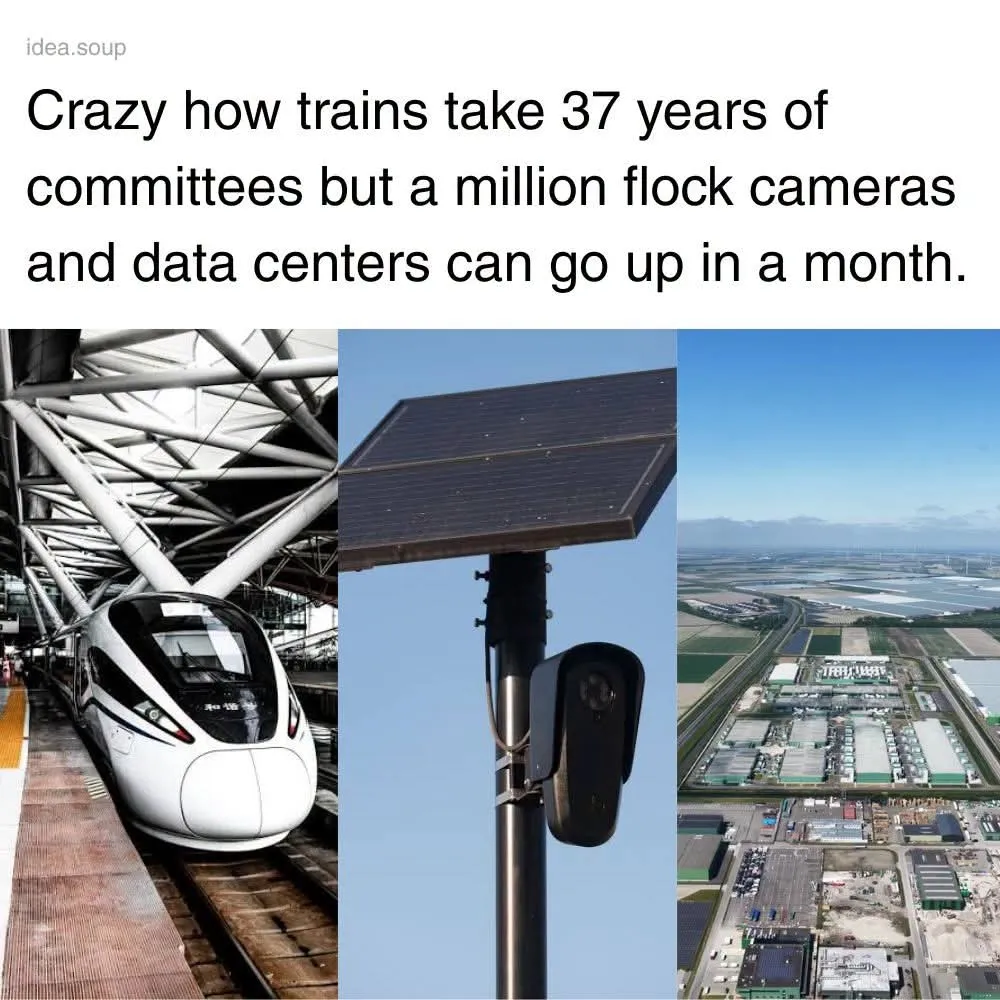
Outside of town is high speed rail also less of a headache to build. Sure, you need more tunnels and bridges but for example the LGVs in France have surprisingly high gradients, so they can follow the landscape better than many people believe.
I am not saying that HSR is easy to build I am merely saying that they are not such an existential challenge as US Americans make it out to be. Even developing countries manage to build them, highly developed ones manage it and everyone in between. The problem in the US is not that that the technology is so challenging. The problem is legislation that is extremely hostile towards such projects, creating overhead costs that are multiple times the entire project costs in other high cost countries. The problem is a lack of political will and the problem is especially ideology, the idea that rail infrastructure has to be profitable to be justifiable (road infrastructure interestingly is not having that requirement more often than not).
PS: “extreme breaking distance” and “inability to turn independently or operate off track” are not an issue at all, why would they be?
The braking distance and inability to turn is why greater physical barriers are required to separate rail. If a cow walks onto a road, the car drivers can stop or swerve. And even if they hit the cow, the entire network isn’t shut down during the cleanup because people can drive around the wreck.
The inability to operate off track means the system is less flexible because it requires rail everywhere, and the rail spec has to match the train.
Cars operate better on nicer roads, but they’re capable of driving on any pavement, on gravel, dirt, and more. A car has no issues transitioning from one type of road to another, can be more easily re-routed, and is just generally more adaptable.
Rail is great. It can move a lot at once between designated points, and as long as that’s all you want to do and it’s all working that’s great. It works really well in specific circumstances that happen to match the needs of much of the world. But the thing with a lot of the US is that it wasn’t really settled until there were air conditioners and cars, and so it was development with both in mind, and is very difficult to adapt rail to those developments. For rail to work in the South, the whole system from first mile to last must be solved at once because none of it works in isolation.
Houston tried. They put in a light rail system and it super duper sucks because you still have to drive to Houston, pay to park in a giant lot, pay to board the rail, then walk the last 3/4 mile in 110° heat or wait 20 minutes to pay to take a bus in 110° heat. The alternative is just to drive to your destination and pay to park in the garage for less money. And even that shitty system uses up half of Houston’s sales tax.
The system needs commuter lines going into and out of the city, but those need the light rail. There also needs to be a way to get from your house to the commuter train. It’s a 4-part system (first mile, commuter train, light rail, last mile) that ALL needs to be in place for any of it to make sense, and that’s extremely difficult to implement.
“The braking distance and inability to turn is why greater physical barriers are required to separate rail.” That’s nonsense. HSR does not require any extraordinary barriers. Nothing more than you commonly find at modern highways in Europe.
Your “inability to operate off track” argument still doesn’t make any sense. I think you fundamentally do not understand how rail works. They don’t need to be able to operate on roads and for pure transportation purposes, they can be moved across any freight rail track of the same gauge. The US is full of those and even where there is no network at all, units can be transported also by ship and even via road if need be. If there are reasons why a HSR can’t be operated, well, it doesn’t operate. Easy as that. Same as if an airport is blocked due to bad weather. My experience with HSR is that it operates much more reliable than aviation.
Houston lilght rail sucks because it is an inferior system in a city completely designed for the car, with a barebone light rail tapered on at the side. Singapore is a hot city too, yet it has a well working rail system. And much of China is also hot and humid with great working rail systems, HSR as well. I know there are a lot of excuses that the US can’t have any of that because it is so big, so hot, so cold and what not. Those are excuses with countless real world examples proving that they are.
I find it rather bewildering how people don’t seem to think that airports can’t work because of the lack of transit, but with HSR stations it is absolutely impossible to have them working without. Yes, local transit is highly beneficial for both, but it is not a requirement for either to work.
My entire point is that Hpusolton is already developed around cars and tacking transit on top of that doesn’t work without an entire system being deployed at once, which is essentially impossible.
And the inability to work off track matters because trains don’t have flexibility. If something happens to the track in the middle of a 500 mile stretch between cities, that entire area of the network is down until a repair crew can be transported to the site and complete the repair because the trains can’t just drive around the issue like a car.
That is where you are going wrong. US cities were not transformed overnight to car oriented places either. That took decades. Maybe where the error arises is from the idea that only transit needs transit oriented places to work well, but cars do need car oriented places to support a car only design as well. Yes, cars can drive on all sorts of roads but that is true for one car, if you put everyone into a car in a transit oriented city, the whole traffic is going to collapse, commute takes forever …
Transition to transit oriented places can work, but you need long term dedication and political support. The Netherlands demonstrate that quite well. In the 1970s they were on their way to become transformed into a US style car hell hole, even had US city planners to make it a reality. The first oil crises and rising popular opposition against it, saved them.
You don’t transform an entire car oriented city into a transit oriented overnight. It is more like a crystallization process. A transit oriented city condensates along axis. This is happening in some places already today. One example is the Washington DC metro area. But of course, due to lack of political support if not open ideological opposition, it happens even much slower than it has to.
Exactly! The car transition wasn’t overnight because it can be done piecemeal and still work fine. Connecting to a road network is really easy. My parents live at a lakehouse in a neighborhood with 100 houses that popped up in the middle of bumbfuck nowhere by laying down gravel next to a little county road running to a power plant that uses the lake for cooling.
My old office complex when I worked in Houston poured roads on both sides of the parking lot and dedicated them to the Citybas part of the platting process, and the city had a new alternate route they didn’t even have to pay for.
Rail doesn’t have that flexibility. If a developer dedicates an easement for rail as part of a development, it still isn’t useful until every landowner along the route has done that, which will probably take centuries.
This shit is what I do for a living. All through college we all loved the TOD dreams, but when you actually work in municipal and regional transportation and development, you quickly learn how incredibly difficult it is to achieve even before the political process gets in the way.