Most “family” businesses (like Chaebols in Korea, Keiretsu in Japan) are diversified to reduce risk.
This is in fair contrast to vertical integration often seen in Western companies (and also some rare instances when the state orders it) who only diversify when opportunities arise, not for risk reduction.
I’m not sure it’s all of them really. Electricity, water, waste disposal and intra state roads are usually state/city owned utilities in India, with Highway, Railway and most of the Oil and Gas ones under the central government. Some are taken up by both, like public education. Even for the ones that Tata and Reliance are fairly nestled in, there’s government owned competitors (ex. Steel manufacture and Telcom)

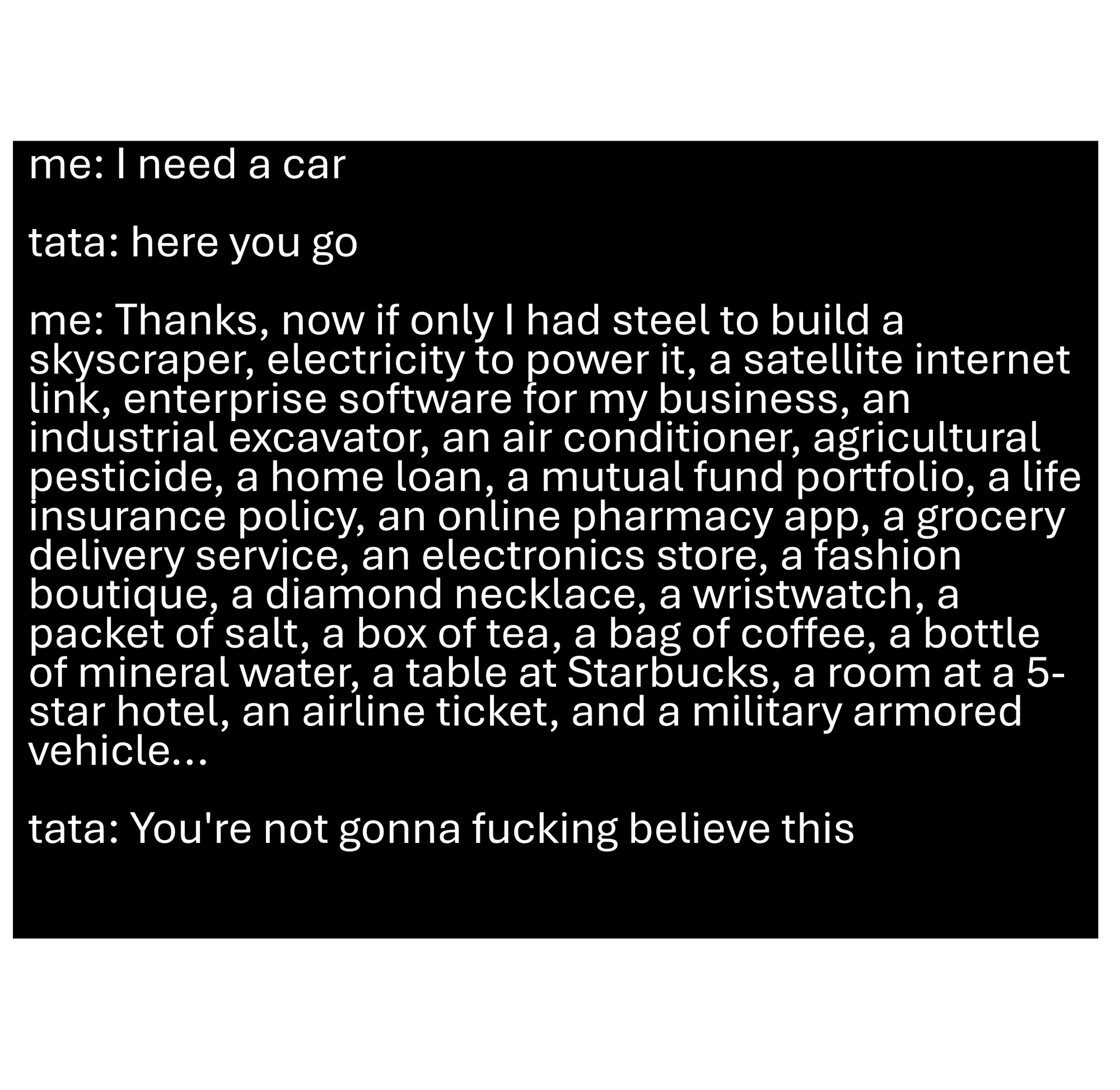
Haha. Love a suffocating conglomerate that has privatized all my country’s domestic utilities and critical infrastructure. Lolz.
Great add. 5/7. tips fedora
Most “family” businesses (like Chaebols in Korea, Keiretsu in Japan) are diversified to reduce risk.
This is in fair contrast to vertical integration often seen in Western companies (and also some rare instances when the state orders it) who only diversify when opportunities arise, not for risk reduction.
I’m not sure it’s all of them really. Electricity, water, waste disposal and intra state roads are usually state/city owned utilities in India, with Highway, Railway and most of the Oil and Gas ones under the central government. Some are taken up by both, like public education. Even for the ones that Tata and Reliance are fairly nestled in, there’s government owned competitors (ex. Steel manufacture and Telcom)
I’m necessarily summarising here, but there’s a non-negligible level of public sector competition here: https://en.wikipedia.org/wiki/Public_Sector_Undertakings_in_India