
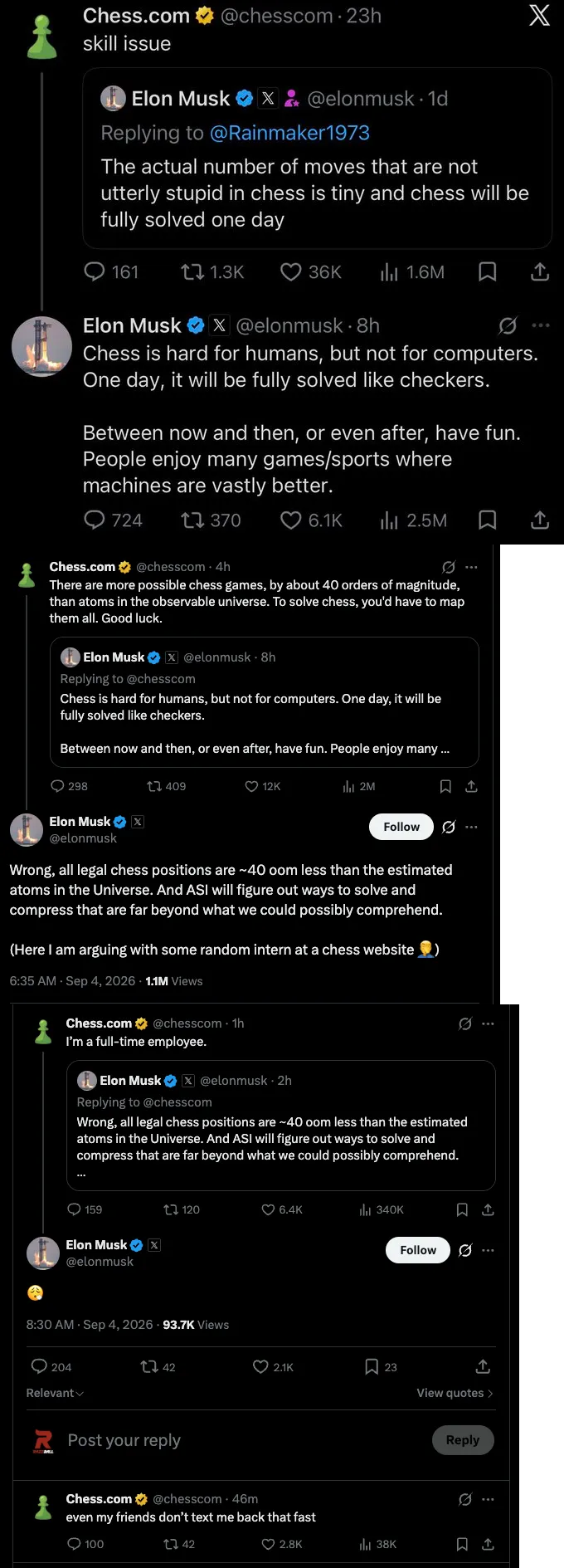
Transcript:
Elon: The actual number of moves that are not utterly stupid in chess is tiny and chess will be fully solved one day
Chess.com: Skill issue
Elon: Chess is hard for humans, but not for computers. One day, it will be fully solved like checkers. Between now and then, or even after, have fun. People enjoy may games/sports where machines are vastly better.
Chess.com: There are more possible chess games, by about 40 order of magnitude, than atoms in the observable universe. To solve chess, you’d have to map them all. Good luck.
Elon: Wrong, all legal chess positions are ~40 ooms less than the estimated atoms in the Universe. And ASI will figure out ways to solve and compress that are far beyond what we could possibly comprehend. (Here I am arguing with some random intern at a chess website)
Chess.com: I’m a full-time employee
Elon: (something-emoji)
Chess.com: Even my friends don’t text me back that fast
I don’t know what he has against chess, but this is like the 3rd time I’ve seen him try to convince everyone that it’s pointless because of computers.
We know what he has against chess, he sucks at it because he is a moron.
Another classic example that proves this:
Sounds like Radovid in The Witcher 3. You know, the mad, genocidal king.
What I take from this is “I can’t cheat, so I won’t play”
“I keep losing because this game is TOO SPUPID”
Oh you can cheat at chess.com. People use engines to suss out the best moves and plug them into their games. Chess.com spots many, but not all of them, you will get notices after the fact that your rating has been changed upwards because they detected them cheating.
It’s quite common.
He is talking about when he was young though
In truth hes just a huge fire emblem fan and goons to edelgard or something
Lol it means he has the same problem with it that I did: there’s absolutely no random element to blame so when you lose you just fucking lose and that’s all there is to it. The other person’s brain just stepped on your brain and wiped it off on the curb.
Yeah I played a bit as a teenager and after getting demolished several times by old fucks 5 times my age I just couldn’t take it anymore. Felt like there was nothing you could do to surprise them. Like running against a wall.
Generally random factors allow players with less skill to win. I think about that with games a lot.
It’s one of the (many) reasons I don’t really like DND very much. Huge random factor. You can make excellent tactical decisions and lose. You can be an absolute baffoon and triumph.
Some randomness is okay but not like that.
You must not like life lol.
I wouldn’t really characterize many things in life as the same kind of random. Throwing a dart at a dart board isn’t a random action in the same way as rolling dice
Furthermore, dnd’s randomization produces flat probability, which is often jarring.
…Bro wants chess to be Age of Empires? wtf kind of response is this?
It’s written like a deliberate parody of people like him, it’s so ludicrous.
If it’s real, it’s the first tweet by him I’ve seen that’s actually funny. Perfectly leans into the absurdity of that position.
My theory is that he’s frustrated that he can’t manage a team or pay someone to get better at it for him.
The humility it takes to be a beginner at something is uncomfortable when you have a huge ego.
I mean, he could very easily do both of those things. Chess teams are a thing, and they need sponsors to be able to attend tournaments - I suppose that counts as “managing” a team. Chess coaches are also a thing, and even some of the worst novice players have seen massive improvement in their chess game after being paired up with famous chess streamers, but without him putting in the actual effort to absorb the information, he’ll never get any better.
When all else fails, he could create an account and pay some broke ass GM to smurf for him. Nobody gets rich off of playing chess for a living, so him paying them to improve his elo and then him taking all the credit publicly would be par for the course and highly effective. Nobody is really going to call him out on that because he has a cult of personality surrounding him that built him up to be a genius. I mean, if you ask him to explain why he made a certain move in a high level game, the illusion would fall apart, but the media wouldn’t dare hold his feet to the fire like that.
Wow the most cringe comment possible. Amazing. He keeps doing it.
I’m pretty sure it’s because he can’t stand losing. The man clearly suffers from a narcissistic personality disorder.
If you read “careless people” you see that Zuckerberg is the same. His minions purposefully lose at Catan with him to make him happy.
Right? I’m sure he expected to immediately be a god at chess with no studying or practice, then got upset when that wasn’t the case.
Yes, because of his financial success, he considers himself a genius—which he very obviously never was. This is a common trait among billionaires. Many of them are psychopaths who have amassed their wealth through utter unscrupulousness, irresponsibility in the form of an absurd willingness to take risks, and sheer luck.
In the case of Musk, Thiel, and various others, that stroke of luck was PayPal. That company was so successful that it made all of its investors immeasurably rich—it was more a matter of chance that PayPal succeeded, and everything that followed really wasn’t all that difficult because that kind of money cannot lose anymore no matter how ridiculous stupid someone might be.
That’s precisely the problem: We only hear about the people who bet everything on one card and won—they’re portrayed as geniuses, which they never were. We never hear anything about all those who failed miserably—and that’s the vast majority.
Billionaires aren’t geniuses or even above-average in intelligence. Their financial success has, in the rarest of cases, anything to do with intelligence.
Some of them might be considered marketing geniuses, like Jobs was.
I would rather consider Steve Wozniak than Steve Jobs. Jobs was undoubtedly excellent at selling products, and he was certainly a smart (and also ruthless) businessman, but the pioneer—and the one who actually “did the thing”—was Wozniak.
It’s true, of course, that Wozniak probably wouldn’t have been able to make his product a success on his own, but that’s precisely where the problem lies: Bill Gates is certainly no fool either, but DOS—the product that made Microsoft the billion-dollar-company that it is today—was developed by someone else, namely Gary Kildall. Gates’s achievement consisted mainly of making a lot of money from it. He did just that, and did it well, while Kildall was fobbed off with a ridiculously small sum relative to the product’s success, since he was in a weak position at the time.
Although Gates was far more technically adept than Jobs, his core qualities were essentially the same—a good sence for business and a utter lack of scruples: Kildall never received a bonus payment from Microsoft for his work that would have even remotely acknowledged his importance.
There are many people in the IT sector who are worthy of admiration, but almost none of those who truly deserve it are among those the industry or rather the public celebrates as pioneers or visionaries—these are almost exclusively businesspeople who played only a marginal role, if any, in the development of the products they market.
In my view, success stories like Apple or Microsoft are fundamentally no longer possible today, since visionary spirit, wisdom, and inventiveness have been permanently replaced by the inhuman logic of cutthroat capitalism, which the U.S., above all, embodies. Its heroes are always the wrong ones—not those who have advanced humanity through their achievements, but always those who have known how to exploit others particularly ruthlessly for their own ends. These people lead the Western world today, which is why it stands on the brink of total collapse, since these people know nothing but boundless greed.
They are utterly unfit to lead millions upon millions of people—yet that is precisely what they seek to do in their pathological hubris.
The thing about The Woz is, he showers.
I really think Jobs dying was the start of the tech industry enshittification.
While he was a massive cunt and didn’t personally develop the products, he pushed his people to innovate, and the rest of the industry followed to try to keep up.
Once iPhones became yearly iterative bullshit, the industry followed.
But Moore’s Law slowing down does come into play.
My lay-person perspective is Jobs pioneered enshittification. The iPod was not an mp3 player, you had to use proprietary format music, which needed to be loaded with iTunes, a piece of proprietary software that acted almost like a virus once installed on your machine.
Huh? You could use mp3s and other formats on the iPod.
It may be that his death marked a turning point, in a sense: He had already been forced out of his role as CEO by business executives in 1985 and didn’t return until 1997, when the company was on the brink of collapse. He then truly turned the company around through innovation: first with the iPod, then with the iPhone—both products that changed the world. I don’t want to downplay this foresight at all, and I also think that Jobs was someone who cared about the cause—about products that are meaningful and useful.
Nevertheless, I don’t believe the start of enshittification can be pinned to the date of his death. Rather, he was one of those, who laid the groundwork for it—here’s an example: soon, Google will tighten the screws and design the Play Store along the closed model that Apple introduced back in the day.
In short: I think there are many other reasons. Jobs was an outstanding businessman, but he lived in a different world than the one we live in today.
Did you write that wall of text to say that Wozniak was the marketing genius instead of Jobs?
I’m pretty sure they were saying that while Woz was the real genius that made the product, simply making a superior product isn’t a guarantee it’ll be successful.
In reality, you need both people.
He understood the market and knew what products to put there, I’d say he is a genius at that - but imo a marketing genius would be someone who can sell anything no matter how shitty the product is, so i’d say that term would be better fitting for his competitors at Microsoft for example.
I enjoy see sport competitions because I like to see what humans are capable of. I don’t need a so-called genius to prove that we can create robots running faster than humans. Likewise I don’t need to be told that Stockfish is stronger than Carlsen because then what? We should stop playing because a machine is better?
Also, what does “solving chess mean”? We already have algorithms trying every possible move
Modern chess players are much stronger than last century precisely because they train against stockfish and use it to analyse the optimal move.
No no see, we can “solve chess” and find the one path that will always win no matter what.
Then we can stop plahing, duh.
/s
Can’t lose to chess if you refuse to play it
Greetings Professor Falken