

- cross-posted to:
- [email protected]
- cross-posted to:
- [email protected]
Crossposted from https://fedia.io/m/[email protected]/t/4559012
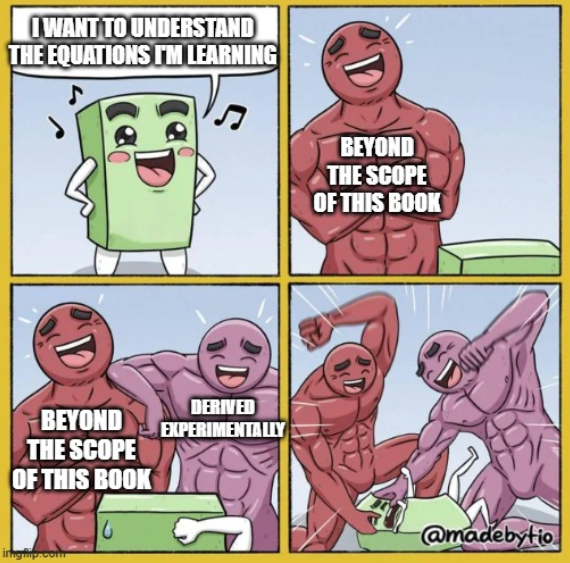
Maybe engineering was a mistake.
Crossposted from https://fedia.io/m/[email protected]/t/4559012
Maybe engineering was a mistake.
You know, that’s one thing I really hate is when all information provided in a lesson is surface level only.
“I’m just gonna tell you what this thing is. You don’t need to know the why or the how or the how we found any of this out.” - that’ll be $900 a credit hour. Thank you very much.
The advanced classes don’t make sense unless you already know the stuff you had to take on faith in the intro classes. Seeing the big picture requires having enough of its small pieces in your mind, and until you get to that point each small piece necessarily feels somewhat arbitrary.
Then you circle around to where you start answering kindergarten level questions like “What even is a number?” with way more detail and rigor than you thought possible.
“We’d love to tell you - but the slow kids need to pass, or I’ll lose my job.”
Most of the time, we can’t dig too deep because we’re paced at middle of a class. Other times, the derivation is beyond the student’s ability to follow without a lesson or two dedicated to it (and even then, what level are you building from - the axiomatic or some random midpoint system?).
Then you find out it’s all surface level and we don’t know what energy, or entropy, or gravity, or time, or space, or matter actually are nor how or why they work.
I… think we have fundamental answers for all of those? Einstein’s field equations and the subsequent research into particle physics and quantum mechanics which came from them have done a pretty stellar job in that regard. At this point the “big” unanswered questions are far more abstract than can be easily described, and we’re finding that questions like “what is space” are, as the late great terry prachett described, “the wrong sort of question”. It’s a very neat time in physics, although I confess I’m not much more than a physics cheerleader.
We can describe their behavior under normal circumstances and make predictions about it, but under extreme circumstances like very hot, cold, big, small, fast our understanding of the behavior reaches its limits. Then there’s the question of what they are. Energy and space are complete unknowns, gravity actually has a mechanical description from relativity but breaks down at the quantum level, time and entropy are essentially mysteries because we can not answer what exactly they are or why they only go in one direction, only that they do.
Why Mr. Gödel, what a pleasant surprise to see you’ve joined the fediverse…
I can already forsee that this is going to devolve to bickering about what it means to ‘answer a question’ remarkably quickly and, truly, neither of us need that. I hope you have a lovely morning!
This is why I hated school, especially math. All memorization, no why
You learn counting so that you can do addition and subtraction. You learn addition and subtraction so you can do multiplication and division. You learn multiplication and division so that you can do fractions and ratios. You learn fractions and ratios so that you can do algebra. You learn algebra so that you can do trigonometry. You learn trig so that you can do calculus. You learn calculus so that you can do differential equations.
There is a reason for it, but for some reason teachers don’t like explaining these things to you. Either that, or you’ve been told this before and it just didn’t click because it was said so subtly, it didn’t have any power behind it.