Plato would slap them from the grave for not using pure geometry. He did the same when someone used a machine to do the work.
It’s an impossible problem using just compass and straight edge (proved impossible in the 1800s) but the greeks and romans were obsessed with trying to figure it out.
A Greek philosopher like Plato would scream, sure. But the Romans in general were way more practical; I wouldn’t be surprised if their answer was simply to make each edge 5/4 larger (a 2% error is almost nothing for most purposes).
The problem isn’t about getting close enough. It’s a mathematics question on figuring out cube roots. You can do it with machines but it’s impossible to do with straight edge and compass. The greeks and romans wanted to figure out if there was a general solution using straight edge and compass so a close enough guess wouldn’t work. They already had solutions like that.
This problem was a head scratcher for literally millennia along with squaring the circle and trisecting an angle. All three were proved impossible to do with just straight edge and compass.
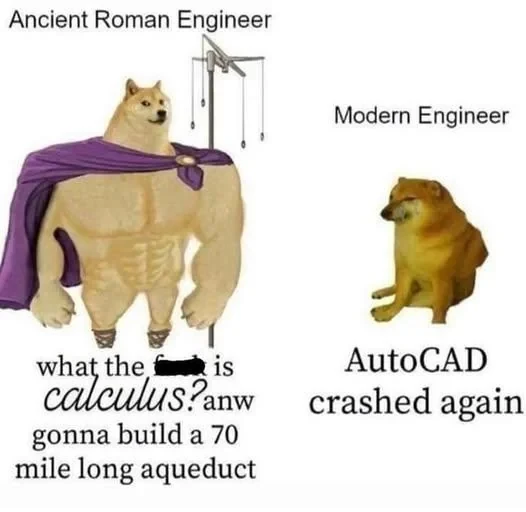
I’ve always found it amusing that, for all the use of advanced technology and engineering from the Romans, you don’t really have much in the way of contributions to mathematics, physics, etc, from Roman writers. “Too thinky, not practical enough >:(”
Hell, even the only Roman philosophers of note are all pretty orthodox thinkers of a pre-established Greek school. Yet our surviving engineering texts from Roman authors are [chef’s kiss]
It’s funny what results cultural priorities can produce.


Plato would slap them from the grave for not using pure geometry. He did the same when someone used a machine to do the work.
It’s an impossible problem using just compass and straight edge (proved impossible in the 1800s) but the greeks and romans were obsessed with trying to figure it out.
A Greek philosopher like Plato would scream, sure. But the Romans in general were way more practical; I wouldn’t be surprised if their answer was simply to make each edge 5/4 larger (a 2% error is almost nothing for most purposes).
The problem isn’t about getting close enough. It’s a mathematics question on figuring out cube roots. You can do it with machines but it’s impossible to do with straight edge and compass. The greeks and romans wanted to figure out if there was a general solution using straight edge and compass so a close enough guess wouldn’t work. They already had solutions like that.
This problem was a head scratcher for literally millennia along with squaring the circle and trisecting an angle. All three were proved impossible to do with just straight edge and compass.
I’ve always found it amusing that, for all the use of advanced technology and engineering from the Romans, you don’t really have much in the way of contributions to mathematics, physics, etc, from Roman writers. “Too thinky, not practical enough >:(”
Hell, even the only Roman philosophers of note are all pretty orthodox thinkers of a pre-established Greek school. Yet our surviving engineering texts from Roman authors are [chef’s kiss]
It’s funny what results cultural priorities can produce.
Ah, but Plato was Gr*ek. Latin problems demand Latin solutions.