

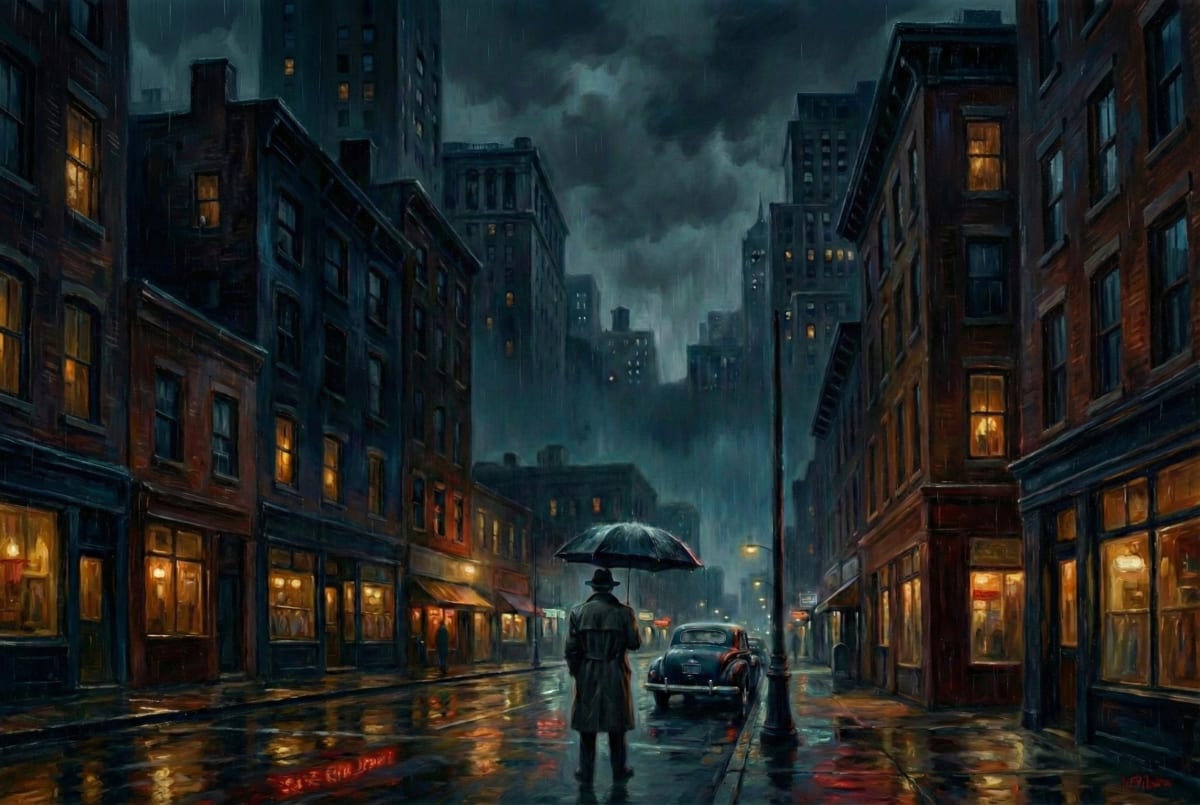
The Crane Method - Chapter 3: No Stomach for It
Caspian Crane hailed the taxi to a halt two blocks shy of the Penhaligon estate. He had no intention of announcing his return. He had sent the lady of the house away with a hollow promise to scout the black-market curiosity circles for the origin of the crow feather, but something didn’t sit right—and Crane wasn’t the type to let things lie. It was something in the geometry of the furniture and the sterile, filtered air of the library; it didn’t suggest an external breach, regardless of how agile the intruder might have been.
He slipped through the side gate, taking advantage of a security guard far more invested in a mortadella sandwich than his surveillance monitors. Crane moved up the gravel path with the weightless gait of a specter loath to wake the living. From this vantage, the mansion looked more fraudulent than formidable—a structure of aristocratic pretension hiding deep fissures beneath a coat of pristine stucco.
He entered through the servants’ entrance. The hallway smelled of cheap detergent and the quiet resignation of those who spend their lives scrubbing away other people’s filth. He didn’t have to search long. The clatter of china and the low hum of strained voices guided him to the tea room—a space Lady Penhaligon used to dazzle her social circle with Meissen porcelain and high-caliber gossip.
Pushing the double doors open, Crane was met with a tableau that elicited a smirk of cynical satisfaction. The household staff were lined up against the wall under the watchful, albeit clumsy, eye of Captain Briggs. No one in that line-up looked capable of orchestrating anything of consequence.
Not one of them met Crane’s eyes for more than a second. Some bowed their heads; others fixed their gaze on an arbitrary point on the wall as if it held the secrets of the universe. The silence wasn’t born of respect or defiance—it was practical. People accustomed to taking orders had also learned how to take the blame.
“My, my,” Crane said, leaning his umbrella against the doorframe. “It seems I’ve missed the dress rehearsal. Briggs, have you taken up detective work, or is this group therapy for the traumatized staff?”
Briggs spun around, his face flushed with a cocktail of surprise and annoyance. “Crane. You said you were heading back to the city.”
“I grew bored halfway there. The city is full of people who walk too fast and think too little. I preferred to return and see if any of these pillars of honesty have anything to say about the cleanliness of the ventilation ducts.”
Crane paced before the row of servants. He scrutinized each face with agonizing patience, waiting for a crack. He was in no rush; none of them looked like they were going anywhere.
He stopped in front of the butler, a man named Stevens who was attempting to cling to a dignity that his uniform—frayed at the elbows—could no longer support. Crane looked down at the man’s feet.
“Stevens, isn’t it?” Crane asked.
“Quite so, sir,” the butler replied, his voice striving for firmness but vibrating at the frequency of pure panic.
“Tell me, Stevens, how long has it been since you buffed your shoes with the care this house demands? I see specks of dust in the welts.”
“It has been a difficult morning, Mr. Crane. The robbery—”
“Don’t sell me the robbery as a tragedy,” Crane cut him off. “Besides, those gambling debts you’ve been nursing since the last Derby aren’t going to pay themselves, are they? Your hands are shaking. It’s not over the loss of the Winter Egg; it’s because you know that if Lady Penhaligon falls, you’ll be the first thing demolished to make room for something more functional.”
He drifted toward the maid, a young woman named Agnes who couldn’t stop wringing her hands. Her apron was spotless, but her eyes darted frantically, like someone searching for an exit in a burning building.
“Agnes,” Crane said with a softness more terrifying than a shout. “You are responsible for dusting the library. A simple task, isn’t it? Keeping the surfaces bright so no one notices what lies beneath.”
“I didn’t see anything, sir. I swear.”
“Of course you didn’t. You were too busy trying to ensure your gaze didn’t betray the fact that you know exactly who opened the kitchen window last night. You have no talent for lying.”
Crane returned to the center of the room and looked at Briggs, who was watching the scene without grasping half the subtext. The detective reached for his cigarette case but tucked it away immediately, realizing his tobacco was far too refined for this atmosphere of stale tea.
“If any of you had done this, you’d be talking by now,” Crane said. “You have no stomach for it.”
He stepped toward Stevens again. The butler was sweating. A solitary bead rolled down his temple, leaving a glistening trail against his sallow skin. Crane leaned in, invading his personal space with the cold confidence of a creditor collecting a past-due debt.
“Tell me something, Stevens,” Crane whispered. “Something didn’t click last night. And your mistress isn’t as careless as she wishes to appear. Last night, before ‘disaster’ struck this manor, what exactly was she doing?”
The butler swallowed hard. The sound was audible in the sepulchral silence of the room. He glanced at Agnes and then at the door, praying the mistress of the house would appear to save him from this acidic interrogation.
“She… she was in her quarters, sir.”
“A lie,” Crane said. “I heard her say the Egg was her life. No one abandons a thing like that through oversight. You saw something, Stevens. Something that doesn’t fit the image of the grieving widow.”
Stevens opened his mouth, but no sound came out. The words remained lodged in his throat, reduced to a futile gesture. He pressed his lips together, trying to seal in whatever was about to escape. Crane didn’t hurry him. He knew that at this stage, silence was a far more effective tool than any question.
Crane tapped his umbrella against the floor. The sharp crack made Agnes let out a small sob. No one else moved. The rest of the staff remained rigid, braced for a danger they didn’t know how to dodge. They weren’t looking at Stevens out of solidarity, but out of fear: they all understood that once the levee broke, any one of them could be next.
Stevens closed his eyes, as if trying to board up his mind against the detective’s pressure.
“I don’t want you to tell me about the robbery, Stevens,” Crane insisted. “Tell me about the theater. Tell me about the lights and the shadows. Because I know Lady Penhaligon isn’t just a socialite; she’s a frustrated stage director.”
The butler broke. It wasn’t an explosion, but a slow capitulation. His shoulders slumped, losing the artificial rigidity that had held them up. His hands stopped trembling and hung dead at his sides.
“It was before dinner,” Stevens confessed, his voice fractured. “She asked me to come up to the library. Not to serve anything, but so that I might listen.”
“Listen to what?” Crane asked, arching an eyebrow.
“She was standing before the Venetian mirror—the one beside the safe. She had her lace handkerchief in her hand.”
Crane nodded, gesturing for him to continue.
“She made me wait at the door,” the butler went on. “She said she wanted to ensure the sound projected properly down the hall. And then… then she screamed.”
“Screamed?” Briggs stepped forward, bewildered. He looked at Stevens as if seeing him for the first time. The confidence he had brought into the room was beginning to fracture, replaced by a clumsy discomfort. He sensed something vital had been revealed, even if he didn’t yet know what. He stayed silent, realizing—belatedly—that interrupting now would be a mistake.
“Three times,” Stevens said, staring at the floor as if searching for a hole to crawl into. “She rehearsed her scream of horror before the mirror three times. She asked me which one sounded most convincing, most… spontaneous. Then she touched up her makeup and ordered me to go down to the kitchen as if nothing had happened.”
A dry, joyless laugh escaped Crane, echoing off the walls. He no longer had any doubts.
“Three times,” Crane repeated, savoring the words. “The precision of fraud. It isn’t enough to lie; one must find the right inflection so the audience doesn’t notice the facade is made of cardboard.”
He turned to Briggs, whose look of stupefaction was almost comical.
“There you have it, Captain. It wasn’t a robbery. It was a performance. And someone made sure she was heard.”
“No one stole anything,” Crane continued. “They simply moved the pieces.”
He walked toward the exit, feeling light. The mystery no longer offered any resistance.
“Stevens,” Crane said before stepping out, “shine those shoes. The next time you fake a tragedy, try to do it with a bit more attention to detail.”
He stepped into the hallway. Crane knew Lady Penhaligon wouldn’t be long in appearing, likely with a fresh interpretation of the grieving widow, but he now carried the original script in his pocket.
He walked toward the library. He needed to see that Venetian mirror. If she had rehearsed there, perhaps the reflection of her ambition had left a mark that Briggs had been too blind to see…
…"
–“Continue reading and experience the original text in Spanish at https://fictograma.com/. Join our open-source community of writers today!”–