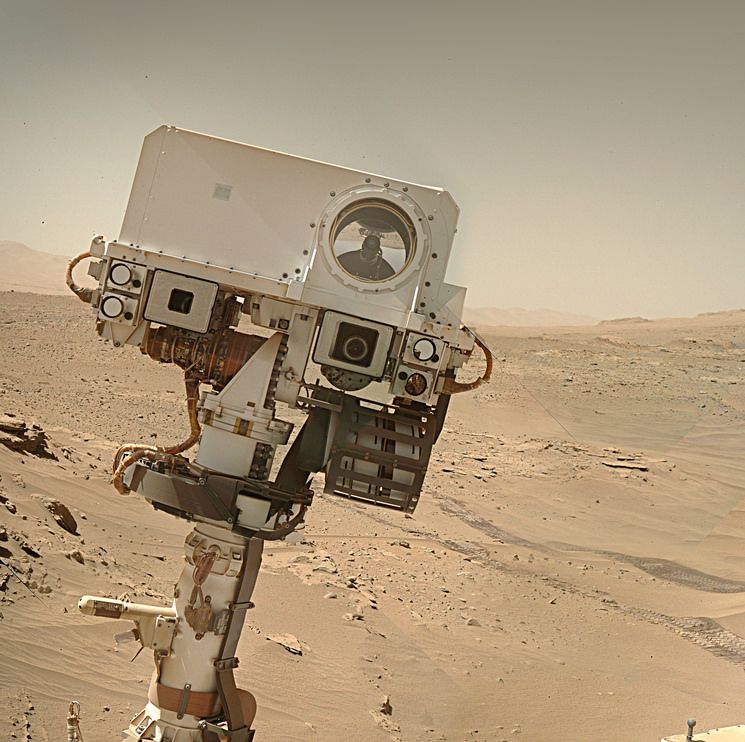
The captivating shapes of wind-carved crags called yardangs are revealed in this zoomed-in crop of a broader panorama captured by NASA’s Curiosity Mars rover on Aug. 11, 2026. Scientists are eager to learn more about how the yardang layer formed. Credit: NASA/JPL-Caltech/MSSS
The full press release is on this link
https://www.jpl.nasa.gov/news/nasas-curiosity-rover-catches-stunning-martian-dawn/
You must log in or register to comment.
Okay, at the risk of sounding dumb: what’s a yardang?
No such thing as a dumb question on this forum.
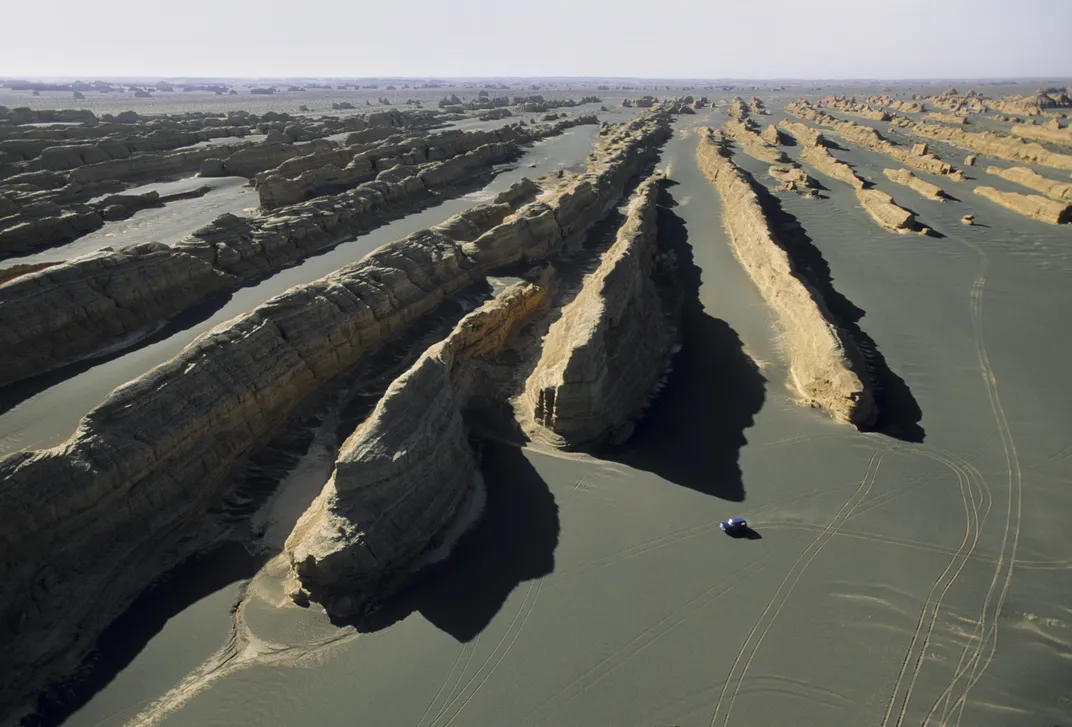
Basically it’s a soft bedrock that can be easily eroded by wind blown sands and chips of the same rock. The wind carves out deep channels and troughs that usually align with the prevalent wind direction. We have them here on Earth and also on Mars.
Here’s a link to the best description I’ve seen and it also contains some great photographic examples
https://www.smithsonianmag.com/smart-news/what-yardang-180951461/
Once upon a time, NASA and JPL would themselves take up the task of adding scale to rover images, by adding in a correctly scaled model of the vehicle to actual photographs:

Now Opportunity compares to a golf cart in size, whereas Curiosity and Perseverance are nearer a car or van. The above image of Opportunity at Victoria Crater, a small break in the immense flatness of Meridiani Planum, would seem modest compared to a scaled model of Curiosity ascending Mt. Sharp. I wish I had the skills and time to do that kind of work…
I wish I had the skills and time to do that kind of work…
Another from Sean, this one with scaled Curiosity https://www.youtube.com/watch?v=YvjcWvb5skY
One of the best at adding those scale models was Sean Doran… I just did a quick search and before I could find one that included the rover I found this gem from 9 years ago…
Holy crap this is otherworldly, wow.
Super cool! Thanks for the info. Great posts here as always, I love reading your writeups
Holy crap this is otherworldly, wow. We live on a very geologically diverse planet, but share many of those geologies with the other rocky planets like Mars :) The car in that shot really provides scale for those Yardangs in the Gobi desert :)
The wider panorama (large file)
Wow, I haven’t been this excited about wallpapers since Windows XP. Finally a good use for ultrawide screens.
Wow, I haven’t been this excited about wallpapers since Windows XP. Finally a good use for ultrawide screens.
The ultrawide screen just moved up a few notches on my wish list :)
This artist’s concept shows Mount Sharp, the 3-mile-tall (5-kilometer-tall) mountain that NASA’s Curiosity has been ascending since 2014. The location of the yardang layer, which the rover recently captured from a distance, is indicated by an ellipse … Credit: NASA/JPL-Caltech/ESA/DLR/FU Berlin/MSSS

The yardang layer extends roughly 10 miles (16 kilometers) across the northwestern reaches of Mount Sharp, a 3-mile-tall (5-kilometer-tall) mountain that Curiosity has been ascending since 2014. In fact, the rover recently passed another milestone in its ascent, reaching 0.6 miles (1 kilometer) of elevation — the most ever climbed on Mars. As it draws ever-closer to the yardangs, mission scientists expect to get even more amazing imagery — and, they hope, answers to how these cliffs were created.
Mount Sharp is made up of layers, each recording a distinct period of Mars’ history. By studying them, scientists have been able to learn more about lakes and streams that covered this part of the Red Planet billions of years ago. Eventually, the water dried up and left salty minerals behind. After new material stopped settling on the mountain, some of it may have been stripped away by wind, giving rise to the yardangs.
“The yardang layer looks out of place. It’s the wrong color, the layers tilt at an odd angle, and it almost appears plastered on,” said Ashwin Vasavada, Curiosity project scientist of NASA’s Jet Propulsion Laboratory in Southern California. “But that’s what makes it exciting to reach. No one is sure exactly what created this layer, but one idea is it may be ash deposited by ancient volcanic eruptions.”
Curiosity is in the second year of its fifth extended mission, which started with an exploration of the spiderweb-like boxwork ridges. The rover will spend most of the next year or so driving through layers enriched with sulfates and carbonates, both signs of ancient drying on the surface. Sometime in 2027, scientists hope to reach the base of the yardangs, where Curiosity will be able to use its robotic arm to collect one-of-a-kind data on these mysterious features.