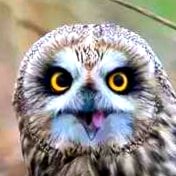


From Niek Kuijpers
Waldohreule
1/125 sec - 1600 Iso - f5.6 - 120mm
That’s a Long Eared Owl to us non-German speakers. It means “Wood-eared owl.”
Sorry you didn’t win again this year, little fella… I still love you!
From Niek Kuijpers
Waldohreule
1/125 sec - 1600 Iso - f5.6 - 120mm
That’s a Long Eared Owl to us non-German speakers. It means “Wood-eared owl.”
Sorry you didn’t win again this year, little fella… I still love you!
I never know which translation to trust!
Being a German word, I just assumed it was a string of adjectives strung together, but I thought it was an owl that looked like a piece of wood and had ears.
Someone at some point told me steinkauz was from the Little Owl liking to live in stonepiles and such rather than just being shaped like a rock as well. I still think it works either way. 🤪
I think you posted some photos of owls that are very well camouflaged, I suppose they adapted to their preferred environments.
Going by his name the photographer is from the Netherlands. In Dutch the long-eared owl is called “Ransuil”.
I checked the Dutch wiki to see if it explained the name.
But I could find nothing when searching for ranse. I saw lots of traditional hats, a few that may resemble the plumicorns, but nothing actually labeled as a ranse. Any idea what they are talking about?
Bing also translates Ransuil to Tawny Owl. Whoopsies.
I enjoy your enthusiasm! You’re keeping me on my toes.
Sorry. I searched for it but came up empty. It seems all the (Dutch) pages I found use the same quote for the owl but don’t offer pics. Bet there’s only one source for the quote and they started copy/pasting without looking up the actual source material. You might have seen the correct item already but going by a more modern term. Purely going by the minimalist description my guess is that it’s a cap for women with some kind of decorative folds. There are many different versions of traditional folk clothing. They vary depending on region, time and the different headdresses can also show age, status, wealth or religious affiliation of the wearer.
But what I discovered through the wiki is a Dutch book about the origin of bird names including Ransuil. And there’s a different description and a second potential explanation of the name’s origin.
Excerpt:
Translation (by DeepL, free version) Meaning of scientific name: long-eared owl. The long-eared owl, elsewhere known as Raansoel (Gr), probably owes its name to the feathers on its face that form lines, making it look as if the owl is wearing a veil. This impression of a veil over the face is also found in some other owl species, such as the barn owl. According to another view, ‘ans’ is derived from the German words ‘rantzen’ and ‘ranzig’, which mean ‘to jump boisterously’ and ‘to be randy’ respectively, suggesting that the name refers to the male’s courtship call. It is the owl with the longest ear tufts, as they are called (they are decorative feathers on the head), which has given it names such as Great-eared Owl, Ear Owl, Horned Owl, the similar Frisian name, and Horenuil. When alarmed, the tufts stand up like ears. Because of its cat-like head and its sound, it is called Grote Katuil (Ut), Kat-ûl(e) (Fr), Katuul (ZVI), Kat-oele (Ach) and Katof. The element ‘of’ is comparable to the Anglo-Saxon úf and the Old German ‘auff’ and ‘uvo’, sound imitations from which the bird name Uhu, known to us as Ochoe, was also formed. During the day, when their vision is poor, long-eared owls are sometimes chased by a group of squawking birds. However, it was once believed that the owl served as a guide or companion to other birds (Latin: dux). The French bird name that arose from this became Middelste Hertog in our country, a noble name that further indicates that the bird is intermediate in size between two other eared owls, the Oeho and the Scops Owl (see also there). Bosuul (Tex) refers to the habitat of the long-eared owl. This is not the tawny owl - Strix aluco. Schuifuil and Schuifuit are either corruptions of the Middle Dutch scufuut = beggar, scoundrel, or of scuvût or scovuut = night owl, words with the same background. The second assumption is a distortion of the Old French choete, French chouette, an onomatopoeic name. Similar names in Belgium are Chauhête, Souwete, and Schavuit. Other Belgian names are Houlpai, Houperale, and Poute. In the past, long-eared owls seem to have been used to catch falcons or hawks. The owl was trained to attract the attention of a bird of prey during the day () at the moment desired by the catcher, after which a bird attacking it would be caught in the catcher’s net.
Source (PDF): Henk Blok en Herman ter Stege - De Nederlandse Vogelnamen en hun betekenis Page 143 (book) / 148 (pdf)
Google, Bing aren’t that reliable - I remember a few years back, there were games and funny segments on the radio based on their translations. When it comes to texts I mostly rely on DeepL (free version). It’s not perfect but it gets the job done (hopefully they didn’t prove me wrong in the text above 😅)
That is some amazing stuff! I love when you guys can point me to sources like this that I’d never have available due to the language barrier. Going to have to mark this to browse more later.
Something like this was the hat I thought closest had long ears. The caption calls it a kraplap, which is a really fun word in English. 😜
It’s funny you couldn’t find anything more on the hat thing. Like you said, it may just be a “fact” repeated with no basis. I’ve come across that s few times myself.
My friend dated a Ukrainian for a while and since I like words, he’d teach me some things and we basically played a similar game seeing how Google Translate would mangle things and he’d try to get it to do more accurate translations.