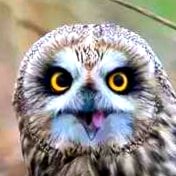


From World Bird Sanctuary
Which of us needs help? 3 of these 5 baby Great Horned Owls are injured, 2 are not. Can you tell which is which? Put your guesses in the comments!
Baby season has started with our first calls about baby Great Horned Owls. A baby’s best chance at a long and successful life in the wild is if they are raised by their parents, so we want to make sure they only come into our care if they actually need it. The first step in this process is to ask the caller to send us a picture of the baby they’ve found.
A photo can help identify numerous factors that would indicate if the animal needs help or not, but even as experienced professionals, we are not always able to discern this from just a photo. If looking at the photo is not definitive, our next step will be to ask questions about the bird’s behavior to further assess. We may also ask for additional photos or videos. If we are still unable to tell if the baby needs help or not, we’ll send a team out to do a field exam. If the baby is healthy, we leave it in a safe spot for the parents to continue caring for. If it is injured, it then comes back to the hospital with us for care.
If you find wildlife (babies or adults) on the ground, it’s important to contact a licensed rehabilitator right away to see if it needs help. Don’t wait to see if it’s still there in a few hours or recovers on its own. When an animal does need help, the difference of an hour or two can be the difference between life and death. As you can see from these photos, it can be very difficult to tell just by looking at an animal if it is injured or not. An experienced professional will be able to assess the situation and determine the best course of action. We would much rather receive more calls about animals that end up not needing help rather than receive animals when it is now too late to save them.
We’ll post the answer tomorrow to which of these 5 are actually injured and which 2 are healthy.
Let’s see those guesses, c/superbowl!
remindme! 3 days
Yeah 1 and 3 look more alert to me as well. It looks like 4 has a visible wet injury under its right wing but the photo resolution isn’t great so it’s hard to tell. Definitely tricky, but maybe that’s the point they’re trying to make - it’s hard to tell so better to call a rehabber or other expert to be certain.
Yeah, it’s no good if you’re lucky enough to find a bird and then toss it back to nature before it could get checked out. It may be well enough to get out of sight, but it could be starving, dehydrated, concussed, have a cut or infection you might not notice, parasites, lead poisoning, and so much more.
And just another general reminder, don’t give food or drink to wild animals! There are a number of reasons depending on species, but the odds are much greater you hurt them than help them.