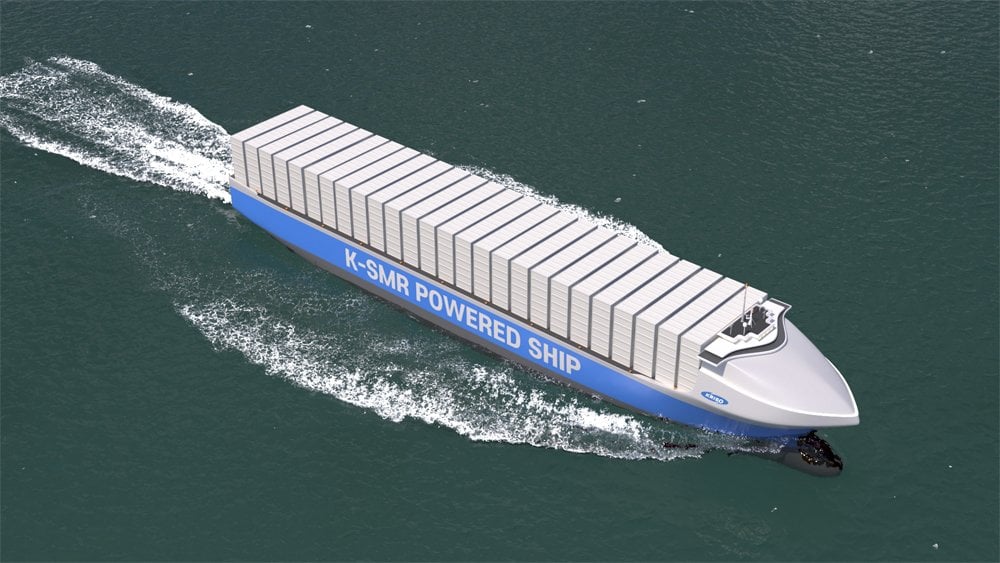
Korean researchers working with Samsung Heavy Industries have cleared a key hurdle in their efforts to develop designs for a containership powered by...
Nuclear heats up water to turn steam turbines to generate power. There’s still that loss from heat source to electricity stage they have to figure out.
The molten salt acts as both a heat storage buffer, and a backup shell if things go wrong. But if there’s a catastrophic failure and seawater gets in, the salt will dissolve in water and spew potentially radioactive particles far and wide. Not sure this is a good idea for use in water. At least, on land the molten salt will stay put.
It’s not zero but it’s also not exactly high. They didn’t specify the core type or reactor design in the article, but it’s possible to run a molten salt reactor using solid fuel bundles too. The salt theoretically shouldn’t have long lived radionuclide species in it, so if there is a potential release it would decay within weeks well ahead of that release contaminating food supplies or something. The low solubility would help out a lot here by increasing the time it takes to dissolve short lived species into the water.
It’s an entirely different ball game if you’re using a liquid core salt reactor though like a sodium fast reactor, or a thorium LFTR (much less likely. The fuel reprocessing demands are complex and aren’t suitable for being on a ship lol. Better for dry land)
It depends if we’re talking about coolant salts or fuel salts, no? If it’s coolant salt in the heat exchanger, no big. But if it’s fuel salt, it’s actually mixed with the fissile material (Uranium/Thorium, not sure what Samsung is using).
And then there’s the corrosive byproduct ‘waste’ of the process (highly corrosive Tritium in some systems). That has to be removed or stored in glass, then disposed on-shore. Unless they’ve come up with a different process, all of this is extra-double risky to lose in seawater with a potentially large damage radius.
Side issue: since it’s a container ship, it will be landing at ports. Leakage or spill at the wrong time could potentially flow to intake ports of desalination plants sprinkled all over Asia, Middle East, and Africa. We’re seeing container and tanker ships get damaged in Strait of Hormuz and the Red Sea practically daily. None of this is theoretical speculation.
I’m just a casual watcher. Putting nuclear anything in water, or flying up to space gives me what scientists call ‘the heebie-jeebies.’
I was talking coolant salts, which is what the article implies. To my knowledge, just neutron exposure alone will activate certain elements in the salt making it radioactive on its own, but they’re short lived since it’s typically a neutron absorption making a short lived isotope.


Nuclear heats up water to turn steam turbines to generate power. There’s still that loss from heat source to electricity stage they have to figure out.
Source: https://www.nrc.gov/reading-rm/basic-ref/students/science-101/how-does-nuclear-power-plant-make-electricity
The molten salt acts as both a heat storage buffer, and a backup shell if things go wrong. But if there’s a catastrophic failure and seawater gets in, the salt will dissolve in water and spew potentially radioactive particles far and wide. Not sure this is a good idea for use in water. At least, on land the molten salt will stay put.
It depends. Lithium fluoride salts have pretty low solubility in water
Solubility source
It’s not zero but it’s also not exactly high. They didn’t specify the core type or reactor design in the article, but it’s possible to run a molten salt reactor using solid fuel bundles too. The salt theoretically shouldn’t have long lived radionuclide species in it, so if there is a potential release it would decay within weeks well ahead of that release contaminating food supplies or something. The low solubility would help out a lot here by increasing the time it takes to dissolve short lived species into the water.
It’s an entirely different ball game if you’re using a liquid core salt reactor though like a sodium fast reactor, or a thorium LFTR (much less likely. The fuel reprocessing demands are complex and aren’t suitable for being on a ship lol. Better for dry land)
It depends if we’re talking about coolant salts or fuel salts, no? If it’s coolant salt in the heat exchanger, no big. But if it’s fuel salt, it’s actually mixed with the fissile material (Uranium/Thorium, not sure what Samsung is using).
And then there’s the corrosive byproduct ‘waste’ of the process (highly corrosive Tritium in some systems). That has to be removed or stored in glass, then disposed on-shore. Unless they’ve come up with a different process, all of this is extra-double risky to lose in seawater with a potentially large damage radius.
Side issue: since it’s a container ship, it will be landing at ports. Leakage or spill at the wrong time could potentially flow to intake ports of desalination plants sprinkled all over Asia, Middle East, and Africa. We’re seeing container and tanker ships get damaged in Strait of Hormuz and the Red Sea practically daily. None of this is theoretical speculation.
I’m just a casual watcher. Putting nuclear anything in water, or flying up to space gives me what scientists call ‘the heebie-jeebies.’
I was talking coolant salts, which is what the article implies. To my knowledge, just neutron exposure alone will activate certain elements in the salt making it radioactive on its own, but they’re short lived since it’s typically a neutron absorption making a short lived isotope.