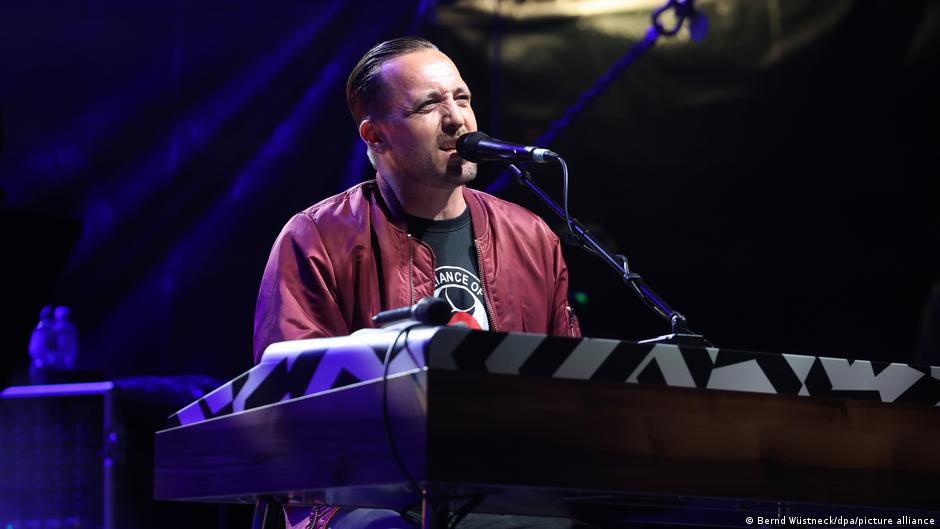
German rapper Danger Dan and pianist Igor Levitt had been invited to play a song for the 100th episode of a political satire show on TV. The performance was canceled at the last minute due to its message.
So ZDF is a public broadcaster, and was the center-right CDU/CSU spinoff of the center-left SPD leaning ARD, but everything current I can find says laws have made both as impartial as possible now?
When looking to see if there was a consensus or not as to if ARD/ZDF has any bias today, it sounded like they are both as reasonably as possible neutral. I did find an English article discussing things related to how Germans see these 2 stations today and the ongoing difficulties neutral broadcasters are having in covering left and right wing movements.
One of the most persistent points of contention involves the reporting on decentralized political movements, most notably “Antifa” (short for anti-fascist). The debate here is not about whether these groups exist, but how they are characterized in news reports. Critics argue that public broadcasters often use descriptive language that legitimizes the movement’s goals while downplaying or omitting instances of political violence associated with these groups.
The core of the accusation is that by framing Antifa primarily as a movement fighting fascism, the broadcasters adopt the movement’s own self-definition rather than applying a neutral, external analysis of its methods. This perceived leniency is often contrasted with the reporting on right-wing movements, which critics claim are subjected to much harsher scrutiny and more frequent labeling as “extremist.”
Broadcasters, conversely, defend their approach by stating that they report on the stated intentions of the participants and that any illegal acts are reported as they occur. They argue that the term “Antifa” is not a single organization with a central headquarters, but a broad ideological label, making it difficult to apply a uniform “organizational” critique in the same way one might with a registered political party.
And they also had a nice section relating thing to our public broadcasting in the US, so that nicely confirmed I seem to be reading things accurately in how similar events are testing our trust in public media.
Germany’s struggle is a microcosm of a larger global trend. Across the West, public broadcasters are facing a crisis of identity. The rise of social media has democratized information but has also destroyed the “shared reality” that public broadcasters were designed to maintain. When everyone has their own curated feed of news, the concept of a “neutral center” becomes almost impossible to define.
n the UK, the BBC has faced similar accusations of bias from both the left and the right, particularly during and after the Brexit referendum. In the US, while there is no direct equivalent to the ARD/ZDF system, the funding battles over the Corporation for Public Broadcasting (CPB) reflect the same political weaponization of media funding.
The challenge for ARD and ZDF is to prove their value in a world where “neutrality” is often interpreted as “bias” by whoever feels the reporting doesn’t align with their worldview. For these institutions to survive and remain relevant, they must not only adhere to the letter of the Medienstaatsvertrag but also demonstrate a visible commitment to intellectual diversity in their hiring and editorial processes.
Longtime public broadcasting fans here seem annoyed at NPR (public radio) and PBS (public television) has given more time promoting pro-MAGA viewpoints after the right in the first Trump term threatened their funding, and the right still calls them hardcore leftists, when they were center-left at best in my opinion. It sounds like Germany does things a bit better by the fees for the media go directly to the broadcasters from what I gathered. That keeps away the influence we have where the broadcasters have to get the money approved by our government.
Thanks to all of you who’ve replied to me so far! I never expected to learn so much from this and be able to relate it to my experiences so readily.

Lol why didn’t I think of that! 🤪
So ZDF is a public broadcaster, and was the center-right CDU/CSU spinoff of the center-left SPD leaning ARD, but everything current I can find says laws have made both as impartial as possible now?
When looking to see if there was a consensus or not as to if ARD/ZDF has any bias today, it sounded like they are both as reasonably as possible neutral. I did find an English article discussing things related to how Germans see these 2 stations today and the ongoing difficulties neutral broadcasters are having in covering left and right wing movements.
And they also had a nice section relating thing to our public broadcasting in the US, so that nicely confirmed I seem to be reading things accurately in how similar events are testing our trust in public media.
Longtime public broadcasting fans here seem annoyed at NPR (public radio) and PBS (public television) has given more time promoting pro-MAGA viewpoints after the right in the first Trump term threatened their funding, and the right still calls them hardcore leftists, when they were center-left at best in my opinion. It sounds like Germany does things a bit better by the fees for the media go directly to the broadcasters from what I gathered. That keeps away the influence we have where the broadcasters have to get the money approved by our government.
Thanks to all of you who’ve replied to me so far! I never expected to learn so much from this and be able to relate it to my experiences so readily.