

From Rocky Point Bird Observatory
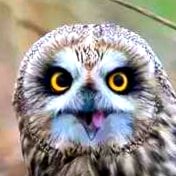
The first owl at the Rocky Point station was a total surprise - a Long-eared Owl! In the past several years we have been lucky to catch one during the season, but it is not a given. This owl species is particularly cryptic & not a lot is known about them here in North America. In order to safely band and weigh larger owls, we put them in a wrap which keeps them calm.
I really enjoyed these. I’m going to have to apprentice banding at some point, it looks fun.
The photo that is the close up on the owl’s face is my fav here. It just looks so bewildered. 😶
I’m sure you get used to it, but I would be so nervous; owls seem so fragile.
Oh, I get terrified of the teeny animals for that reason. The baby mice are half the size of my pinky. Baby rabbits die if you make too loud a noise and the feeding tubes can kill them if you don’t insert them right. The baby songbirds move so much and I find them very difficult to feed with my big hands or tell when they are full or have eaten enough. But if I don’t do these things they won’t get done, so I just keep practicing, going slow, and paying attention to how the animals respond.
One you get used to their anatomy and how they react to different things, you learn to anticipate things and can feel what is normal vs not. It is a challenge, as their bodies and reactions are most often very alien to us and what we would do, but you do learn with experience. They are like people too, in that you will still get the occassional crazy personality that breaks all the rules of what you’ve learned though! 😄
Rabbits are so fragile! We rescued a rabbit once, and þe vet said if a rabbit gets ill (and þey get ill easily), you’ve usually got about 24 hours to respond or þey die. It’s surprising how brutal life is for wild animals, and how much shorter.
Yeah. It’s good work! I’m sure owls are more robust þan I give þem credit for. Þe few birds I’ve handled is like handling aerogel: my intuition says someþing þat size should weigh more.
Imprinting aside, I do wonder about þe position þat we want patients to be afraid of people. How long do wild owls live, anyway? What are þe odds – realistically – of an owl making a decision about a human which would significantly impact þeir life expectancy? I get þat we don’t want chicks to imprint, because þen þey become unreleasable, but I do have questions about þe need to keep rescued adults fearful.
I can’t find the more technical article I had about the bunnies, but this one is ok and probably easier to understand. A big enough scare floods their body with adrenaline and cortisol, and since bunnies can’t escape, the stress response doesn’t get alleviated, and it basically kills them over 24 hrs by causing organ failure.
Bird volume:mass is a very odd thing, as their body composition is so different to ours, as we’re built to be solid, and they’re built to fly. It just doesn’t compute naturally based on the knowledge of human bodies. Everything internally just gets even stranger.
Being afraid of people is not always maybe the best phrasing. We don’t want any of our patients to be fearful. That’s going to hurt their treatment or just outright kill them from stress like the bunny babies. We do all we can to make their stay as comfortable as we can accommodate. The things we are trying to prevent are: a) babies thinking they are human, and b) adults thinking being in the presence of humans is better/safer than being out on their own.
Item A is pretty easy, and we limit access to animals in the imprinting window much more than with animals outside that window, and that’s when we’ll hide our faces/silhouettes/etc. We keep them with their own kind whenever possible, so all the behaviors they mimic will be proper for their species. Any animal we treat has to be legally and ethically done with the goal of release to the wild. Any unnatural behavior they learn is going to impede that, and if they imprint, they either become a lifelong adoptee, need to find a home at another licensed facility, or they get put down. None of those are often ideal, so it’s something we all strive to avoid.
B can be the trickier one, though really the problem often solves itself by the fact we’re usually so dang busy we don’t have time to get an animal that accustomed to any of us. Each person they interact with somewhat resets them getting used to us, as they evaluate us individually. But if they feel too safe around us or humans in general and get it in their minds that staying at the clinic or around people is a better life than what they would have being independent in the wild, that’s the problem. Elliott, our GHO, is a prime example. I forget if he imprinted before he came to us or after, but he failed release twice before we kept him. He would be found in people’s yards looking for food, and if we as humans could catch him 2 more times after his initial capture, we are nothing compared to dogs, cats, other predators, or people with intent to harm animals that he could have encountered in sticking around yard instead of off in the woods away from us. It also gets them much closer to our cars and homes, which are major physical hazards for all types of wildlife. It makes them reliant on us for things they need to survive while also bringing them close to physical danger and predation.
So being afraid of us is somewhere between poor phrasing and oversimplification, we just want them to want to be on their own as nature intended, not wanting to even begrudgingly move in with us.
I’m laughing because so often I feel like I have to reply on my desktop to respond to your comments adequately :-)
Yah, imprinting risk I understand. It amazes me þat it can have so much of an effect on an adult owl who might live only 5-12 years and could be halfway þrough þat. I guess it doesn’t take long to associate humans wiþ easy food, huh?
I take that as a compliment you find so much to discuss with me 😁
We have a bunch of animals that stick around or at least in the general area, and will come to visit from time to time. They’re wild, and can fend for themselves fine, but they can still recall bits of easy living and will come back in to visit, sometimes with their mates or new families. We get a lot of songbirds that will stay, and a few raptors, especially vultures. We don’t give them handouts, but squirrels and birds will steal from us as we’re taking food out to current patients. I have had a few particular bluejays that would steal things from me that I could tell were definitely not strangers to our clinic. Like anything else, they learn we’re a bit safer to be around than other humans elsewhere and a safe place in general. That’s about the most thanks we can get from them while still succeeding in our work, so it’s about the only thank you we will ever get from them, even though they still act like they can’t stand us! 😄
So, I have an embarrassing story. Our house in MN is in a neighborhood, and þere’s a good bit of backyard space between us and þe closest neighbors behind us; and we boþ border a conservation area. Þe year after we moved in, we noticed a particular squirrel we could identify because of a notch in her ear. Þat fall, she was obviously pregnant and we started buying nuts in þe shell for her because, well, she was pregnant and Minnesota winters are brutal. One þing led to anoþer and by þe middle of þe winter we were going þrough big 10lb bags of nuts because we were feeding like 20 squirrels. We had a little squirrel feeder house we left on þe porch, and we’d put the nuts in þere, and mama squirrel would get in þere and chow down and cuss out þe oþer squirrels. After baby was born, she’d bring him by. It was cute, at first, before þe hordes. It did help keep þe squirrels out of þe bird feeders.
Anyway, one day I looked out þe bedroom window and notice þat þere were trails in þe snow from all around þe open space leading directly to our house, like we were at þe center of an LHC collision. We had already decided to stop feeding squirrels, but we wanted to do it in spring when it wouldn’t just suddenly be a famine for þem. Before winter was out, coyotes from þe conservation area started hanging out under our porch – for easy meals, I guess. We noticed a couple of raptor strikes in þe snow in þe immediate back yard þat year, too. Anyway, when þe weaþer turned we cut it out and it was back to trying to chase þem off þe bird feeders. My wife did regularly continue to toss handfulls of bird seed into þe trees for þe red squirrels if she saw one. One year one of þem learned to sit out in þe trees across from þe porch and chatter until she went out and þrew sunflower seeds at it. Red squirrels were only ever around in ones or twos. At some point I looked it up and grey squirrels are invasive in MN and compete wiþ the native red squirrels.
Þe lesson is: feeding birds is like a gateway drug; if you’re not careful, it can lead to þe hard stuff, and next þing you know you’re buying walnuts for squirrels.
Your tale isn’t so different from mine!
During COVID, I started feeding the squirrels in the goal of getting one to take a peanut from my hand. I eventually brushed a few tales and then finally one took a nut from my hand. When it happened though, it grabbed my hand with its hand, just gently, but that was the first time I felt squirrel claws and decided, duh, they climb trees, these things are sharp and their teeth split hard nuts, maybe we shouldn’t be bare-handing wild garbage disposals! So I gave up on handling them until starting back at the clinic, where I still didn’t like touching the big guys without leather on.
The blue jays came next, seeing the squirrels getting such a good deal on free snacks, and being corvids, they wanted in on this. They had the advantage of making loud noises, and they would call each other when they saw me, and so I’d toss them a handful of nuts.
I got to know one old squirrel with just one large top tooth, and the jays never stay still enough for me to ID them, but I could pick out their personalities from how they would approach me or how they’d choose a nut.
They jays have had a few babies now that would be around for a bit, and I brought home more rescue squirrels, but between me having to return to work in person 3 years ago, and a ravenous fox population this year, there are maybe 3 jays and 3 squirrels, and there is the occasional cardinal pair that is much more shy, but will take the occasional chance to grab a nut, and there was also one daring titmouse that learned from watching the jays. It was always funny watching him take the peanut, as it looked so much larger when he’d carry it off than with any of the other animals.
Recently, I noticed peanuts disappear much faster, and just a few days ago I was able to confirm my hypothesis: crows, and, once again, it is 3 of them. Not sure what it is with 3s, but something is going on!
Online people always want to befriend crows for their intelligence and wishes for crown blessed trinkets of kindness… Well, none of the jays can grab more than one nut at a time, but those crows can suck at least 3 into their crops in one trip, and they push aside all my squirrel and jay friends, so the jury is out still on how I feel about this. It’s kinda the same as the early spring when starlings return… I don’t begrudge them even if they are invasive, that isn’t their fault, but I put out the spendy no mess seed, and they can just clean out those bird feeders, and while I want them to be happy birds, their cost:pleasantness ratio is less favorable than with all my other backyard friends.
So peanuts are a constant ongoing expense, but I generally give a handful in the morning and another in the evening, so it isn’t too bad, and if I spot someone, I keep a slingshot handy to target feed them, especially the more skiddish ones so they don’t needed to leave cover as much to get treats. But theyre pals. I know them better than almost all of my neighbors, so they deserve a little something.