I actually kinda wonder if my issues with Linux as a daily driver and not just for my server stuff was because I was always chasing the bleeding edge.
It’s actually more simple than the way people usually explain it.
Each distro is made of thousands of components. Their interoperability needs to be thoroughly tested and the versions of the software need to be stabilised.
Debian’s slow and steady release cycles not only do this, but make a guarantee that if the OS works on your system on release day, the OS will continue working there until the LTS window closes.
With faster release cycles, the interoperability and stability of the software is replaced with more up to date software without that kind of guarantee, and due to deprecations happening and being accepted, this further decays stability.
Recent examples that personally WOULD have affected me include KDEs X11 deprecation, and NVidia removing compatibility for my graphics card from their driver.
EDIT : Even with fedora’s 6 month cycles, while inter-related software might work well together, they are still taking X.X versions , and the in between deprecations will still affect your system. Hooray, KDE got an incremental upgrade from 6.3 to 6.8 you have 3 new features. BTW I hope you were ready to stop using X11, because if not, have fun unbreaking your system and fixing every customisation you made that adjusted the settings of your system and programs to play with X11 the way you wanted it to.
Rolling releases are great for testing new versions of your software, since everything else is immediately preparing you for the future. For stable, “daily driver” systems, older or middling hardware, debian’s long term stability is great.
If you have a bleeding edge system that has hardware that came out yesterday, you are developing something that depends on the newest version of a library, and you have all your essentials in a different machine, and you have a backup, and you want to participate in linux ecosystem actively, raising bugs as you see them, sure, definitely go for a rolling release system.
Also to reconfigure fucking everything constantly.
With Rolling releases everything is constantly tested on thousands of machines in real world usage. Yes things might break a little, but it’s fixed within hours if it happens.
Small price to pay for constantøy getting updates and being on a version of software developers actively work on
Idk, I’ve just never had a more stable system than i do now on CachyOS. Just seems that if your on rolling and actually update often you’ll have less problems because it doesn’t take 6 months to get fixes for things


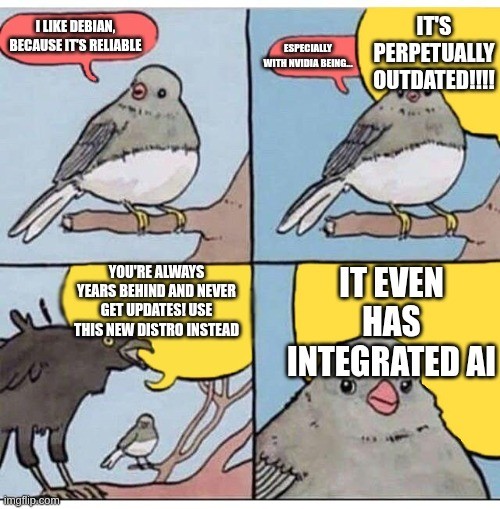
It’s actually more simple than the way people usually explain it.
Each distro is made of thousands of components. Their interoperability needs to be thoroughly tested and the versions of the software need to be stabilised.
Debian’s slow and steady release cycles not only do this, but make a guarantee that if the OS works on your system on release day, the OS will continue working there until the LTS window closes.
With faster release cycles, the interoperability and stability of the software is replaced with more up to date software without that kind of guarantee, and due to deprecations happening and being accepted, this further decays stability.
Recent examples that personally WOULD have affected me include KDEs X11 deprecation, and NVidia removing compatibility for my graphics card from their driver.
EDIT : Even with fedora’s 6 month cycles, while inter-related software might work well together, they are still taking X.X versions , and the in between deprecations will still affect your system. Hooray, KDE got an incremental upgrade from 6.3 to 6.8 you have 3 new features. BTW I hope you were ready to stop using X11, because if not, have fun unbreaking your system and fixing every customisation you made that adjusted the settings of your system and programs to play with X11 the way you wanted it to.
Rolling releases are great for testing new versions of your software, since everything else is immediately preparing you for the future. For stable, “daily driver” systems, older or middling hardware, debian’s long term stability is great.
If you have a bleeding edge system that has hardware that came out yesterday, you are developing something that depends on the newest version of a library, and you have all your essentials in a different machine, and you have a backup, and you want to participate in linux ecosystem actively, raising bugs as you see them, sure, definitely go for a rolling release system.
Also to reconfigure fucking everything constantly.
With Rolling releases everything is constantly tested on thousands of machines in real world usage. Yes things might break a little, but it’s fixed within hours if it happens.
Small price to pay for constantøy getting updates and being on a version of software developers actively work on
This doesn’t address the nuances I explained above and says the same old thing.
Idk, I’ve just never had a more stable system than i do now on CachyOS. Just seems that if your on rolling and actually update often you’ll have less problems because it doesn’t take 6 months to get fixes for things