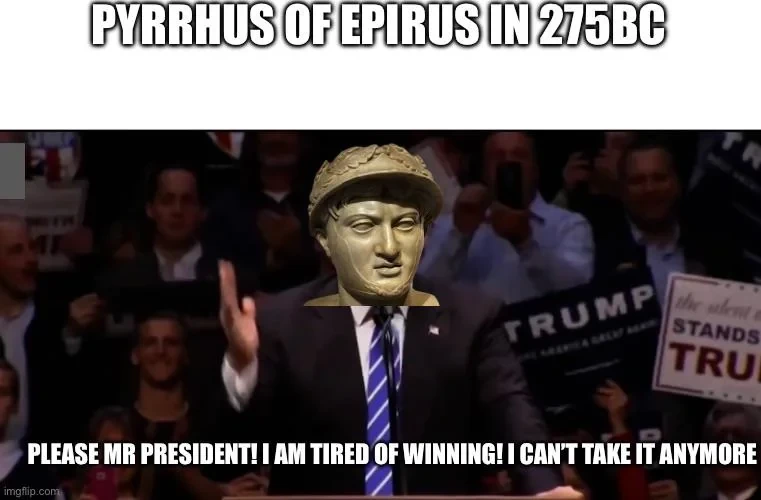
Explanation: Pyrrhus of Epirus was a Greek warlord who came into conflict with the middle-era Roman Republic. If his name seems familiar, you might know where this is going.
Pyrrhus of Epirus, reinforcing Greek city-states in Italy, fought with Roman legions of citizen-soldiers. And won! In fact, he won three times against Roman armies!
Only… the Romans could replenish their losses, being native to Italy and with a strong power base located there, and Pyrrhus, as a foreign invader, could not. “One more victory like this”, he is supposed to have said, “and we shall be undone.” Hence the name ‘Pyrrhic victory’. After the third ‘victory’, he decided to leave Italy to the Romans and return to warring in Greece.
Depicted is the current shitgibbon sitting in the American presidency, who constantly and incoherently rambles about ‘winning’ and ‘winning so much you’ll get tired of winning’, yet has nothing but degradation of the already-shaky American government and society on his record. I think to afford any of his endeavors the title of ‘Pyrrhic victory’ would be overgenerous to him - and unfair to Pyrrhus!
That being said, Pyrrhus was certainly tired of winning against the Romans!
Pyrrhus of Epirus
EpirusCurrently in northwestern Greece and southeastern Albania
https://en.wikipedia.org/wiki/Epirus
https://en.wikipedia.org/wiki/Epirus_(region)
https://en.wikipedia.org/wiki/Gjirokastër_County
https://en.wikipedia.org/wiki/Vlorë_CountyPlease don’t take these comments as criticism, they are assistance. I know you have many posts to do, and want to help give further modern context to ancient locations for the reasons I shared on your previous posts. I appreciate the posts you make and the effort you put into the explanations.
No criticism taken! I’m always happy to see people add on to my explanations! I only have so much time, and, for that matter, so much knowledge about the matters at hand! Filling people in where I haven’t or can’t is assistance I’m always grateful for!
'what can you tell me about Phyrrus?
‘Phyrrus a pier sir’.