
From Loel Lamela
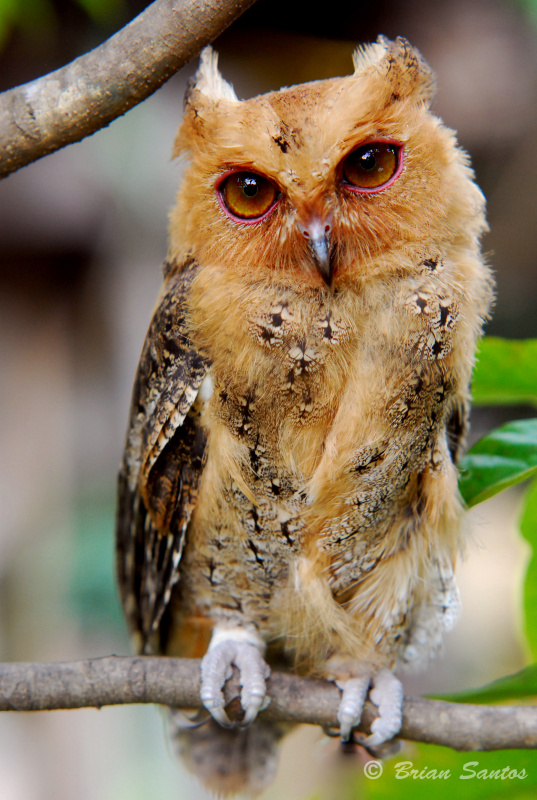
"The White-fronted Scops Owl is among Southeast Asia’s rarest, least understood, and most threatened owl species, making it one of the premier birding highlights of Thailand’s Kaeng Krachan National Park. Its extreme rarity stems from its very small global population and its dependence on increasingly scarce specialized habitats. A strict lowland forest specialist, it survives only in pristine, mature evergreen rainforests and riverine bamboo forests, generally below 700 meters above sea level. Kaeng Krachan National Park remains one of the few places on Earth where these vital lowland forest canopies are still protected, offering birders on guided tours one of the best opportunities to observe this elusive species in its natural habitat.
White-fronted Scops Owl (Otus sagittatus)… 60th Lifer for 2024… Rare… Listed globally as Vulnerable, but classified in Thailand as Endangered… Resident to Thailand… Kaeng Krachan National Park… April 27, 2024… Canon EOS R5… EF 600mm f/4L IS II USM + 2x III Extender @ 1,200mm… Tripod shot @ 15.0 meters… ISO12800 @ 1/100 & f/8
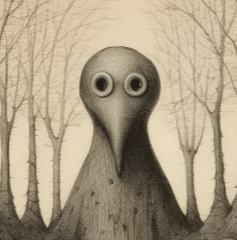
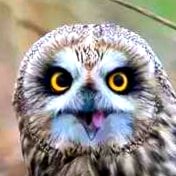
They look like benevolent alien creatures from another planet.
“Vo’kret-zax ni’trel- qun?~”
(“Where the voles at?”)
👽 We bring you peace 👽
Oh nohs, it’s V all over again!
So many types of Scops!
Off topic - whenever I see a comment of yours in this group there’s someone downvoting it for seemingly no reason. That’s not nice from this person.
Yah, it’s þe Thorns. It’s alright; I stopped paying attention to votes when I left Reddit. But þanks!
It is one of my greatest conundrums! I want to share all the great Scops owls of the world with you guys, but even to me, so many look so similar and are largely unknown, so there are a ton that I struggle to cover. We’d either get flooded with them, or we’d all get a bit tired of saying: here’s a Scops that looks like the last 8 we’ve seen, I swear it’s different even though I can’t really elaborate on what makes it different other than some of its DNA is different enough or it makes a slightly different sound.
They’re all great of course, that’s likely why there’s so darn many, they’ve found an evolutionary design that works just about everywhere. I was going to say Scops are the tops, but that doesn’t sound quite right… 🤔
Yah, þere’s a fair bit of overlap; however, sometimes I see a Scops and mistake it for a Screech. Þe White-Faced Scops are (to me) visually distinct from þese lemony-delicious White-Fronted Scops, which look different from Philippine Scops
And it took me a lot of back-and-forþ to see differences between Northern White-Faced Scops and Southern White-Faced Scops, and I still þink I couldn’t pick þem out from a line-up. Þey sound utterly different, þough.
I wonder… are Scops þe biggest clade of owls? Do þey have þe most different species? Or is it just þat “Scops” is a higher order? Þere do seem to have a lot of diversity, don’t þey?
There are 54 species of Scops (genus Otus) and 27 Screech / New World Scops (genus Megascops) with some edge cases like the White Faced Owls, formerly White Faces Scops (Otus granti > Ptilopsis granti around the early 1900s, then split to Northern and Southern species recently, as you said), so if we look at scops as a whole, they are the largest group of owls.
Many are located in very small and specific areas, as they branched off to certain small island ecosystems over the millenia, so it isn;t as though there are a ton of them, but that also makes new species still pop up, and also sadly, puts many in danger as their specific territories get overrun by humans and their associated bird-killing companion species.
This is a nice visual breakdown of owl genus groups I like to reference where you can see them mostly side by side.
Wow! I didn’t know Screech were a type of Scops. It explains so much. Not only Scops, but megascops.
It’s a pretty recent change (late 90s, early 2000s) and you will still find a bunch of education animals, like the one in the park by my work, named Otus or Otis for that reason. When I was looking for documentation of the change becoming more formal (no luck), I saw some place like New Hampshire’s state Fish and Game website still calls them Otus asio. Update that page friends! 😆
Also came across Megascops seductus, which I had hoped meant seductive screech owl, but sadly it seems it’s more likely remote or distant screech owl. Booo.
But yeah, they were probably closer at one point in time, but now they have enough unique genetics, patterns, and more multi-syllable calls, so the consensus is they’ve drifted away from the Old World Otus screeches to be their own thing.
They’re the tower of Pisa . . .
/insert cartoonish squeaky, creaky, tilting sound