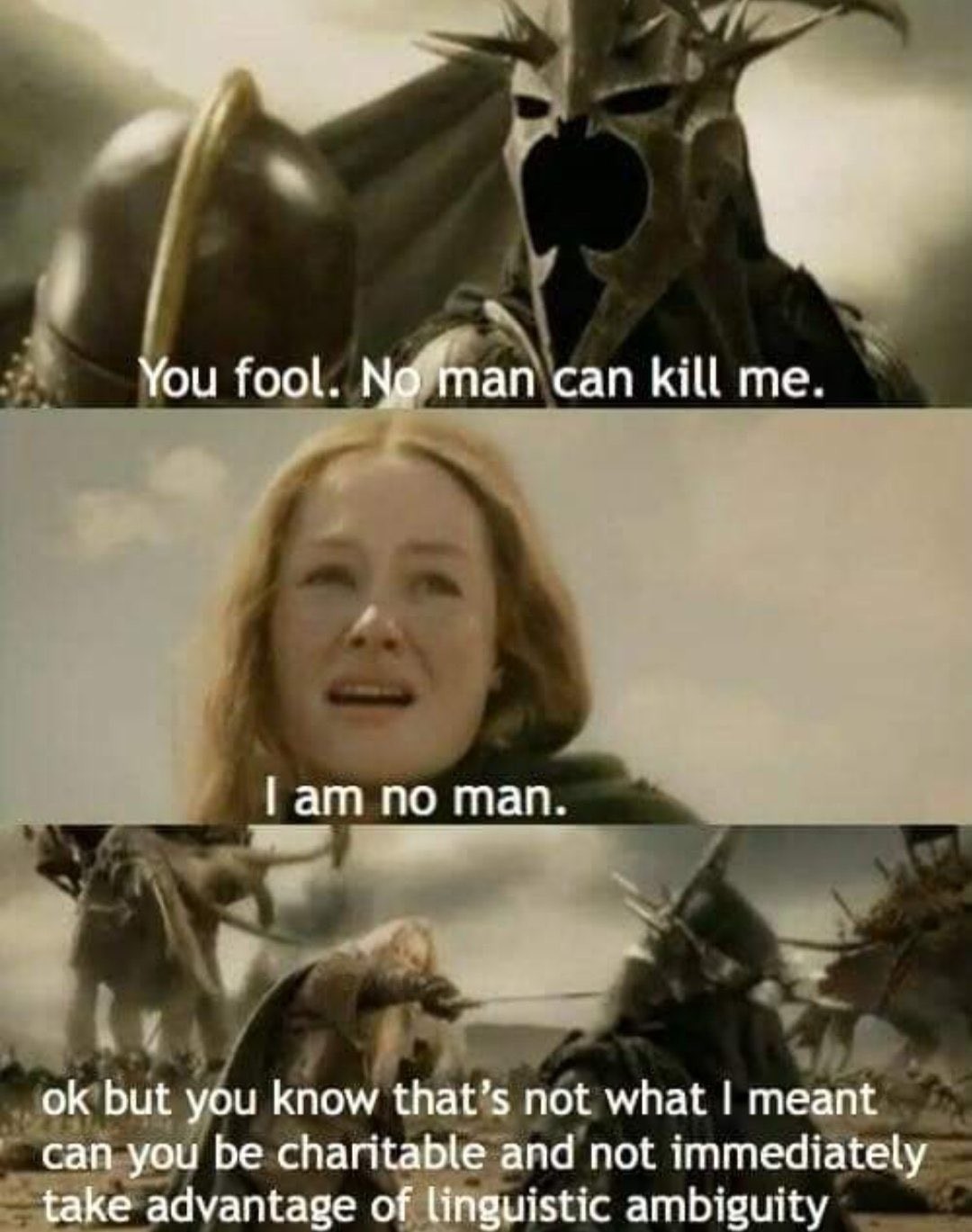
What’s that?!? A Hobbit from behind with an elven chair!!!
Hardly surprising. Halflings do tend to have a hobit of interfering with dark lords’ plans.
Merry, a Hobbit, not a man, made the Witch King vulnerable to Eowyn by stabbing him with an ancient magic blade (picked up in the barrow-downs and given to him by Tom Bombadil, which movie-only people didn’t get to see) specifically designed by the smiths of Arnor for the fight against Angmar.
Source: In Deep Geek
Afaik Hobbits are men.
Hobbits on the other hand were in nearly all respects normal Men, but of very short stature. They were called ‘halflings’; but this refers to the normal height of men of Númenórean descent and of the Eldar (especially those of Noldorin descent), which appears to have been about seven of our feet. Their height at the periods concerned was usually more than three feet for men, though very few ever exceeded three foot six; women seldom exceeded three feet.
The People of Middle-earthSo… Halflings are just dwarves?
No, Dwarves are Dwarves.
According to the Simarillion, they were made by the Vala Aulë and later given free will by Ilúvatar(God).
Tbh I understand it not being all that clear, especially since afaik there is not explanation where Hobbits come from.
11 year old me read the books and this was my favorite line. And then they changed it for the movies. Because movie audiences don’t know what the word hinder means apparently.
I’m still grumpy that they ruined my favorite line for no good reason
What was the line in the book?
I’m guessing it was “Hinder me? Thou fool. No living man may hinder me!”
Exactly this one!
And the funny part about this meme is that in the book it highlights this… The witch king pauses like “… wait does that count?” And that hesitation is why merry gets the drop on him.
So even the witch king wasn’t sure if it was meant to be literal or not
Yeah I know what you meant but I used the opportunity for a witty clapback–it wasn’t for clarification, it was for dramatic flair, which you could understand if my sword weren’t in your face right now
deleted by creator
I would literally die if no man did this to me
Yeah I always hated this line, it doesn’t even work in a lot of languages we have today. No way it would have worked in whatever language those two were using to talk to each other.
The point is that there was nothing special and the prophecy wasn’t real, it was only that people believed in it and they were generally very difficult, but not impossible, to kill. Ironically the witch king believed it too because if he acted more cautiously, as they had always acted before only in the dark and stealthily, he would have been safe.
I’m going to need a source for this, because I think common consensus is that this (along with the trees (Ents) literally “marching to war”) was a critical response to Shakespeare’s Macbeth, where Tolkien considered Macduff being born by C-section a cop-out solution to the prophecy “cannot be killed by a man born of woman”.
Playing with ambiguous language in ways like this, especially with regards to prophecy, is a trope thousands of years old in myth (Croesus and the Oracle at Delphi probably being the paradebeispiel), and so I see no reason to think that a scholar of myth like Tolkien would not do the same in his own take on the genre.
It was a prophecy from Glorfindel, He will not return to this land. Far off yet is his doom, and not by the hand of man will he fall. , which isn’t much but the nazgul were aware of it. https://scifi.stackexchange.com/questions/59204/in-the-lord-of-the-rings-was-the-witch-king-aware-of-the-prophecy-about-his-dea
That can be viewed as a real prophecy or a fake self fulfilling prophecy.
I know where the prophecy is from - I just see no reason to interpret this as fake when high elves like Glorfindel are already canonically known to have the gift of sight and the prophecy was fulfilled. Given the Macbeth connection, without evidence from Tolkien there really isn’t any good reason to assume the prophecy was fake.
The language they were using was almost certainly Westron, since that’s what almost all of the Red Book of Westmarch was translated from (with the notable exception of Bilbo’s Translations from the Elvish, of course), and since Tolkien is the one who invented the language, it would have worked exactly as well as he wanted it to.
The real question is whether Sindarin also works this way.
deleted by creator