

The chief executive of Six Flags says the company will install seat belts on the Georgia roller coaster from which a rider fell to his death earlier this month. The company’s rides with similar restraints will also get the safety upgrade.
The theme park operator announced the extra safeguard less than two weeks after 42-year-old Hassan Jihad Ibn Kariem of Atlanta died after being ejected from his seat on the Goliath coaster at Six Flags Over Georgia.
Wish it had more details about what actually happened and why that restraint. Wondering because I’ve never felt like that kind of restraint left room for falling out of it, even if I positioned myself such that there would still be room to move a bit after the attendant pushed it down. Though I’ve also only ridden rides with this restraint that were just a series of parabolic hills, which would probably be fine with just a lap belt, since the riders and train are pretty much both just following a ballistic arc.
Was this a mechanical failure that caused the restraint to release mid-ride? Unusual leg/pelvis geometry? Was the guy actively trying to get out, maybe not thinking he would succeed? Did he shit himself or something which added enough lubrication to slip free? What was the ride doing when he fell off, like just a parabolic hill or did it have something like a reverse bank on a turn or an inverse loop that creates forces away from the car?
When I was young, I assumed anything that didn’t have a seatbelt didn’t require one, there was no danger of leaving the seat. I don’t think I ever truly believed it, considering the fact that the school bus had no seatbelts.
If you’re curious who’s supposed to be regulating these…
It’s at a state by state level (for permanent theme parks), which is why these accidents keep happening in red states.
This is just the result of decades of erasing regulations in exchange for political donations.
Regulations previously inked in blood. Now they demand more sacrifice.
Wasn’t the six flags thing that kept brain damaging and killing people for the past decade in California?
I mean, the line between neoliberals and Republicans is blurry at best…
But yeah, I’m sure Newsom has taken money from that industry and regulations haven’t kept up for longer than he’s been around. The mouse isn’t shy about lobbying.
All nine of the Six Flags coasters… feature similar clamshell restraints that sit at the top of a vertical bar between each rider’s knees. The bar locks a padded restraint into place over the rider’s lap and upper legs.
Thinking back to theme park visits from my childhood, I had never thought to myself that more was needed then the big clunky hardware holding us in. I fully support adding seatbelts on top of this, and the article says there are a lot of rides across the country down for maintenance now, likely to do the same.
I didn’t have the clamshell like this, just the old lap bar. A ride damn near dropped me out and my sister had to hold onto me the whole time, but when we reported they just shrugged and said ok sorry.
You and your sister did great. That’s so scary.
That one wasn’t as bad as the ship that flips upside down, that lap bar almost dropped me too because the whole thing lingers upside down for a few seconds and it just didn’t come all the way down. Ahh king’s dominion memories
I’m very afraid of heights. This is awful
These particular clamshell restraints where patented in 2001 (per the article), so they aren’t from my childhood, but I don’t know your age.
Thinking back to theme park visits from MY childhood, I have never once in my entire life felt well secured or safe when riding a roller coaster in that style. If you’re a smaller than average person you’re pretty much entirely responsible for your own fate with those. A lot of times the bar didn’t even touch my body at all. I usually ended up clinging onto the restraint bar with my arms, to prevent myself from sliding around beneath it.
The over the shoulders style top restraint is a thousand times better and safer, in my opinion. Never had a problem with one of those.
I’ve never ridden Goliath, but I would’ve just assumed it had seatbelts already, in addition to the bar, just because it’s so big and (relatively) new. I could’ve sworn I remember at least one of the other coasters at Six Flags over Georgia already having them, but I can’t remember which one(s). Maybe Mindbender?
You may be right about the Mind Bender. The Scream Machine needed seatbelts but I don’t believe had them, Batman, Ninja, and Superman rides all had the over the shoulder(and in the case of Superman over the whole torso).
Seatbelts! Of course!
Seat belts in addition to the “bar” that goes across your lap…
Which still isn’t enough, they should all have the shoulder harness, but those are expensive.
Bolting in seatbelts doesn’t fix anything, but it’s cheap and reassures the idiots who still go to the capitalist hellscapes that are modern Theme Parks.
The only reason they’re doing the seatbelts is because the deaths hurt their profits.
I’m not sure why you think lap belts won’t help. There are some rides that warrant shoulder restraints, but typically engineers use physics to determine where the loads and accelerations are. It isn’t strictly a matter of cost. Roller coaster accidents are not some rampant death trap. They could be safer, and lap belts in many cases will help.
Which still isn’t enough, they should all have the shoulder harness, but those are expensive.
I think the main cost isn’t the purchase price, but rather the operational costs of ride operators having to individually check that everyone is buckled properly. It would slow down the ride and/or increase labor costs due to multiple attendants.
My first thought on that ride as a teenager was “wow, this is the only restraint? No seat belt?”
If the restraint is working properly then it doesn’t need a seatbelt. They are probably skipping out on necessary maintenance that keeps the restraining devices in proper working order. Rather that make sure safety rules are maintained, just add a seatbelt under the device that might break.
Having multiple independent points of failure is not “unnecessary maintenance”. The entire point is that in the case of “something is not working properly” that there is another independent safety mechanism that would also have to fail for the rider to be ejected. This is basic design in redundancy and safety.
“We don’t need seat belts if drivers are driving properly”
“We don’t need oxygen tanks if planes are operating correctly”
This ride, at least when I rode it, is just an upgraded lap bar essentially. Which is reliant on someone’s physical body proportions being the main thing that keeps someone inside.
Sorry for the reddit link but I’m on mobile and my image upload isn’t working.
https://www.reddit.com/r/rollercoasters/comments/ezy1qr/goliath_at_six_flags_over_georgia/
But it’s looks like that.
Even wooden roller coasters have seat belts. It’s absolutely insane that someone had to die before they put them in the ride.
Every other roller coaster at that park, at least when I went, had at least two forms of restraints. It is far from “unnecessary maintenance”. It’s literally standard practice.
The original design of those particular restraints has 4 separate pawls that engage with the ratchet holding down the restraint, any one of them is more than capable of holding the full force of even the largest rider. The newer versions are purportedly half ratcheting half hydraulic, but that’s not what was present on the Goliath in question.
The unlocking mechanism works on the entire row at once, so since it was just the one seat it’s probably not related to that.
B&M, the Swiss manufacturer also has notably not suggested any other customers close their similar rides pending investigation.
All that’s fine. But, the point is redundancy. It’s not about the safety factor of an individual restraint. You can have the strongest and most reliable safety mechanism; you still design safety around having multiple independent points of failure.
The “seat belt” is a restraint that is not doing anything 99.999% of the time. For some people, that might seem like a “unnecessary” part as the comment I was replying to stated.
But that’s the entire point. And a secondary form of restraint that is independent is the entire point. I just wish someone didn’t have to die before that happened.
What the corporations talking heads decide is “necessary” is not what I’m talking about. I’m talking about safety from the perspective of an engineer.
I use to work in power systems and designed redundant power supply arrays. For some customers, like hospitals, they don’t just factor in a “n+1” (n active with 1 redundant) redundancy. They require a “n+m” (often with m>n) redundancy because of the critical operation of their power infrastructure. Because operating standards and regulations force them into maintaining this level redundancy.
Meaning, an array of power supplies that needed 4 power supplies to operate would have 4 or more additional redundant power supplies doing “nothing” most of the time. Because you don’t design around “the average day”. You design systems like this around “the worst possible day”.
So, when the dumb guy that plugs in the wrong power cable, ignores the flashing lights, burns a power supply, and then thinks “hmmm not working, let me try plugging it into another one.” When that dumb guy comes around. People in the hospital have the best chance of survival.
Right what I’m saying is internally it is 4x redundant and is designed to fail safe regardless.
Here’s an old (2006) publicly available version of ASTM F2291 which governs amusement ride safety, notably class 5 restraints (highest tier) must be either redundant (i.e. two distinct devices as you suggest, or fail safe) and have external verification, which in the case for these ones is a proximity sensor that gets flagged once the pawls have dropped in by enough teeth
We are getting deep into safety design factors here. So I appreciate the conversation. No one else is gonna read this. So I’ll expand a little. Because you are hitting a good point.
What you’re talking about is not another independent point of failure in the scope of “keeping the rider alive”. The “scope” is within the design parameters of a locking mechanism.
In my example of power supplies; the redundancy is around the failure of a single power supply. So the scope is “make sure power supplies operate with ‘m’ levels” of redundancy.
A single portion of the system can have redundancy. And that’s what you’re talking about in your comment. But, to continue with my comparison on power supplies, the power supply arrays has no ability to ensure it’s source power isn’t cut. The redundancy in the power supplies is useless if the power source (central power, substation, electrical grid) is cut. It’s a single point of failure still.
So, “zooming out” to a more macro level we would want to ensure redundancy there. Backup power generators being the obvious answer.
Do you get my point? There can be redundancy in the single restraint mechanism (just like redundancy in my power supply array) but the “seat belt” is similar to the “power generator”. It’s another separate level of redundancy.
I hope that makes sense. I zoomed out my analogy from its original intention based on your interpretation of it.
Either way. I like these conversation. When talking about design and safety there is a “scope” that is important to understand. That we assume the same safety requirements are met at the point of which we have no control over or are not considering in that design. It can be outside of the “scope” that the design is meant to control. So, reading a safety standard on a specific locking mechanism is within that “scope” but assumes further safety and redundancy beyond its given scope. Just as we assume a hospital will have backup power generators when designing a single power supply array. A safety standard for a locking mechanism will have redundancy built into it; but assumes, outside of its design scope, that there is further redundancy in “keeping the rider in the seat”. Because it’s entire goal is “keeping the rider in the seat”. The locking mechanism redundancy is tighter, factored around if X part of the mechanism fails then Y part ensures the rider is contained.
Hope that makes sense. All systems will have a single point of failure. The point is to understand the scope of which that system is meant to operate in and add redundancy to it. If we “zoom out” enough all roller coasters safety systems will fail if the ride is hit by an astroid from outer space. The point is in understanding the scope of the system and adding redundancy in multiple independent mechanisms. The scope being “multiple independent systems of restraint”. Which is what the seatbelt adds.
Yeah I see what you’re getting at, and a seat belt would probably have saved this man.
To point back to the ASTM standard for a second though, most seatbelts in use on rollercoasters are not allowed to be counted as part of the restraint system for enhancing it’s class rating to 5 via redundancy because they can be opened by the rider (6.4.3.9 (4)). The vast majority of intense rides that use them are typically using them as external verification of sufficient restraint position instead of or in addition to the proximity switch.
From an industrial safety perspective the seatbelt feels like more of an administrative control to me than an engineered* control because of the rider ability to bypass. Which an administrative control can prevent accidents, but an engineered control is definitely preferable where feasible.
*For anyone following along, the seatbelts are definitely engineered to handle the loads, just in my opinion industrial safety wouldn’t put them in an engineered control category because of aforementioned reasons
Canada’s Wonderland has 2 similar rides, the Behemoth and the Leviathan. When I last went in 2009 they did not have secondary restraints. I rode Behemoth multiple times and tried it both flexing leg muscles when locking it down to give myself some play then relaxing and with it very tight.
I liked it both ways, even relaxed there was no way I was coming loose but it did give me a bit more movement.
I’m not saying seatbelts are a bad thing, I’m more saying lax safety standards are making them needed because companies can’t be trusted to maintain to a high enough degree that lives wouldn’t be lost from maintenance issues.
Did you feel like you were riding a flying carpet?
Honestly, everytime I road it I DIDN’T have that feeling because of the knowledge that I didn’t have a seatbelt on.
Youve got a lap bar, and the roller coaster lover in you wants to raise your hands and maybe even push off your feet a little to raise your body into the air. Which would be awesome, if you had a physical strap holding you under the main restraint.
But, I never did, the restraint feels like you can slip out. And, I remember “testing it” too. I sat forward in my seat and stuck by gut out, the operators let the ride go with the restraint clearly not tight enough on my body. I had ridden it enough times to know that I could still click it and lock it myself going up the hill. Which I did, obviously. But I can definitely see how that could happen without the rider even noticing.
But, is is kind of wild, to see this article after all these years. I always felt that the restraints on that ride were bad.
Thought Catalog has an image of the restaurant in question (though the image has a USA Today watermark, and shows a lap belt):
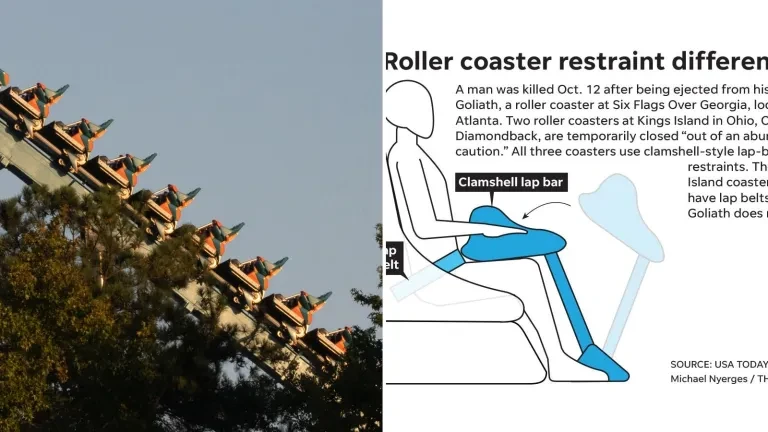
Just a better version of that second pic.

What’s the “deaths by km traveled” stat for this thing?
I’ve never understood how people like roller coasters like these. They’ve always felt loose and unsafe to me. The sliding and dangling in your seat makes me extremely uncomfortable.
Because it’s supposed to feel unsafe. That’s the thrill of roller coasters, isn’t it?