

https://piefed.social/post/2215171/comment/12141440#comment_12141626
Many late-coming technologies are issues of concept. Slow-sand filters are incredibly simple, for example, but require an understanding that did not arise until the 19th century (some possible examples in Mesoamerica excepted). Gliders are not actually particularly difficult to acquire the materials or tools to make, especially in cultures that use kites, but require, again, an understanding of the principles involved to provide controlled flight (with gliders requiring precise balance of lift and drag, whereas kites primarily need only light weight and wind stability). Fire pistons are conceptually advanced and were not discovered in Europe until long after they were in Southeast Asia, despite some Southeast Asian cultures which produced and used fire pistons being literal stone-age cultures, in terms of available material tools.
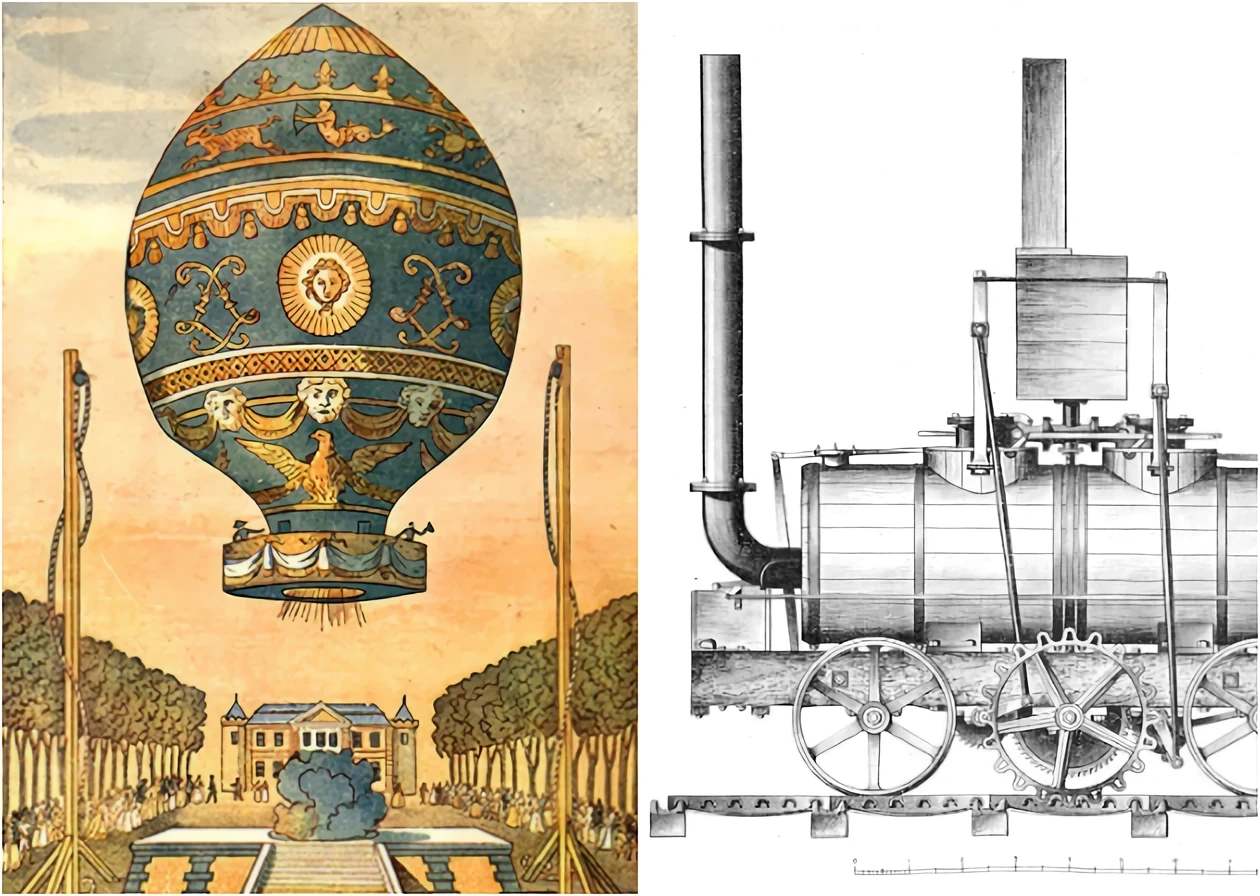
Hot-air balloons, I would imagine, follow the same principle. If you lack the concepts behind the invention, the only way to discover it is by accident, which is generally unlikely. It’s why so much material development is concentrated in the modern and early modern period - we started to piece together how the world, on a fundamental level, works, beyond pure trial-and-error.
Also, hot-air balloons before plastics were often made of silk (and rubber), since most other materials are either too heavy (at least for practical purposes) or too thermally sensitive, and that’s an expensive experiment to be undertaking if you haven’t the first clue how it works.
In my uninformed view I came to a different conclusion. Lack of technical development until recent history is more of a problem of materials science first and easily accessible/cheap energy second.
We classify ages of humanity by advances in material science. Prehistory is noting advances in humanity using ceramics as signs of advancement. “The Bronze Age” when humanity figured out that combining copper and tin produced a metal stronger than either alone. This lead to “The Iron age” where mining and refining metal produced even stronger tools and allowed humanity to access/create even stronger/lighter/cheapers materials. Refined Aluminum was more valuable that gold (I think) when it was first discovered and isolated.
Humanity advances with better materials unlocking yet more better material.
But the Bronze and Iron Age did not lead to one another. In fact, much of Subsaharan Africa lacks a Bronze Age entirely, precisely because they don’t lead to each other - the forms of furnaces (bloomeries) that spread in Subsaharan Africa were efficient enough to smelt iron from the start. Bronze is not needed to smelt iron - bronze or iron tools (though obviously you still need the iron itself) are not even needed to smelt high-quality steel, if you really know what you’re doing - all you would need are earthen furnaces, clay crucibles, coke (processable, if you know that it can be, in earthen kilns), and flux.
Theory does a lot of lifting that we often don’t appreciate.
First, I don’t claim to be a historian, but if you’re willing to indulge the exploration of the topic from my limited knowledge I’m game to do the same.
According to this link those first Subsaharan bloomeries were from the 6th or 7th century BC placing them well after the Bronze age from about 1000 years before. In this way it doesn’t look like they had the technological insight to skip the Bronze Age discoveries, they were just recipients of the technological advances from other parts of the world. Iron bloomeries were already in use elsewhere in the world over 1000 years before Subsaharan bloomeries.
I’m also not arguing that technology or technological development is evenly distributed across the whole of humanity. An example being ancient China was well versed in gunpowder hundreds of years before other areas and Europe was the recipient of this technology from China later.
No argument to that statement. I would argue that materials science is even more underappreciated.
Bronze Ages are regional; Subsaharan Africa lacked any such distinct Bronze Age in its history. Subsaharan Africa is suspected to have begun working iron and bronze effectively simultaneously in most areas, with some suggested dates as early as the 2nd millennium BCE, and a few outliers in the 3rd millennium. Furthermore, the design of bloomeries in Subsaharan Africa is largely autochthonous to the continent, without clear links to bloomery designs of North Africa or Eurasia.
The point is entirely that there were no “Bronze Age discoveries” other than bronze; the discovery of bronze defines the Bronze Age, and very few material technologies are linked to the usage of bronze, specifically. Iron has somewhat broader uses, but in most cases other metals can be substituted, in principle if not necessarily scale. The reason why so many cultures end up with a Bronze Age and an Iron Age is because bronze and iron are incredibly useful military metals, and if any of your neighbors have bronze or iron, you will learn from them very quickly, or else be very quickly conquered by their elites.
“Bronze Age” covers an incredibly wide variety of societies, as does “Iron Age” - the only unifying factor between such societies is the discovery of bronze or iron. In fact, of the two, I would regard “Bronze Age” as much more meaningful, as widespread use of bronze usually implies long-range trade routes, which in turn imply relatively robust state structures to ensure trade routes remain viable. “Iron Age” societies run the gamut from the incredibly urbanized and developed proto-industrial Roman Empire, to early nomadic Bantu tribes which rarely numbered above the low thousands.
Again, no technologies of the Bronze Age are necessary for the discovery or development of iron. If the first viable furnace in a region that is developed can reach temperatures above not just bronze, but also above the point needed to make iron bloom, there’s no need for any form of intermediate stage - and bloomeries do not require any metal tooling to be designed or constructed.
For that matter, China, for instance, is generally considered to have skipped bloomeries entirely.
Technology is not linear.
Materials science is the main thing most people consider when thinking about the conditions of the past, along with engineering/design, often to the exclusion of theory and organizational technology.
I wouldn’t even go that far. Having iron weaponry when your opponents have bronze is an advantage, yes … but I really doubt that it’s a decisive advantage. It’s not like a bronze-wielding army is suddenly going to become helpless against a foe with iron weapons. If the bronze-age army has better numbers, better tactics/strategy, and/or better motivation, they may very well defeat an iron-age enemy in battle.
Still, though, they definitely are going to notice the other guys’ iron weapons and figure out that iron is superior. And at that point, they’re going to be highly motivated to find out how to make some of their own. So even if the bronze-age side wins, they will probably be adopting iron very soon afterward.
A few times, sure, but on a historical scale, it’s a ticking time bomb. One of the advantages of iron, other than being significantly superior for usage in edged weapons (armor is a mixed case), is that it is much more plentiful and cheap, and doesn’t require distant supply lines to be maintained in war time in most cases.
“Their swords are better than our swords” is bad, but not necessarily spelling doom. “Their swords are better than our swords and they can make 5x as many for the same time and cost, and they aren’t reliant on their trade ships not being pirated or sunk by storms to continue making them” is a bit dire.
It may be worth pointing out that the metal ages are used primarily for old world archaeology. The Americas utilize a different system that isn’t so bound to metallurgical ages.
Lithic > Ancient > Formative > Classic > Post-Classic
Each era is about mlre than material sciences, and specifically metallurgical ones, of the old world. (But let’s be clear, the Bronze age is so, so much more than bronzeworking. Sometimes that gets lost in the nomenclature.)
Arguably one could apply the american measurements similarly to old world history too, since these are all approximations for coherent discourse.
In the 1800s you suddenly had a middle class where farmers, small business owners, and local artisans had access to a wide variety of tools and books, things their ancestors could have never afforded.
I mean… yeaahhh?