
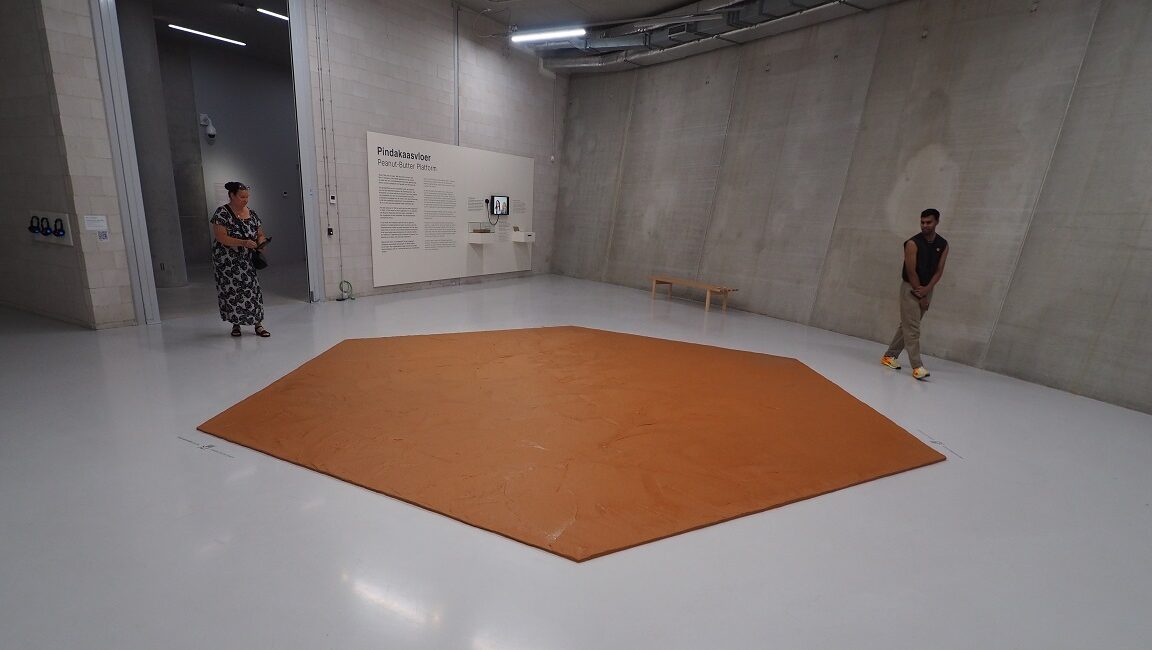
Visitors have already stepped on the infamous peanut butter floor, less than a week after it opened in Rotterdam.
The Depot of Museum Boijmans Van Beuningen said that at least one person had walked on the exhibit, and another had dropped their phone into the peanut butter while attempting to take a photo.
A real test for service dogs
Lmfao 😂🤣
It seems as if the artist to whose honour it was installed, the late Wim T. Schippers, might not have been mad about it, though 😉
“Schippers was known for his silly and absurdist artworks,…”
Maybe he would regard accidentally stepping inside as of the concept, or at least a contribution 😄 who knows
Giggling to himself the whole time he was putting it down.
Yes, this is why I think it’s humorous. I would have liked to meet that artist, I think.
How common is peanut butter as a food outside the US? I feel like the US loves the stuff. PB&J, fluffer nutters, flavored peanut butter, etc.
In Switzerland it’s pretty popular. I’d say the #4 most popular thing to smear onto bread, after butter, Nutella and jam.
Edit: though I guess it’s not readily used for many other things here.
Just imagine that the exhibition just started. Many more opportunities for exhibitions of human stupidity.
They spread 390kg of a premium pinderkaas (peanut butter) over 20 square meters.
I hope they have some kind of cooling, and a good air filtering. The last time they set this exhibit up somewhere (luckily they use new pinderkaas every time!), people with peanut allergies got issues even outside the museum.
people with peanut allergies got issues even outside the museum.
Airborne peanut allergy is not a thing though. It’s an urban myth debunked by recent studies.
get out of here with your science. we all know that the only truth is a delusional mothers fear for her child dying because someone opened a packet of peanuts 50ft away on the playground.
That was just what the newspaper wrote this week. How this happened, I don’t know.
Don’t spread dangerous misinformation that is going to get someone killed.
Airborne allergens are a thing and always have been, and specifically peanut allergy challenges and studies have held up that smelling peanuts can indeed cause an allergic reaction.
Simonte’s research is dogshit (who the fuck considers 30 a sample size?) Later research has indeed shown that airborne can cause reactions, the only difference is intensity, which comes down to HOW allergic you are, which has no upper limit.
Source? Because the medical professionals say otherwise.
There’s a lot of misinformation from dipshit allergists that don’t understand that ‘less risk’ for ‘the average peanut-allergic person’ does not mean ‘no risk’ for ‘all peanut allergic people.’
That article is incredibly bad, and it’s citing research that is either bad or misinterpreted.
Simonte, as I said, was a dogshit study with a minuscule sample size of only 29 people, it is in no way a ‘landmark’ study, it’s directly fucking killed people. To put into perspective how goddamn bad the study was, they claimed ‘highly allergic’ subjects were tested, and those subjects additionally had peanut butter smeared on their arms. Most did not react, meaning they very much were not very allergic in the first place and would have never reacted to the airborne allergens in the first place. Several did react (minimally) to skin contact with the allergen.
Simonte’s conclusion DESPITE SEEING REACTIONS was that ‘casual contact cannot cause allergic reactions’ which is ABSOLUTE FUCKING NONSENSE. Contact-based reactions are VERY well established. His entire study is completely worthless. He tested an incredibly small sample of minimally allergic, and even non-allergic, people to specific aras of allegen that don’t go airborne well. I will give some credit- we didn’t know at the time that those specific aras didn’t go airborne well. To his discredit, we DID know there are more aras.
Perry’s test was useful research re: cleaning, but the airborne section wasn’t particularly useful because it only focused on testing for ara 1, 2, and 3, which are the heaviest aras. They fall from the air quickly, this is known. You can be allergic to aras 1-9 (and some cross reactivity stuff I won’t go into). A lot of allergist researchers ONLY focus on ara 1 and 2, and occasionally 3, because ‘most’ people with allergies are allergic to those. You want to know how many peanut allergic adults can be identified solely through those? Only a third. (Kansen et al, 2020) And yet you still see stupid shit like Hemming’s dumbass research that saying that ara 2 is the only thing you need to check.
Case in point, they immediately quote Jin et al, 2016, which ONLY LOOKS AT ARA 2. Meaning it’s useful for fuck all in regards to actual allergic reactions from 70% of the population that’s allergic.
tl;dr: You typically end up exposed to less of an allergen in a airborne situation. This is true. You end up exposed to less types of allergen in an airborne situation, this is also true. This does NOT mean that you cannot have a reaction to airborne allergens, or that peanut allergens cannot get airborne. It just means that it is RARER. And indeed, there are documented cases of people reacting to airborne allergens (even ones that they are not aware of, since you can indeed make yourself have the symptoms of an allergic reaction to nothing if you think you SHOULD be having a reaction).
EDIT: I should note- if you actually look at the underlying studies that the article is quoting, most of them are reasonably legit and say up front what they are/are not testing, e.g. Perry’s. I’m not saying the research is bad (except for Simonte’s PoS), it’s the article that’s taking VERY SPECIFIC research and generalizing it across all allergens, which just simply not how allergies work.
EDIT2: I just realized the article literally cites Sicherer et al, and claims it says the opposite of what it does. What the fuck?
Your source did not show/prove that “Airborne peanut allergy is not a thing”. It just shows that peanut being airborne is unlikely. Not sure how good is Semonte’s study, I will read the paper and report back.
It is obviously impossible to prove a negative in science. But the evidence is good enough that the experts say it’s not a thing.
Experts do say it’s a thing, there are just unfortunately bad articles drawing conclusions from a single bad research paper, and being misinterpreted from other papers because the article writers don’t understand what ara 2 means.
You keep saying that, you want to link an authoritative source? Because I would think a bunch of allergists and immunologists know what they’re talking about.
a single bad research paper,
That has apparently been reproduced many times according to the source I gave
imagine the smell
Mmm, peanutty…
Last time they set it up, people with peanut allergies got issues even outside the museum.
Supposedly not possible according to studies
Stop posting this, please. it’s not true. Airborne reactions can and do happen.