

Hi, I’m working on a page for the /c/writing worldbuilding resource wiki on “High Context Living” and I’m hoping some of you might have good examples/stories!
My working definition at the moment is “the sort of custom, DIY systems favored by offgrid homesteaders and people without other options, which trade user-facing complexity and unique quirks/challenges for significant efficiency and lower cost in parts and materials.”
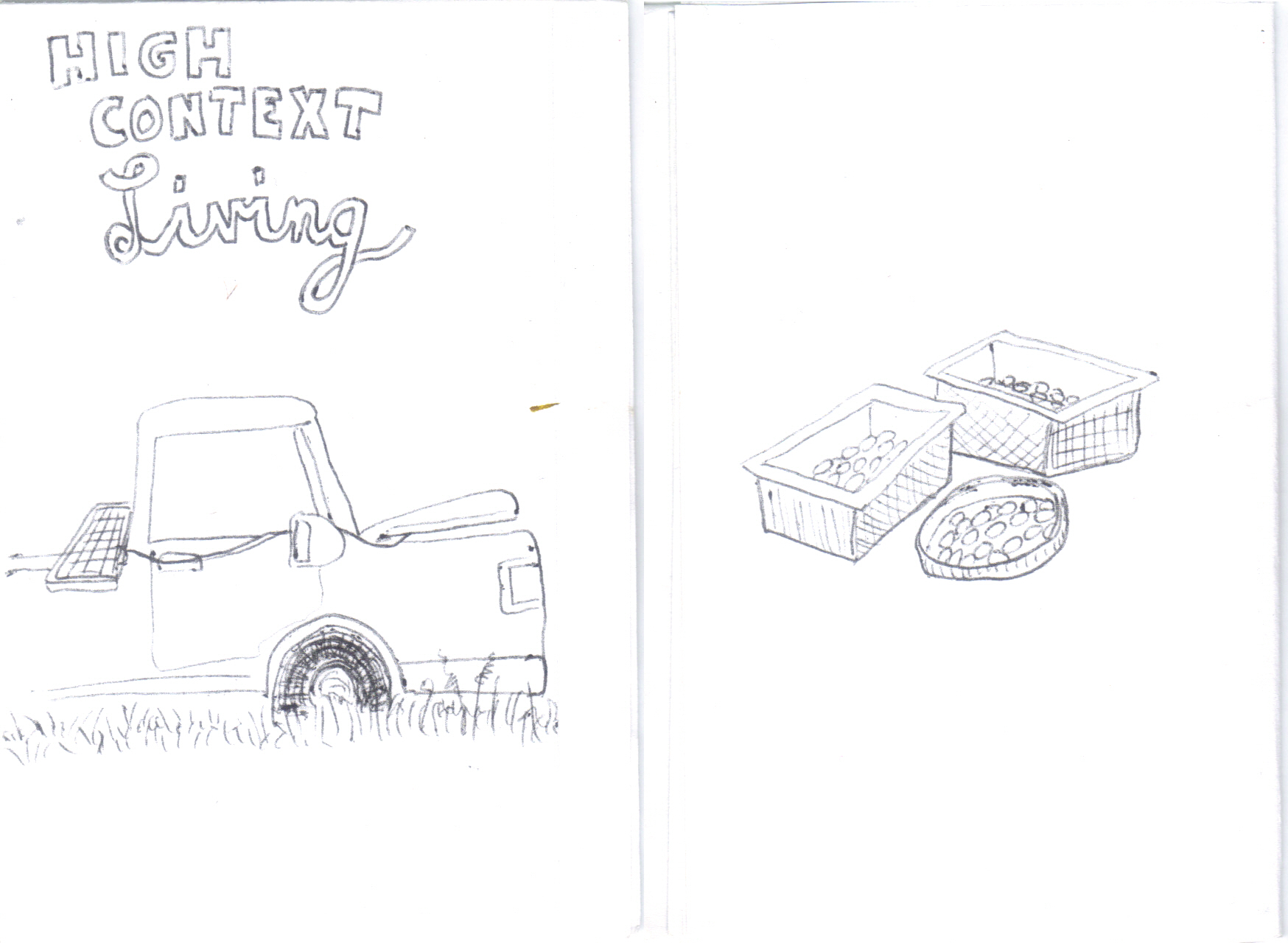
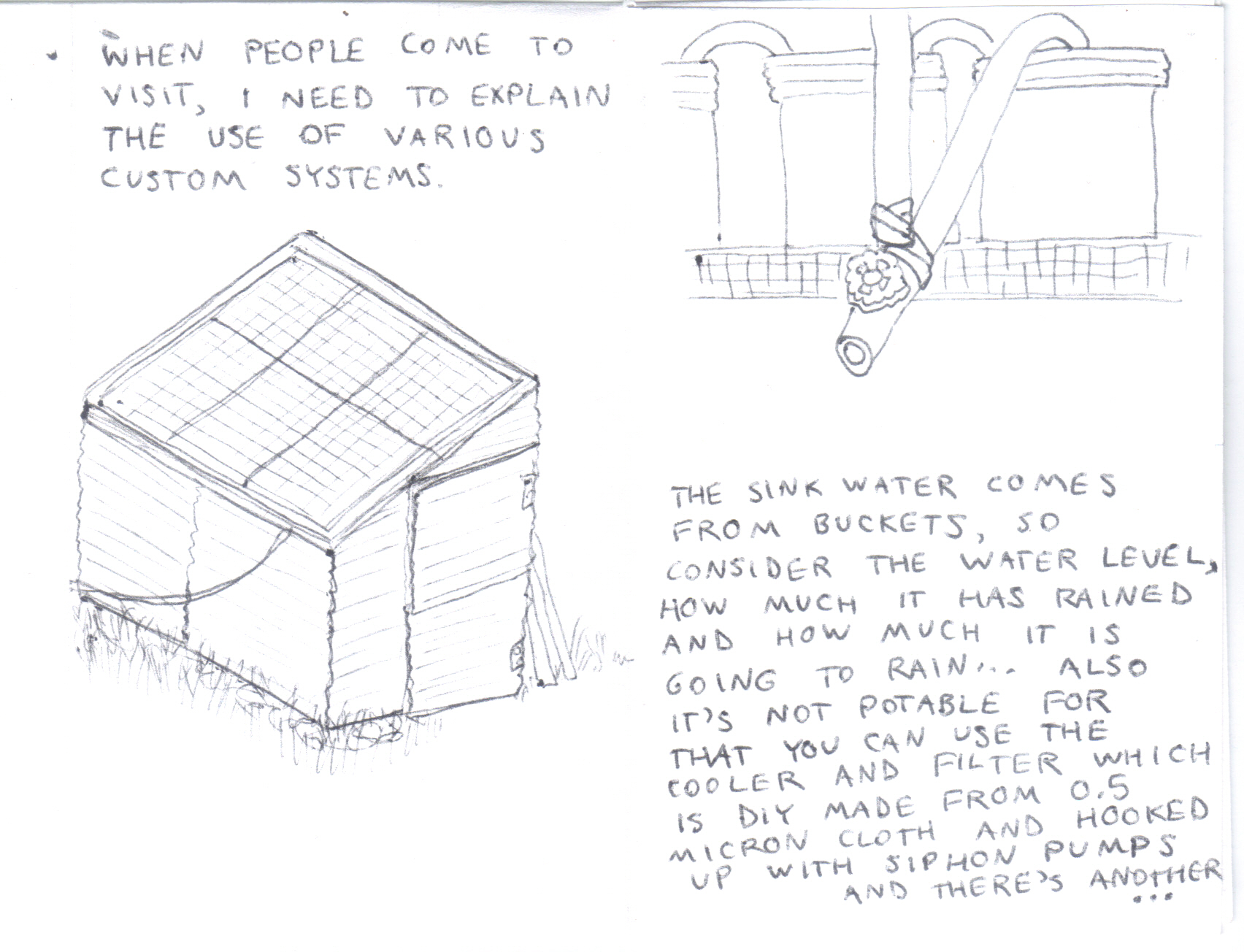
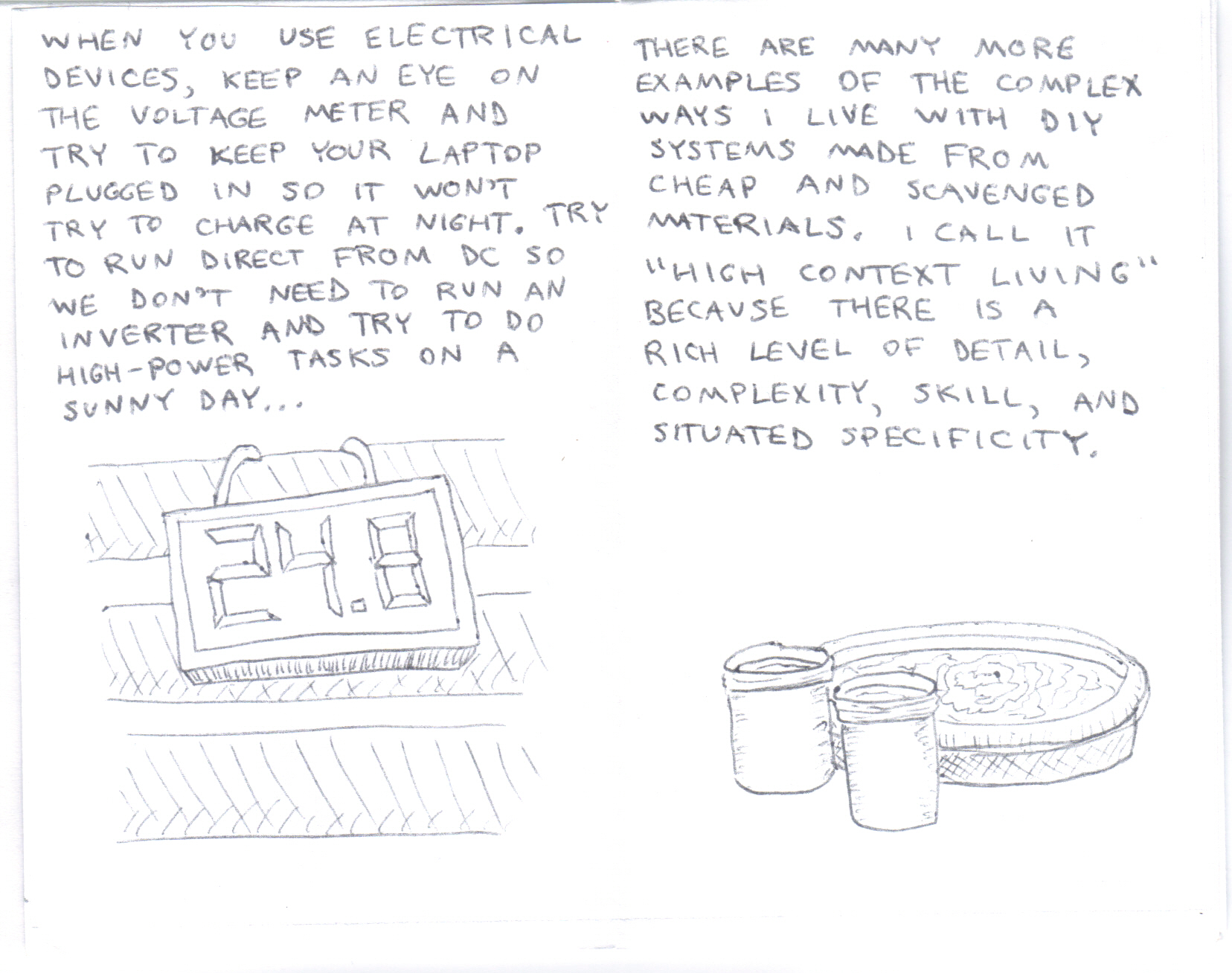
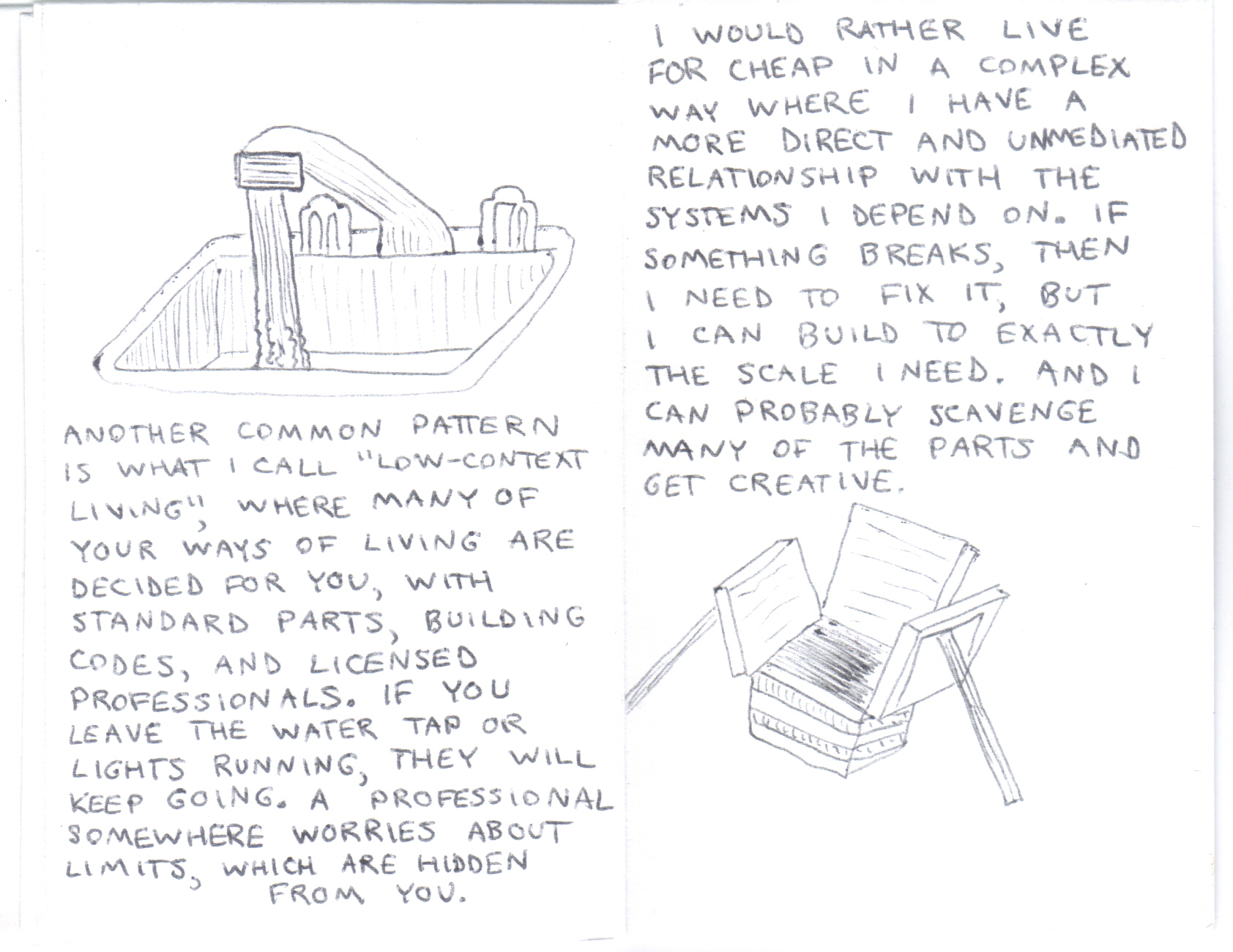
It’s probably easier just to share the zine that named the concept (included below with permission of the creator (who wished to remain anonymous)).
Very, very low tech, but maybe interesting info dump from the bog creature’s farm life:
Water for my garden comes through a gravity system from a smallish reservoir that refills from a permanent water source, but the source slows to a trickle in summer and so the water level is going down gradually now. I have to coordinate planting and watering to not only have sufficient water for the next day, but also throughout the whole summer. Also, if I ever left the garden tap on and the reservoir runs dry I’d have to wait months for it to refill again. To know how much water the plants need and how much I can take out of the reservoir takes a lot of experience (which I don’t have, wish me luck).
Water in my house comes from a well (same problem as the water source, limited supply in summer), and the house has a water toilet with a leaking mechanism (I know, I should either repair the damn thing or switch to a compost toilet, haven’t had the time). So far the solution is to keep the tap of the water tank of the toilet closed and just turn it on to flush twice a day. If a guest found my unflushed toilet they might think I’m a filthy bog creature, and they are not wrong!
My AC is a system of curtains, blinds and windows which I open and close or even soak for evaporation cooling at certain times of the day - if I get it wrong my rooms overheat and I have to go hide in the cellar during the hot hours. I still want to add a 5l bottle on top so the curtains soak gradually during the day - that would be my automatic AC then, yay! If I had to explain to an AC junkie how to work this system it would be a challenge.
I actually like it when my half broken and fragile system slows me down and forces me to be mindful and respect the passing of the seasons, because that is what I’m after in my life. If unlimited water just came out of a tap I’d spend it without thinking. Same with electricity everywhere. I’m on the grid now but lived here on 1 solar panel and a car battery in winter and it made me painfully aware about my energy use. Switching on the light without having to count Ah still feels like xmas and also slightly frivolous!).
Seasonal living used to be way more common, we just lost this in the factory age and following the clock has become very normalized. Harsh new climate quirks force people to either tech up or return to systems that honor the seasonal differences (or a bit of both). By adjusting yearly, monthly, weekly and daily schedules to outside temperature, water availability, sunlight availability, etc., life becomes less resource-intensive. Most of my home systems and ‘life-research’ have to do with this topic, about re-discovering how to fit into external conditions gracefully with a smallish footprint.
Lately I have been tending towards dropping more complicated tech in favour of really basic solutions. For example, I once built a stupidly complex solar cooker with tracking system and motors. These days I’d just paint a pot black and leave it in the sun all day next to a couple of mirrors leaning against a few rocks. Because with resources, money and time running short nobody needs to fiddle around with a sun tracking system.
This is exactly the sort of stuff I’m looking for, thank you! I think when these systems are coupled with lower expectations they can be way more efficient than the infrastructure defaults - that’s something I might have to work into the definition if I can back it up
I also suspect they are way more efficient. Whenever I make these comparisons about how I would have made things a few years ago (during my EE bachelors years and brief high tech insanity phase) I realize how I save time for the things I really enjoy: sit under a tree, watch my live stream and the duckies floating on it, listen to the wind in the leaves. But I also save money, energy and materials. For at least some measurable difference: I think I managed to not visit the shops for over two weeks - because for every problem I encounter I try to find a way to solve it with what I have around here. I don’t spend the fuel and I don’t buy all the stuff I used to. At the moment I mostly use trash and leftover materials from around the farm. I rebuild, recover, reuse what I can.
Here’s some random thoughts about building materials and building, since I have been hopping around other people’s building sites and my own quite a bit throughout my life:
I look into how to use the naturally available stuff - stones, sticks, clay, plants … even nicer to work with than trash, but a bit of a learning curve for the average urban-grown person. So I have to compromise of course. I did buy wire mesh for the chicken house, for example, because I don’t trust my ability to combine the natural materials so that weasel and mongoose stay out. I am learning to build stone walls by simply playing around with the damaged walls next to my place. It’s a useful skill in a place full of stones. What is a useful skill to learn depends on where you live.
When I first started building I used bricks, cement, concrete, metal. These are not people-friendly materials, they are materials of the empire. A lot of energy goes into their production and usually they arrive from far. When you use them your skin hurts, your back hurts, your lungs hurt … Most modern building sites are sick - building in the wrong places without respect for the place and its former inhabitants, using harmful materials and creating a harmful work environment. And a bit of a feminist view? Did you know there are so many man-sized tools, bags, devices, ladders, helmets on a mainstream building site? Men come home from these places broken, needing repair from ‘their’ women. We should rethink this way of nest-building and make it a little softer.
To find people-friendly ways of building you have to rethink smaller. Or think modular - a good house is one that can grow with its community. Studying traditional ways of building in different regions can help determine what makes ecological sense where.
A good one is 100 rabbits, which is a couple working on low tech games living on a sail boat.
https://100r.co/site/knowledge.html
Oh and you know the early retirement movement. Turns out one of the pioneers of what is now a hardcore capitalist idea did it, because he believes in peak oil and the need to reduce energy consumption. His blog is really interesting, as he took saving to another level, by living in a trailer with a lot of hacks.
https://earlyretirementextreme.com/
Another one would be Tyler Disney living in hut in the desert:
LowTechMagazine has a lot of this sort of stuff:
That describes my life living on a sailboat full time pretty well haha
I love my systems. It’s like I have my own spaceship that is built in a way that sustains me well but it easily becomes unsustainable once you have someone join you unless they know all the intricacies.
Even things like keeping an eye on the forecast and switching to my propane stove instead of the induction ome because I won’t be generating much power from few rainy days.
It’s definitely something for people that actively love the significant challenges it brings.
Feel free to ask any followup questions!
I’m not sure I even know where to begin but I’d love to hear about any of the warnings you have to give people when they’re staying with you!
Well, if you want to use the bidet you must first set the water saving aerator on the sink faucet to “mist” then turn the handle to a medium temp setting before then using the bidet controls. (Bidet is connected through the cold line of the sink faucet). And then There’s the whole composting toilet talk and instructions lol
The obvious “save water as if it was gold” cause I have 200L in tanks and running the desalination unit uses a loooot of power. (I.e. power expensive)
The zine does cover power things pretty well tbh. Essentially, converting energy between states is wasteful. You have losses from solar into the batteries then out of the battery to 12V and then again from 12v to 120v so taking all that into consideration is always happening in my brain.
Also, pointing out what items are structural and can be used as handles and what would break if leaned on.
If you can’t puke outside, please puke in the kitchen or bathroom sinks.
There’s probably a lot more that I’m not thinking about.
Good point on the structural items, something I don’t even think about in my self-built environment!
Well, a simple and common example is a solar-thermal water heater where you need to tell people visiting to only take showers in the evening and preferably on sunny days.
For extra complexity I plumbed a heat exchanger from a wood stove to the solar powered electric water heater too!
That sounds like a fairly elaborate rig! I don’t want to pry into your location but what kind of seasons/temperatures were you dealing with and did you have to do anything to keep from overheating the water lines? Could you connect and disconnect the stove?
Halifax or Toronto mostly during my winters. So down to - 25°c a few times but the average is more around - 10 or so.
To prevent overheating I was constantly pumping water through the coil that was got imbedded in cement. Heat loss once you reach shower water temps was enough to regulate it even if the stove was cooking all day. I can also remove the coil assembly from the stove during maintenance.
I also have a diesel heater and a few electric ones too since I’m usually at a de-iced dock when the water freezes but most of my heating is done using compressed pine bricks that is made with the waste from a nearby moulding company.