- cross-posted to:
- latestagecapitalism
- cross-posted to:
- latestagecapitalism
You must log in or register to comment.
Capitalism
I think nearly all western nations have similar problems, so it’s not solely a US thing? I see people talking about affordability in Toronto, London, and New Zealand at least. I recently saw a video of a Chinese software engineer living in a makeshift shack on the roof of a building and still needing to do food delivery on a hacked ebike to make ends meet, so it may not be only a western thing either.
I would guess it’s a multitude of issues causing it. Wealth disparity and the ballooned financial sector is probably the largest contributor. Resources (lumber, fossil fuels, etc) getting more expensive to extract and transport probably plays some role. Stricter building and sanitation codes, zoning, and communities fighting low income housing being built probably does too.
i think that lots of things broke.
- one issue is that living expenses didn’t rise, but wages fell. this creates the same net effect to the average person, but it’s structurally different. due to ongoing automation (which has actually started since 1900) wages have gone down continuously (in real terms, but not nominally because inflation outpaced that decline). meanwhile, for some expenses such as housing, the real prices have not gone down as quickly, therefore we see a net increase of the ratio of housing prices to wages.
- another issue seems to me that the american public (and unfortunately also large parts of the european public) have been convinced that they need “more” - that they need bigger houses, cars, etc.
the consequence is that new houses are bigger, and therefore more expensive.
there’s also other issues that are sometimes being quoted, such as: housing being seen as a commodity, housing being held by a few big house-owners. but i’m not convinced that that alone could cause prices to skyrocket.
if there’s a whole lot of developers trying to gain from housing economy, then there would be more houses being built until there’s more housing supply than demand, then prices would go down again until they stabilize somewhere. but that doesn’t seem to be what’s happening.
sometimes, the city and community are called responsible for keeping land area expensive (by not making more land area available to be built on). this probably varies geographically, and i find it quite hard to believe that communities around the (western) world would not have realized this one simple trick to make houses more affordable again. so i guess there’s more to it.
deleted by creator
The 1974 Tax Code re-write, that baked Trickle Down Economics into our tax code, created the Oligarch class, giving them the disposable income to manipulate political policy to their further benefit.
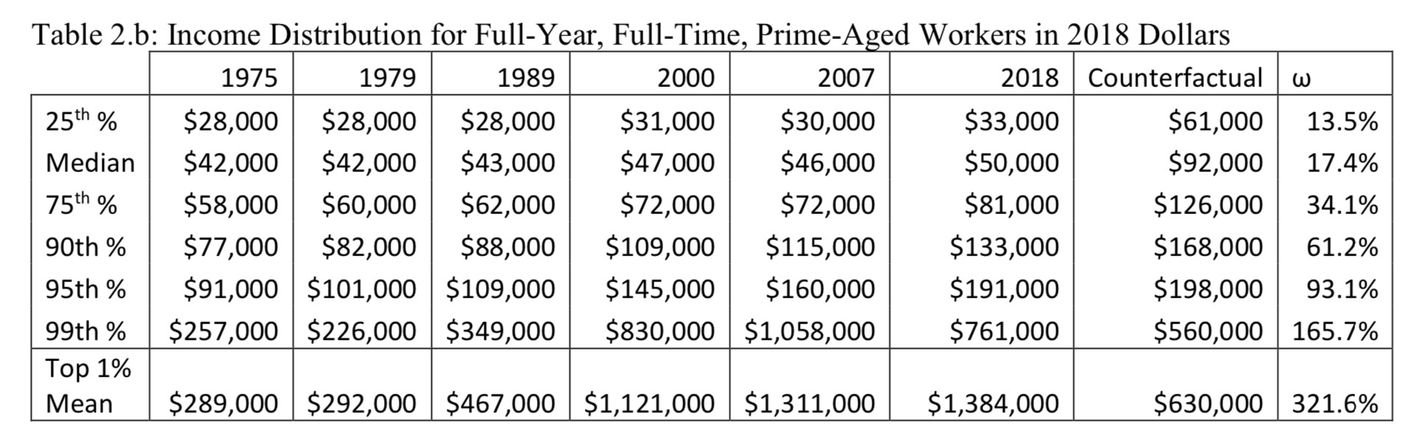
The Rand Corp issued a report on income inequality, and the situation is far worse than most people think.
The median salary of $43K in 1975 has increased to only $50K today, while they would have been making $92K if the tax code hadn’t been steadily re-written to enrich the wealthy at the cost of the middle class and poor.
In that same time period, the mean income for the top 1% went from $289K to $1.384 million, while they would have been making $630K under the old tax codes.
Thats a 17.4% increase in the lower median, and an increase of 321.6% in the 1% median. Clearly there has been an upwards distribution of wealth at the expense of the middle class since the tax codes started to be re-written in 1974 to favor the top economic tier.
Read more about it :
New York Mag: http://nymag.com/intelligencer/amp/2020/09/rand-study-how-high-is-inequality-us.html
Fast Money: https://www.fastcompany.com/90550015/we-were-shocked-rand-study-uncovers-massive-income-shift-to-the-top-1
Yes our earning power is trash compared to the 70s, and I think there are more reasons for that than what you stated. But your answer didn’t really address why homes specifically have dramatically outpaced the general rate of inflation.
Probably because land is one of the best non-fungible assets around. You buy land and you have something whose upper limit on price is only limited by what someone else wants to build on it. And premium space around existing economic centers (cities) doesn’t just spring up.
Why use nearly decade old data though?
That article is 6 years old, and uses data through 2018.
Median household income today is $83k.
And that’s adjusted for ”productivity”. Not exactly a concrete metric.
What broke is they allowed housing to be a commodity allowing speculators to bid on.
Yep. With the repeal of Glass-Steagal, the commercial banks used for things like mortgages, checking accounts, and car loans were able to merge with investment banks. The Act was out into place in 1933 because having retail banks mixed with investment banks was why Black Tuesday lead to the Great Depression.
That allowed houses and mortgages to be combined into investment packages for the speculators, and lead to prices skyrocketing.
It’s what caused the 2008 crash, and in all the aftermath of that, nothing was actually done to fix the issue. The fix was simple - re-divorce them and reinstate Glass Steagall.
Nothing broke.
This is capitalism working as intended.
So did you fix it?
Every home must serve as a primary residence at least 183 days out of the year + single family structures cannot be used for profit
Edit: could also throw in some “single family homes can only be sold at cost or less for X years after acquisition” with X being 1-5 years as a mechanism to control market outside of interest rates only
Houses should be investments… in the same sense that a good, durable pair of shoes is an investment.
In a well designed system, the value of property should stay pretty flat over time, and the value of a structure built on that property should slowly go down over time as wear and tear sets in.
It’s ridiculous that it makes sense to buy more home than you need, and to hold onto a house longer than you need it because it’s one of the best and safest money-earning investments you can make. It’s especially annoying as someone in a position to make that investment gets to live inside their investment and enjoy it even as it appreciates in value.
Nothing else works that way. Can you imagine if you bought a classic car and drove it on the road as a daily driver and it went up in value? Or, if you bought a rare Magic the Gathering card, used it in your regular deck, and somehow it only became more valuable?
I’m mean, once you’re comfortable with a monthly payment why would you leave if the house suits your needs? Or payoff the asset and not have a payment. The being, you shouldn’t think of housing as something that depreciates over time, it’s not a car, you can fix it up, you can repair it to make it last 30 more years. Cars not always
I’m mean, once you’re comfortable with a monthly payment why would you leave if the house suits your needs?
You could say the same about a pair of shoes. If they’re in good shape, why not keep using them as long as they still suit your needs? If you get a good pair of leather shoes they can last decades needing only the occasional repair.
The difference is that you wouldn’t expect your shoes to go up in value every year even while you’re wearing them.
The reason why it matters is that someone with a good job can’t afford a house anymore, and shelter is right there at the bottom of Maslow’s Hierarchy of Needs.
I’m mean all the examples I’ve seen have very limited life spans, houses can last hundreds of years. It’s apples and oranges
That’s not the reason it’s apples and oranges.
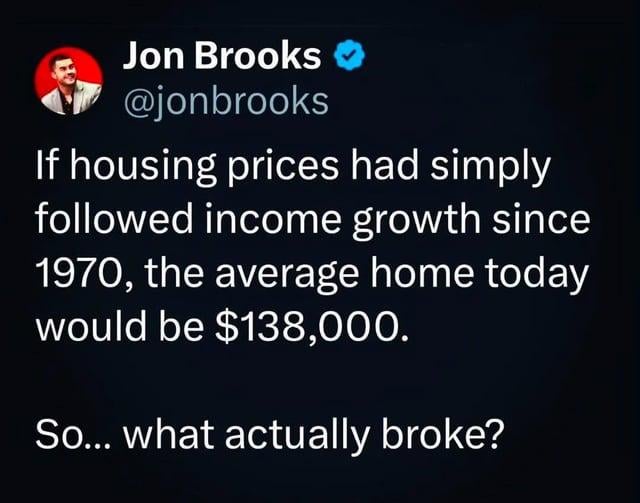
What actually broke?
People figured out they could buy more than one house and rent it to other people, paired with a housing shortage partially due to people/companies owning all the houses, paired with technology to allow you to rent your houses out for a few days here and there to make income.
We allowed house ownership to become entangled with entrepreneurship.
that’s not broken though. this is how capitalism works at a temporal scale. we were marketed to and sold lies. on purpose. by monsters who have spent centuries making us think we can achieve a “dream.”
Gotta be asleep to dream!
…and it screwed EVERYTHING up;
-
People can’t afford kids because the rents are too high,
-
Rents too high for cool spaces to hangout in, so everybody’s at home and miserable.
-
Rents too high for a cheap restaurant to open, so everybody’s mad and pointing fingers,
-
Can’t find daycare, because it’s too expense for the daycare to rent a commercial property,
-
Even before that there was a boom in people using houses as an investment opportunity instead of just a place for people to live. Land ownership became the get rich quick opportunity that people who don’t play the stock market could put their money into. Then the people who do play the stock market got into it.
Nothing broke - the capitalist system is working exactly as designed. We’re just not the tiny sliver of the populace that benefits from it.
E-corps playing games with housing.
Also in 1971, the Powell memorandum was written and submitted to the Chamber of Commerce.
It’s the end of the monopoly game
Someone should get mad and flip the board and say fuck this shit
I think Luigi did that
He should do it again. Or at least his brother, Mario, since Luigi is a bit tied up at the moment.
It needs to be be collectively accomplished
Sounds like a job for smash bros
Smash Bros. would be a fire name for a revolutionary movement
If it ever happens we’ll know that we started it all right here. Feels good to be part of history.
Private businesses being allowed to buy up the market to artificially increase prices and scarcity. How else can you ensure real estate is a solid investment stream?
I think that’s part of it, but a larger part–having been a local reporter–is that government is run by people trying to keep property values high. In cities, that’s real estate developers and landlords. In suburbs, it’s typical homeowners.
Most construction brings down property values: increase supply=lower demmand=lower prices. There is therefore a strong political will to oppose ALL new construction.
The second concern is: how do we keep poor people out? Things like minimal lot sizes are designed to keep the prices up and limit the amount of new citizens.
The third concern is: how can we spend the most of our money on OUR children’s education. Many suburbs are spiritually and economically designed to do ONE thing: get kids into good colleges. That means high property valuations across the board so the most money can go to individual children’s education. There are very many suburbs people don’t even move to UNLESS they’re having children, and they move out when their kids leave school.
If you build an affordable apartment building in one of these suburbs and children start moving in, what happens? THe money from the rich houses is now diverted away from the rich children and towards the poor children, who are now paying much less in taxes. With schools less valuable, the property value of ALL the houses go down. “We’re all in this together,” the rich people realize, refering only to themselves, of course.
I do like the oligopoly narrative, but we have to face that we are facing MASSIVE FAILURES on a social and political levels. Everybody is scrapping for themselves and building walls and pulling up ladders and basically being as self-interested me-and-mine as possible, at the same time money is becoming the dominant form of political activity with which the masses of regular people can not compete.
Don’t worry, with birth rates dropping like a rock we’ll have plenty of extra houses in a couple generations, assuming humanity can make it that far.
Doubt it. There are plenty of empty houses right now.
Right now, the folks keeping an empty unit for speculation can afford to keep it empty.
When the less wealthy investors who need to pay a mortgage for their micro-estate empire of 3 units realize the demand is fading, they’ll be forced into lowering rental cost and maybe even selling.
China has seen a ginormous housing value appreciation over decades. The population is shrinking and the correction is happening. It is brutal.
Well no, they’ll sell to cut their losses. To people richer than them.
No, we’ll destroy houses for freeways and data centers. There won’t be extra supply.
Or they’ll be bought up and turned into rentals. Student houses, Airbnb, etc.
The other factor with much of our development is that it requires an automobile, automobiles that are consistently getting more expensive to buy and repair. We’ve really fucked up.
They realized someday people pay off mortgages. No one’s ever paid so much in rent that they stopped having to pay.
And these cancerous parasites are doing it to everything possible, sucking the goodness and value out of the entire planet and life itself, because their greed is a terminal mental illness.
Unfortunately it isn’t terminal.
Good luck curing it before it kills us all :(
This is nonsense. Corporations own 10% of housing. There is pressure but it’s not a primary driver people need to stop parroting this
Homes are treated as speculation and investments. NIMBY ism abound when it comes to density. Expensive labor for new home construction.
These are the primary drivers.
Dude, so much of our area has turned into corporate rentals for when they host guests, or rent them out when not needed for business personnel.
The house close to my parents went for almost 40k over asking last year, so not even in a heated market.
There’s probably another 10% owned by individual landlords with 3+ properties as well. It’s driving prices far more than you think. I’m my town something like 37% of single family homes are rental properties, if you don’t think that’s causing insane inflation of house prices in my area you’re crazy.
The biggest issue is lack of construction. We’re building fewer units now than we were in the 1960s, despite having double the population today.
Really basic 100m2 house is 450.000€ here. No basement no lot. Construction is stupid expensive since ukraine war started. Add to this, everytime there’s a sale several people demand processing fees in % of the value including state… This drives prices only up.
Doesnt help that china built their economy on real estate in the last decades, consuming lots of the raw materials. Also ever stricter regulations like insulation, heating, electricity is a point.
Companies buying homes shouldnt exist but we are at 650-750k for a 4 person home with barely any lot without that already.