
Every “e” in “Mercedes” is pronounced differently.
An Austrian dude named the Mercedes line of cars after his daughter Mercédès Adrienne Ramona Manuela Jellinek. He got the name from Spanish, and in Spanish all the "e"s are pronounced the same
Except for the ones with accent marks on them…
Well, in Spanish none of the "e"s in “Mercedes” have an accent mark in them, and in Spanish the accent mark only flags the tonic syllable, it doesn’t change the pronunciation.
So no.
That’s how you spell that name in French, though. And yes, you do say all those the same there, too.
I’d say they sound slightly different in French, the middle e is a bit lower than the other two.
Except that the name written in Spanish does not have any accent markings, and even if it did, it would not change the pronunciation of the letter. Accent markings over vowels in Spanish simply denote syllable stress.
Those are French accent marks… which only confuses me more🤔
Then I guess I don’t pronounce it correctly at all.
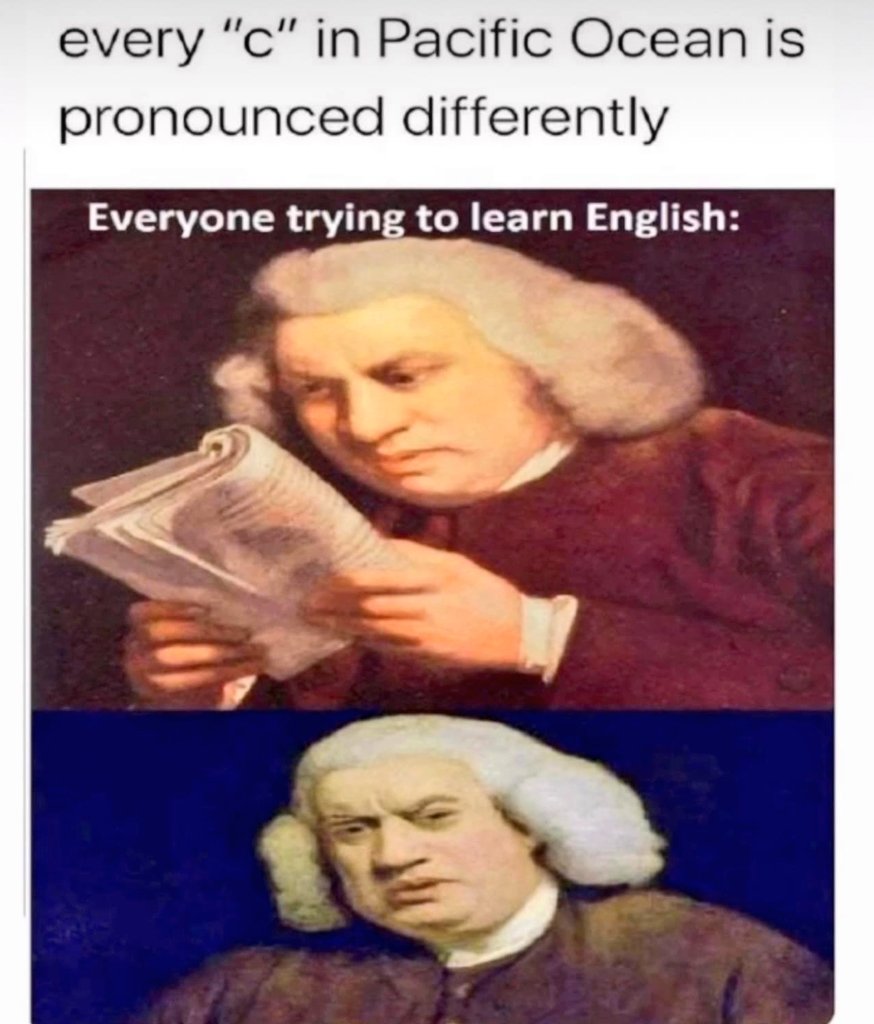
Dr. Johnson (the dude in the meme) actually wrote a great preface to his dictionary. It is about how to think about language and how to write a book describing language.
Great read.
That’s fascinating and surprisingly appropriate for this meme.
The bottom picture is also just in his favorite restaurant in London. I was kinda surprised when I came across it.

Truly a man worthy of one’s most enthusiastic contrafibularities.
People like you are the bright side of internet.
A rough-coated, dough-faced ploughman strode, coughing and hiccoughing, thoughtfully through the streets of Loughborough.
Trying to learn “i before e”
True, but the full saying is, “I before E, except after C or when sounded as A as in neighbour and weigh. And weird is just weird.” There are still some exceptions to this rule though but most of the time, it’ll work.
There’s also a version that was taught to some people that goes like, “I before E, except after C, for words sounding like E” which worked most of the time too back when that saying was made (since we use more words of Greek origin now that break this rule).
Not mine, but gets the point across:
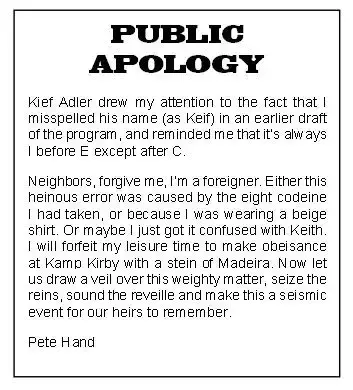
And yes, English is an endlessly exhaustive exercise in eloquence and execution.
Actually, that “full version” is still more wrong than it is right. For example: fancier, species, their, heist, foreign, vein, seize, science, Raleigh, Keith, Neil, either and neither, leisure, deity, atheism (ironic), reignite, albeit.
How to reset an entire language
deleted by creator
It’s like you transformed into K. Rool there for a sec.
Currently going through this with my six year old. It’s really hard to help her learn to read without just doing it for her over and over because pronunciation is shit. She can’t just sound it out when the same letter sounds three different ways.
I learned English by watching shows first in Danish(my tongue) then in English, and was forced to use English in games, this was the way I learned it.
They tried in school but the way teacher’s used to teach English just didn’t made sense fore many of us.
Actually it’s pronounced “specific”.
LMCO
Laughing My Coccyx Off
That’s because we’re not sounding out the c on its own
You guys pronounce?
Pakific othan
Do a lot of people not pronounce the L in calm?
Whoever wrote it was probably from Boston.
most don’t release it. It’s usually a slightly rounding/coloring of the vowel, but most accents don’t say “callum” / “callam” / “callem”
Really grasping at straws with Q and V there.
a whole bunch of non-english words
ok buddy
But… it’s only one of the "C"s…