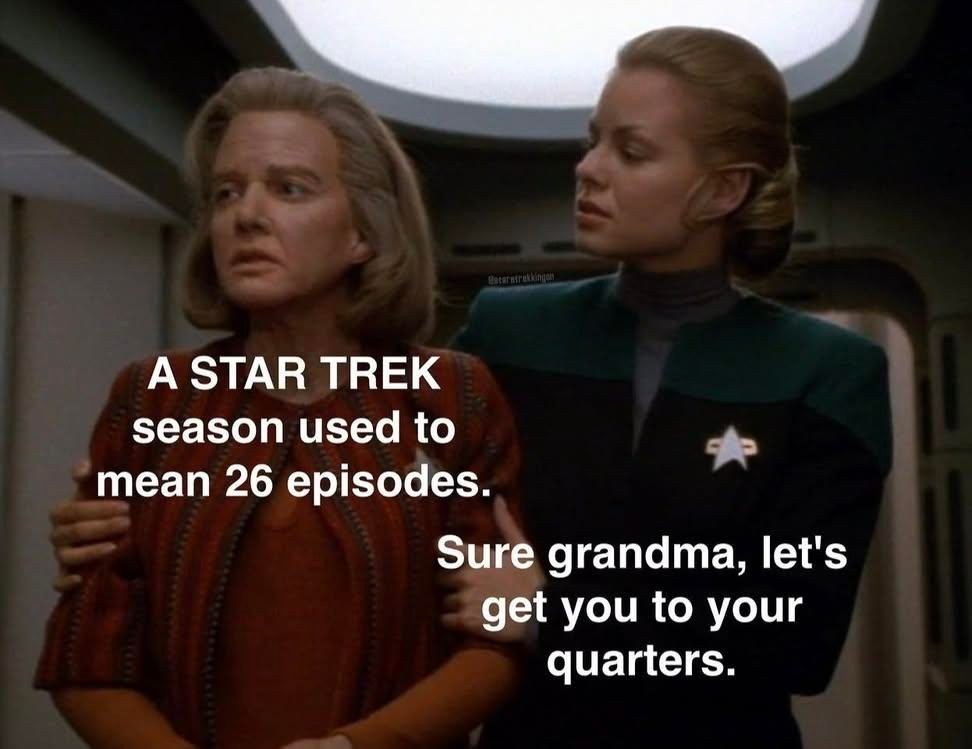
TBH I don’t mind if a modern season is 12 or so episodes, so long as those episodes are rock solid! One downside to 22-24 episode seasons is they obviously phone in a couple episodes, have some filler including the ever-dreaded clip-show.
Just think, due to budget distribution, we got “Family” right after “Best of Both Worlds, pt. 2” and it’s among the best Picard-centric episodes (and provided thematic ground for Generations, First Contact, and Picard–for good and not-so-good)!
i would rather have the ‘longer’ seasons with relatively consistent schedules and early announcement of cancellation or renewal. ya know, like the ‘olden days’. yea. i feel as old as i sound. idc. that’s what i want.
For Strange New Worlds we almost got that, short seasons, but it looks like they only skipped 2024 and were on a very consistent schedule so far. The cancellation/ending of the show was announced last year for I assume next year.
Same, I need shit to have on in the background while I’m playing games or whatever. These 8 episode series just don’t cut it. Fortunately the old stuff is replayable and great for that purpose.
Fortunately the old stuff is replayable and great for that purpose
yup. and i do that, frequently. add directory to vlc, hit random and let 'er go. hours later, maybe get sidetracked by a ‘good’ episode… then get sidetracked by the sidetrack and watch three more.
On the other hand, sometimes episodes written specifically to be take it easy can still be exceptionally good. Duet was a cost-saving exercise and I consider it to be one of the best Trek episodes of all time. A modern show with a movie-tier per-episode budget is not going to have the kind of constraints that caused the writers to focus that intensely on characterization.
They also tend to be episodic, with only a few as part of a full narrative.
NuTrek is more like a movie trilogy, with hour long episodes often being part of a series. You get a single overarching plot with minor subplots. And the production value is far more in line with movie production values.
I miss the episodic vibe. I feel like the writers have so little wiggle room to do characterization when the characters are committed to a long narrative arc. No rando stand-alone, self-contained stories that edify and deepen. No contemplative presentation of ideas. The only device allowed for this is flashbacks, and generally only when it feels like the character is missing some context to explain their behavior in the current scene. It is the second most depressing aspect of NuTrek with the first being that Trek stopped being about presenting a utopia vision for the future.
I feel like the writers have so little wiggle room to do characterization when the characters are committed to a long narrative arc. No rando stand-alone, self-contained stories that edify and deepen.
Yeah, I get that. TNG had a lot more room to play with Data’s quest for humanity than Picard. Which is ironic, given that Data was about as important as Picard in the second series.
But I also didn’t need to watch Beverly Crusher have sex with a ghost. So, trade-offs.
It is the second most depressing aspect of NuTrek with the first being that Trek stopped being about presenting a utopia vision for the future.
I always found the Utopianism of Old Trek overstated. More often than not, it was the Trek crew stumbling on some alien race or society that was experimenting with another Sci-Fi author’s idea of Utopianism. And then the Trek crew became the vehicle of Rodenberry’s critique of the utopian philosophy.
I do think a lot of the NuTrek writers keyed in on the season long conflicts in DS9 and decided “This is what we need to do going forward”. And, as a result, you got these increasingly narrow, black-and-white, action-focused adventures (the post-OS movies were the worst offenders of this trope). The apex of this (for me) was JJ Abrams blowing up Vulcan in his movie adaptation, so he could do Star Wars in Starfleet Uniforms.
But if you go back to the older episodes, I might argue that it was the captains who were Utopian. But the Trek Society was still very militant and authoritarian.
I would actually argue that Seth MacFarlane’s Orville did a much better job of painting a utopian intergalactic federation than Rodenberry or his successors ever did. The culmination of the third season really painted the triumph of politics and inter-uh-galacticism over Realpolitik and imperialism.
Man, putting the entirety of sentient biological life at risk to save the gender identity of one person is not a “triumph over realpolitik” but childish wish fulfillment completely unmoored from any sense of realism.
The alliance was what put sentient biological life at risk. The Moclans were incapable of reconciling with the Kaylons and only pushed the entire Planetary Union towards intergalactic war. The question put before the crew was of political alignment, not annihilation.
And it is reflective of modern global politics, wherein liberals surrender to their fascist neighbors to satisfy a hunger for human sacrifice that transgender people only fulfill on a temporary basis. In the end, it is the upstart working class who can be reasoned and negotiated with, while the religious zealots and fascist chauvinists who rush towards galactic annihilation.
What I remember: Kaylons The Moclans refused military co-operation (edit: against the Kaylons) unless the PU turned over the girl Moclan. Without this alliance, there was a greater risk of annihilation. Is that correct?
Kaylons refused military co-operation unless the PU turned over the girl Moclan
The Moclans refused military co-operation to battle the Kaylons. But then the Orville crew learned more about the Kaylon history and discovered their deep hatred of biological life stemmed from their long history of enslavement and abuse at the hands of biologics. So the crew reconciled with the Kaylons, but ended up in a fight with the Moclans who joined the Krill to wage war on the Union, pretty much entirely unprovoked.
The alliance with the Moclans and Krill was ultimately always doomed, due to the natural ideological conflict between them and the Unions. The Kaylon were the natural allies, but only achieved this allegiance through good faith efforts by each of the factions.
The choice of political alignment, though, had strategic consequences, no?
The binary was:
a) Turn over the girl to the Moclans in violation of PU ethics. This would secure Moclan cooperation in the war against the Kaylon and help the odds of organic life surviving.
or
b) Keep the girl in accordance with PU ethics. This would alienate the Moclans, risk the military alliance, and increase the odds of destroying all organic life.
And as I recall, this wasn’t a choice the crew made, but a choice the PU made as Peter Griffin argued for it.
Maybe it’s from a later season?
But, anyway, as a critique of Democratic Party Politics, I don’t find it very satisfying. The problem with the Democratic Party is that it’s captured by corporate capitalist interest and we are prevented from building an effective political narrative (the rich are out to destroy all of us) because they are funded by wealthy interests that would be threatened by the raising of class consciousness.
As a result, Dems are just sort of stuck being the party of vaguely nice people, which includes being for minority inclusion, but, you are quite correct to say that this does NOT ever really extend to trans-people. But the problem is that everyone assumes Dems do support trans rights because it makes perfect sense to that they would, but because Dems won’t actually DEFEND the position they are ACCUSED of, they lose everyone–unaware people who just assume Dems support trans rights, and people tuned in to the fact that Dems throw trans-people under the bus at every opportunity.
I don’t know you make that fine grained analogy in an epic military space opera, tho.
I always found the Utopianism of Old Trek overstated. More often than not, it was the Trek crew stumbling on some alien race or society that was experimenting with another Sci-Fi author’s idea of Utopianism. And then the Trek crew became the vehicle of Rodenberry’s critique of the utopian philosophy. […] the Trek Society was still very militant and authoritarian
This is what happens when we fail our students. Inattentiveness combines with poor narrative comprehension and people only take away surface-level impressions to (of the few parts to which they paid attention, the still fewer) parts they retain.
but the plot is so bad for nutrek. picard had romulans, android which dropped the next season, and the borg was dropped in favor of a nolstagia last season. pretty much copied from STD.
I do mind. Most of the time the modern short season system means, its a long movie or to use buzz words = binge worthy. You must watch every episode and in order. With the old system, you could watch most of the season out of order and skip episodes. The ones that need to be watched, are usually the double or tripple episodes. The old system allows full episodes for side/background characters, developing their story.
Of course there is the budget and with more episodes, it allows for a bigger difference. I don’t mind cheaper episodes but I hate a big “previously on” episode, where there is not even character development.
I don’t think that’s necessarily true, I always thought 24-26 20-minute episodes was the perfect length for an anime. It’s about 8 hours total, same as a movie trilogy, perfect for a longer narrative without filler.

TBH I don’t mind if a modern season is 12 or so episodes, so long as those episodes are rock solid! One downside to 22-24 episode seasons is they obviously phone in a couple episodes, have some filler including the ever-dreaded clip-show.
That’s what I miss, some of the filler episodes would give so much more depth to the world and characters.
Every Ferengi episode in Ds9 was a treasure
All hail the bottle episodes!
Just think, due to budget distribution, we got “Family” right after “Best of Both Worlds, pt. 2” and it’s among the best Picard-centric episodes (and provided thematic ground for Generations, First Contact, and Picard–for good and not-so-good)!
Other than “Profit and Lace”, I agree with you.
i would rather have the ‘longer’ seasons with relatively consistent schedules and early announcement of cancellation or renewal. ya know, like the ‘olden days’. yea. i feel as old as i sound. idc. that’s what i want.
For Strange New Worlds we almost got that, short seasons, but it looks like they only skipped 2024 and were on a very consistent schedule so far. The cancellation/ending of the show was announced last year for I assume next year.
Same, I need shit to have on in the background while I’m playing games or whatever. These 8 episode series just don’t cut it. Fortunately the old stuff is replayable and great for that purpose.
yup. and i do that, frequently. add directory to vlc, hit random and let 'er go. hours later, maybe get sidetracked by a ‘good’ episode… then get sidetracked by the sidetrack and watch three more.
just do cocaine
On the other hand, sometimes episodes written specifically to be take it easy can still be exceptionally good. Duet was a cost-saving exercise and I consider it to be one of the best Trek episodes of all time. A modern show with a movie-tier per-episode budget is not going to have the kind of constraints that caused the writers to focus that intensely on characterization.
They also tend to be episodic, with only a few as part of a full narrative.
NuTrek is more like a movie trilogy, with hour long episodes often being part of a series. You get a single overarching plot with minor subplots. And the production value is far more in line with movie production values.
I miss the episodic vibe. I feel like the writers have so little wiggle room to do characterization when the characters are committed to a long narrative arc. No rando stand-alone, self-contained stories that edify and deepen. No contemplative presentation of ideas. The only device allowed for this is flashbacks, and generally only when it feels like the character is missing some context to explain their behavior in the current scene. It is the second most depressing aspect of NuTrek with the first being that Trek stopped being about presenting a utopia vision for the future.
Yeah, I get that. TNG had a lot more room to play with Data’s quest for humanity than Picard. Which is ironic, given that Data was about as important as Picard in the second series.
But I also didn’t need to watch Beverly Crusher have sex with a ghost. So, trade-offs.
I always found the Utopianism of Old Trek overstated. More often than not, it was the Trek crew stumbling on some alien race or society that was experimenting with another Sci-Fi author’s idea of Utopianism. And then the Trek crew became the vehicle of Rodenberry’s critique of the utopian philosophy.
I do think a lot of the NuTrek writers keyed in on the season long conflicts in DS9 and decided “This is what we need to do going forward”. And, as a result, you got these increasingly narrow, black-and-white, action-focused adventures (the post-OS movies were the worst offenders of this trope). The apex of this (for me) was JJ Abrams blowing up Vulcan in his movie adaptation, so he could do Star Wars in Starfleet Uniforms.
But if you go back to the older episodes, I might argue that it was the captains who were Utopian. But the Trek Society was still very militant and authoritarian.
I would actually argue that Seth MacFarlane’s Orville did a much better job of painting a utopian intergalactic federation than Rodenberry or his successors ever did. The culmination of the third season really painted the triumph of politics and inter-uh-galacticism over Realpolitik and imperialism.
Take it back, next thing I know you’ll say the episode dealing with Lt. Broccoli’s gooning problem was unnecessary
Man, putting the entirety of sentient biological life at risk to save the gender identity of one person is not a “triumph over realpolitik” but childish wish fulfillment completely unmoored from any sense of realism.
The alliance was what put sentient biological life at risk. The Moclans were incapable of reconciling with the Kaylons and only pushed the entire Planetary Union towards intergalactic war. The question put before the crew was of political alignment, not annihilation.
And it is reflective of modern global politics, wherein liberals surrender to their fascist neighbors to satisfy a hunger for human sacrifice that transgender people only fulfill on a temporary basis. In the end, it is the upstart working class who can be reasoned and negotiated with, while the religious zealots and fascist chauvinists who rush towards galactic annihilation.
What I remember:
KaylonsThe Moclans refused military co-operation (edit: against the Kaylons) unless the PU turned over the girl Moclan. Without this alliance, there was a greater risk of annihilation. Is that correct?The Moclans refused military co-operation to battle the Kaylons. But then the Orville crew learned more about the Kaylon history and discovered their deep hatred of biological life stemmed from their long history of enslavement and abuse at the hands of biologics. So the crew reconciled with the Kaylons, but ended up in a fight with the Moclans who joined the Krill to wage war on the Union, pretty much entirely unprovoked.
The alliance with the Moclans and Krill was ultimately always doomed, due to the natural ideological conflict between them and the Unions. The Kaylon were the natural allies, but only achieved this allegiance through good faith efforts by each of the factions.
Kaylons are the robots that were trying to wipe out all organic life until the season 3, you mean moclans?
Yes, actually, that was a brain fart, I do know what they’re called. Thank you for the correction.
The choice of political alignment, though, had strategic consequences, no?
The binary was:
a) Turn over the girl to the Moclans in violation of PU ethics. This would secure Moclan cooperation in the war against the Kaylon and help the odds of organic life surviving.
or
b) Keep the girl in accordance with PU ethics. This would alienate the Moclans, risk the military alliance, and increase the odds of destroying all organic life.
And as I recall, this wasn’t a choice the crew made, but a choice the PU made as Peter Griffin argued for it.
Maybe it’s from a later season?
But, anyway, as a critique of Democratic Party Politics, I don’t find it very satisfying. The problem with the Democratic Party is that it’s captured by corporate capitalist interest and we are prevented from building an effective political narrative (the rich are out to destroy all of us) because they are funded by wealthy interests that would be threatened by the raising of class consciousness.
As a result, Dems are just sort of stuck being the party of vaguely nice people, which includes being for minority inclusion, but, you are quite correct to say that this does NOT ever really extend to trans-people. But the problem is that everyone assumes Dems do support trans rights because it makes perfect sense to that they would, but because Dems won’t actually DEFEND the position they are ACCUSED of, they lose everyone–unaware people who just assume Dems support trans rights, and people tuned in to the fact that Dems throw trans-people under the bus at every opportunity.
I don’t know you make that fine grained analogy in an epic military space opera, tho.
Why do you want to side with the TERF aliens against the anti-slavery robots, again?
Survival, obviously.
I think we’re looking different things from our media, and that’s fine.
This is what happens when we fail our students. Inattentiveness combines with poor narrative comprehension and people only take away surface-level impressions to (of the few parts to which they paid attention, the still fewer) parts they retain.
The occasional sporadic cringe episode is an easy price to pay for all the other episodes being generally good.
EPISODIC with underlying overarching plot hinting at future episodes too.
but the plot is so bad for nutrek. picard had romulans, android which dropped the next season, and the borg was dropped in favor of a nolstagia last season. pretty much copied from STD.
I do mind. Most of the time the modern short season system means, its a long movie or to use buzz words = binge worthy. You must watch every episode and in order. With the old system, you could watch most of the season out of order and skip episodes. The ones that need to be watched, are usually the double or tripple episodes. The old system allows full episodes for side/background characters, developing their story.
Of course there is the budget and with more episodes, it allows for a bigger difference. I don’t mind cheaper episodes but I hate a big “previously on” episode, where there is not even character development.
scifi shows need at least 20 at minimum, too much to go through that cant be done in 8-10episodes.
Bad writing if you can’t tell a story in 8 episodes
I don’t think that’s necessarily true, I always thought 24-26 20-minute episodes was the perfect length for an anime. It’s about 8 hours total, same as a movie trilogy, perfect for a longer narrative without filler.