
You must log in or # to comment.
they do this alot in shows that remotely christianity plotlines, anything deviating from thier bible that they never read, they would either call it woke, or something else. SPN, LUCIFER, sandman all recieved alot of hate from christians.
Gravity Falls–
Yeah, once I was searching something about Bill Cipher, my mother passed by and gave me a whole lecture about “satanic media”
im christian
and i am sick of people shoving it down clearly uninterested peoples throats
Have you seen Wake Up Dead Man? Had a really intriguing take on reconciling atheists and theists in a way I found very valuable.
I mean there’s nothing wrong with believing. I don’t, but I also don’t go around trying to convince people to be like me. If it comes up I might share why I don’t believe and I’m more than willing to listen to someone who does. I see the value in it.
if someone wants to respectfully discuss their beliefs, im happy to listen, thats a nice thing to talk about! but i wouldnt want to talk about it to someone whos uninterested
Spider-Man, Batman, aqua man, Garfield
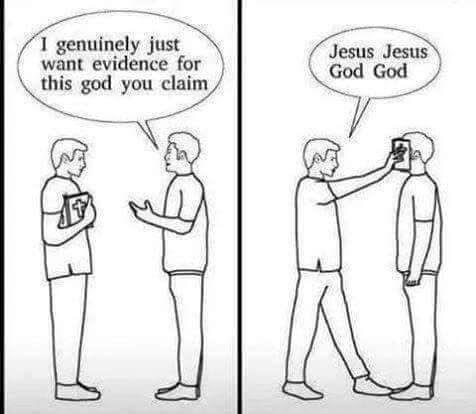
Jesus Jesus God God!
That’s convincingDoesn’t believe in god, wile masterbating keeps saying “oh my god!” Checkmated myself…
What a stupid premise to begin with. God is at least as real as money, love, or America.
All of these are useful ideas to describe things that cannot be “proven” with objective evidence, but still have a meaningful impact on the reality of our lives.
Arguing about the objective existence of God is a red herring. I wish we spent as much time talking about the very well studied social benefits and harms of religion. Then we could start talking about meaningful reforms.
You appear to be moving the goalposts. These are all concepts. God is not as real as Money or Love or America. You’re conflating several things here to try and obfuscate that the existence of God being proven isn’t a “big deal”.
You’ve ironically created the best counter to your statement by making the claim that it’s as real as 3 abstract concepts that are all man made.
If something is real, it can be proven, observed, the effects replicated. This is how every thing in the universe works. No exceptions.
Money can be proven, even the idea of it, even though it’s “conceptual”. It has real value, it’s a construct we created and it has physical objects in the real world and can be exchanged for goods and services. It’s a real idea that takes physical shape in the world and it can be proven as a real world concept that we are 100% in control over. The idea of money changes over time, as our understanding of it grows and improves (or devolves). It is an abstract concept to explain a very real thing that exists in our world. Which we created.
Love is a concept, and while the nuances behind it aren’t well understood, it’s as real as anything anyone feels, like hate, fear, or any emotion. It’s an emotion, and emotions are a part of the human empathic experience. It’s something we’ve evolved and learned over time. It’s real because we make it real every day. Love isn’t existential, it doesn’t have some power we’re unable to measure. It can’t bend or warp or shift reality. It can’t do anything more than we can do as a human. In all the ways that matter, any result of love is 100% measurable and observable in the physical world, no matter how it manifests it is observable and measurable in the real world. It is an abstract concept to explain a very real thing that exists in our world. Which we created.
America is a real place, a real continent, a real country, with real people, and while the idea of a country or its people changes over time, it’s not “fake” or made up, in the same way a claim about a deity is. The idea of America might be what you’re referring to, but it’s as real as any other shared idea or dream people have had in history, including Rome, the EU, etc. It is an abstract concept to explain a very real thing that exists in our world. Which we created.
God is not a real place. It is not anything more than an abstract concept that we shoved everything we didn’t currently understand into the category of for thousands of years until we developed the tools and systems to better explain the world around us. There are real things from this abstract concept, like churches, and bibles, and books, and songs and stuff like that. All things humans created. None of the spiritual claims have ever been proven true, despite an insane amount of testing and observations made over millennia. There’s nothing repeatable here. The only things we can observe about God that can be measured are the things the followers of the religion do. There’s zero things we’ve observed or measured with regards to religion in the real world that have ever gone beyond the physical abilities of what a normal human or collective of humans can do. It is an abstract concept to explain things in the world we couldn’t explain before.
And like the concepts you called out: Love, Money, America; God is also a concept that humans created.
Neither money nor states are dogmatic in their nature. They exist under some basis, that can be verified, and that defines their properties. Gods have arbitrary abilities that cannot be verified.
The only benefits of a religion are being a part of community and coping with reality. The first is not unique to religion, the second is delusional and leads to lots of misjudgement, harms one’s ability to percieve and analyze the objective reality. In other words, even the benefits are quite controversial in their usefulness here.
By the way, if you think about this, religion as a coping mechanism is as widespread only because it have been a substitute for more healthy alternatives for literal milleniums.
Religion should be a thing of past, but alas, magical thinking is still strong in modern society. To get rid of religions, first and foremost we should teach people about common logic fallacies and manipulations, so they would detect and avoid them more easily
I disagree.
Money and nations are well understood to be merely human made systems. They exist within the realm of human control to some degree, and therefore immediately invite open discussions and criticism.
God, in the eyes of those that believe in him, is the ultimate force of the universe of whom all existence and morality hinges upon. Unlike the other things you mentioned, there is fundamentally zero negotiations, criticisms, objections nor doubt’s that can be had against God.
It is significantly harder to convince someone that their perfect being of a God is evil and than it is that money or nations are tools of evil.
It’s not a red herring. Religious people don’t treat god like some social concept that doesn’t physically exist but still plays a role in how we interact in our society. They claim their god literally exists.
People claim money actually exists, too. It’s not an inherent property of human existence. It’s just an organizing principle that helps us coordinate resources.
It would be stupid if the main argument we had about money was whether on not it “exists.” By “stupid” I mean that it is counterproductive to the goals of bettering humanity. We don’t get anywhere with that discussion. Instead, we talk about how we should use use money as a tool to better organize our society. We talk about equity and advancement and poverty.
It’s the same with religion. It’s been well studied that religion offers social benefits:
Association between spirituality/religiousness and quality of life 2021
Assessing the Faith-Based Response to Homelessness in America

63.2% food pantries are identified as being faith-based food pantries
With this being Lemmy, I don’t have to highlight the negative consequences of religion.
The point is that we should be advancing beyond the kindergarten level discussion about what’s real and what’s make-believe. Intelligent people should instead be engaging on how we can ensure religious beliefs are fostering social trust, or how to recognize and combat religious extremism.
Those “social benefits” are band-aids needed because of a non-functioning government solution like a non-fath based welfare state. The reason you don’t see them as much in functioning countries, is because they are needed much less.
But people don’t just argue that spirituality itself is a useful tool. They straight up say their religion is true. Those are not the same things.
How is it stupid if religious people really do argue that their god as an entity is real? I don’t think the comic tries to dispute that the concept of gods aren’t.
Science flies you to the moon. Religion flies you into buildings.
“God Speed, John Glen”
Well, the main reason for that big plain-into-building debacle was US going to the middle east to do some bombing, and the main reason for that is economical (well, and racist, but that’s a given). The only religious part there was people doing suicide bombing instead of shooting rockets.
Why make an ideological argument against ideologies?
Science also led to eugenics and atom bombs. Religion also builds food pantries, wells, and hospitals. It is not about the tool but how we choose to use it.
Science did not lead to eugenics. People used a young science as an excuse to advance their ideals by willingly misinterpreting genetics. Also, atom bombs are arguably more technology than science, and technology is rather neutral with its purpose.
Religion also builds food pantries, wells, and hospitals.
Do they, though? A woman called churches for baby formula and the majority of churches weren’t very cooperative. Also, even if the religious build hospitals, who’s to say they won’t follow some insane creed like Mother Teresa did, who willingly let people suffer because she believed that suffering led people to God? Not to mention that a lot of religious ideas tend to make people worse off, like denying blood transfusions with Jehovah’s Witnesses, or so many other topics that leave people out of proper care like objecting to abortions and IVF, prioritizing faith healing over evidence-based medicine, historical opposition to preventative medicine like vaccines, etc. More often than not, religion seems to get in the way of major health interests.
What religion does do is build community, and communities come together to provide for necessities like community wells, but even an absolutely secular community would build a well. I think it’s a little undeserving to give so much credit to religion.
Science doesn’t take anecdotes.
Most food pantries and beds for the homeless in the USA are faith based. Here are the scientific papers that show it.
Assessing the Faith-Based Response to Homelessness in America: Findings from Eleven Cities
What anecdotes? The woman who called dozens of churches and only got 3 willing to provide emergency food for a hungry child? You can listen to these calls yourself in the video I shared. Notice that I’m not arguing about food pantries, but rather congregations not willing to help adequately.
And still, your emphasis on food pantries is exaggerated. They were invented in the 1960s and are a distinctly American religious invention, so naturally, they would be primarily religious. Your article even mentions the negative effects these food banks have and questions their efficacy:
Despite the rise in charitable food, there is a lack of evidence supporting their effectiveness in addressing the main issue of food insecurity. At the individual-level, the charitable food system has been shown to contribute to stigma and shame among patrons [13–15], offer poor nutritional value [11, 16], provide insufficient and inconsistent food supply [11–17], consist of limited food choice and variety [16], and exacerbate pre-existing chronic health conditions [11, 18, 19]. Furthermore, “pantries spring up wherever someone is moved to create them” [20] (p221). In this way, the geographical distribution of food pantries may not follow any systematic pattern or necessarily reflect need. Many food pantries operate out of churches and volunteers are often motivated to volunteer because of their religious commitments. Given these circumstances and undercurrents, faith is an important and dynamic element of the charitable food system. However, faith-based affiliations within the current charitable food system is unknown and likely context-specific.
I also found this:
a study involving case studies in Indonesia, Fiji and Samoa (Thornton, Sakai, and Hassall, 2012) showed that the contribution of religious groups in providing disaster relief and welfare services to their members and advocacy for the poor is often present but not always comprehensive or positive. The influence of religious groups in the public sphere and as institutions can also exacerbate unresolved tensions between different ethnic and secular groups.
https://www.nature.com/articles/s41599-019-0272-3
Regardless, food pantries and poverty in general are symptoms of great social inequality and of a society that doesn’t prioritize welfare, despite its religiosity. So why limit ourselves to questionable religious initiatives? I’d much rather focus on the overall investment in social programs and their impacts between religious and secular countries.
I agree that religion is useful for bringing communities together and alleviating the hardships of poverty by providing people with a coping mechanism, but it’s by no means towering over secular initiatives because charity is innately human. Religion arguably only serves as a reminder of that with regular church attendance.
eugenics
Not science.
atom bombs
No argument here. Science was also used to develop airplanes and buildings. You can create with the knowledge earned from science, but religion (can) give the justification to misuse those creations.
It is not about the tool but how we choose to use it.
Well said.
Credit where it’s due, science built the plane.
You can’t have a rational discussion with a religionist, particularly one of the Christian/Islamic variety. They will appeal to their book of stories and to them, that should be enough for us.
Kinda ironic that your source for this is gonna have to be trust me bro
Put it to the test!
i have. if we’re talking professionals, i’ve had a harder time finding believing “religionists” (what a stupid word) in the clergy than i have in the congregation.
Lol, you mean “go outside”? Pretty high bar for some internet denizens.
I’ve had plenty of conversations with religious folks that didn’t touch upon their holy texts at all. And plenty of conversations with atheists that were interminably about what they thought those texts said.
Whenever someone generalizes a group so drastically like this, I tend to wonder about how limited their life experiences must be.
Part of science is reproducible events, no?
“And what is your evidence that DC-8s exist, Mr. Hubbard?”
I’m not religious, but I can see the immense value that religion had historically as an imperfect guide to ethics and practical knowledge.
Sure, we can scoff at the hypocrisy and flaws now with our years of schooling, but the common person didn’t have the same access to academia back them. Short, memorable stories that show people getting punished for misdeeds and others rewarded for positive deeds is much easier to impart onto peasants than the nuances of collectivism.
Someone could point to the horrible acts done in the name of religion, but just imagine if those people didn’t have the fear of god in them. Tribalism would have separated humans into different nonreligious groups to genocide in a world without religion.
Someone could point to the horrible acts done in the name of religion, but just imagine if those people didn’t have the fear of god in them
Lol no. Imagine if these people didn’t think they were still righteous in the eyes of god, maybe they might not have felt the need to torture in the name of their god.
Short, memorable stories that show people getting punished for misdeeds and others rewarded for positive deeds
You don’t need religion for that when there’s folklore
Short, memorable stories that show people getting punished for misdeeds and others rewarded for positive deeds is much easier to impart onto peasants than the nuances of collectivism.
I would agree if the stories consistently portrayed that. In the Bible and Torah, Job is the most righteous and good and gets fucked because of that. David has a faithful soldier that goes so far as to refuse to go home to his wife while his comrades were still fighting, and David has him killed in a fucked up way (told his general to send him where the fighting was worst and then have everybody pull back from him), all to try to cover up fucking the soldier’s wife. David’s “punishment” was he married the hot widow and the child conceived in the affair was miscarried. And as soon as she miscarried, David shrugged it off and moved on with his life.
Also, the entire Christian religion is based on absolution for whatever evil you do, you just have to be part of the club. If Hitler had “come to Jesus” right before he died, he would be in heaven while an atheist who spent their whole life doing good would be in hell. Deeds are irrelevant for punishment.
And let’s not even get into Greek Mythology, where how good or bad of a human you were was completely irrelevant to what happened to you at the whims of the gods. Same for Norse.
I don’t know how it is for any other religions, as I haven’t studied them, but I don’t think religion was required to establish a moral code and accountability. The Code of Hammurabi didn’t require religion to have a legal code (while recognizing the relief at the top showing the god of justice handing it to Hammurabi, it seems pretty clear that was artistic expression), and it pre-dated the Ten Commandments.
Someone could point to the horrible acts done in the name of religion, but just imagine if those people didn’t have the fear of god in them.
I just… what kind of argument is this? Do you think the people running the Spanish Inquisition would have tortured harder if they didn’t have the “fear of god” in them? That the Crusades would have been bloodier? What reason do you have to think that the horrible acts done in the name of religion would have been worse if it wasn’t for religion?
I can see the value I can also see the harm I can also see the hypocrisy in asserting there is no God or that the universe came from nothing, in the end it’s all the same and humans are just humans being humans.
Religions aren’t something to be argued about with the tools of empiricism. The mythologies of religions are non-provable, that’s why they are also called faith. If someone religious tries to “prove” the statements of their religion to someone who doesn’t believe in them not only are they misguided but also most likely not too sharp, since they can’t recognize the utter futility of what they are doing. It’s futile not only because they have no chance of convincing their talking partner, but also because there is no way to prove anything about religion.
That doesn’t mean people can’t or shouldn’t have a religion by the way, it just means what I said, that there is no way to argue about religion empirically and so you shouldn’t.
With that said I do also think this is a bit of a strawman. I’m sure there are people who despite the (in my opinion) immensely obvious stupidity of the aforementioned behavior do behave like that, but I mostly only hear about this type of people when hardcore atheists (to whom the same applies by the way, you also can’t disprove faith and someone whose sole basis for reality isn’t empirical observation can’t be convinced by you trying to disprove it) parodize it.
In the end I think the problem with the conversation depicted is that on a logical level it’s the same as two religions arguing with eachother. They have completely different ways in which they define reality, so there is no way to come to a common understanding of it by arguing. You won’t convince someone about the existence of God who only believes in what can be proven by experiment and you won’t convince someone of the non-existence of God who believes in God because they don’t have that same way of defining reality. Doing so either way would very closely mirror for example a Buddhist being convinced to become a Christian.
Well said. There’s also something about a certain type of atheist who confidently voices their refusal to believe in anything unless proven with empirical evidence, that I personally find mildly irritating.
I appreciate critical thinking and I’m quite skeptical myself, but it’s that confident certainty, that nothing that hasn’t been proven scientifically is real, that slightly irks me.
It’s a mindset that seems to conveniently omit the possibility of future scientific discoveries and ‘unknown science’, and comes off in some as a somewhat smug, arrogant attitude that, somewhat ironically, can often be found in the blindly religious.
Exactly, the experience of religion is felt internally and through community. As someone who went Christian -> atheist -> pagan, I can say I do understand both sides. Atheists are right to say that without evidence religion shouldn’t have any power over non-believers. Religious people are right to say that for some people religion serves a role that would be missed without it.
On issues of religion, even as someone who’s been pagan longer than she was an atheist I generally side with the atheists. I grew up watching Christians try to prove Christianity despite our denomination (catholicism) having the doctrine of non-overlapping magesteria, which basically says that anything science can prove belongs to science and where religion contradicts it must be taken as metaphor or flowery language. I’m far better served by freedom from religion than freedom to use religion as a cudgel, just as all minority religions are.
🤔are you okay, mentally?
No but I’m used to it 😆