It’s not as difficult as you might think. Or, more precisely, it’s a lot more difficult to destroy a bridge than you might expect. Look at how much trouble Ukraine has had trying to keep the Kerch Strait bridge out of commission. Or look at the hundreds of bombing runs the US did in Vietnam to try and knock out one stupid bridge.
It’s easy enough to temporarily shut a bridge down. Bombing its road deck is pretty easy. The deck is usually exposed to the sky, so bombs can be dropped right on it from above. And the deck is thin enough to be fairly vulnerable to bombing.
The problem is that bombing a bridge deck doesn’t actually destroy the bridge. At best you create a hole in the bridge deck a meter or two across. That can shut a bridge down temporarily, but it doesn’t actually damage the bridge’s structure. To repair the deck you do something like:
Clean up the hole. Remove any loose concrete chunks with a hammer, cut off any exposed rebar with an angle grinder.
Drill holes at regular intervals through the edge of the hole.
Run new rebar spanning the hole. Epoxy rebar into old bridge deck.
Attach some plywood to the bottom side of the bridge deck to server as as mold.
Pour new concrete and let cure.
This can be done in a day or two. And on a multi-lane-bridge, traffic can continue to flow around the bomb site at reduced capacity.
If you actually want to destroy a bridge, you can’t just hit a random spot on the bridge deck. If it’s a big truss bridge, a direct hit on a key truss member could cause the entire bridge to collapse. But those are very precise targets to hit. And if it’s just a bridge deck sitting on beams sitting on piers, the only way to destroy the bridge will be to knock out the support piers.
The problem with destroying them is that bridge piers are both hard to hit and extremely resilient. They’re protected from above by the bridge deck, so to hit them you’ll have to glide a bomb in horizontally. And even if you manage to hit them, they’re utterly massive. They have to support the entire weight of the bridge above. Plus they’re often directly in a river’s channel. This means they’re built to survive the forces of water current and ice collision if the bridge is in a temperate climate. Plus they’re built extra thick to resist the corrosive effects of the river water. Now, if you do actually manage to knock out a support pier, replacing it will be a nightmare. But that’s a very difficult thing to do.
It’s actually a lot more difficult to destroy a bridge than people realize. Knocking a hole in a bridge deck is easy. But bridge decks are easily and quickly repairable.
And yet, your gut feelings are incorrect. As has been clearly demonstrated by the well documented difficulties militaries have in keeping bridges down through air power alone. But sure, tell the literal structural engineer you know more about bridges than she does.
Now that we caught an actual structural engineer, here’s a question from a fellow engineer (but the wrong kind to know this):
Would it be harder to repair a suspension bridge (or at least the suspended span of a bridge with one)?
I’m thinking of the top of my head that the forces and dynamics of a suspension bridge are very different from those of a more traditional bridge and thus that if the actual cables holding it are blown up at the anchor points, the whole suspended span just brings itself down as a whole leaving just the pillars.
Further, suspension bridges tend to be used for longer lengths of bridge were you can’t really have pillars in the middle (in this example in the US, the suspended spawn being there so that ships can cross under the bridge)
Note/Dislaimer: the information here is purely hypothetical and educational, discussing the limits of Air Power as a means of severing enemy transportation links. The Golden Gate Bridge is used as a familiar example when discussing the vulnerability of suspension bridges. But the author of this post has zero desire or intention to damage the infrastructure of the US or any other country. Nothing in this post should be taken as a threat or warning of any kind.
Your instincts are correct. The forces are very different. If one of the main cables on a suspension bridge is severed, the entire bridge deck will come down. You would be able to reuse the towers, foundations, and maybe some of the vertical cables supported by the main cable that wasn’t hit, but repairing such damage would be similar in difficulty to rebuilding the bridge from scratch. Demolition and restoring that bridge deck probably represents about 50% of the work of building a whole new bridge from scratch.
However, actually severing one of the main cables is lot more difficult than you might think. They’re not a giant rod of solid steel; they’re thousands of individual pencil-sized wires bundled together. At the anchorages, these individual wires spread out and embed themselves into a giant block of concrete. Here are the Golden Gate Bridge’s anchorages under construction.
Those steel elements are only a portion of the total, and after they were built, the entire volume was filled with concrete. The Golden Gate Bridge’s anchorages are giant hunks of heavily reinforced concrete. Imagine a cube of super-reinforced concrete 12 stories to a side. That’s the scale of what we’re talking about.
You can absolutely forget about destroying one of the anchorages directly. They would be trivial to hit. They’re giant hunks of concrete. But anything short of an atomic bomb would have trouble doing significant damage to them. While bunker-buster bombs exist, those are made to punch a hole through many feet of concrete and then explode in the air below the concrete. They’re not designed to turn a massive 30 meter cube of solid concrete into gravel. It takes a minimum amount of energy to pulverize something that large. And that amount of explosives just can’t be delivered by a plane or missile. And even if a bomb takes out a chunk of an anchorage, you’ve only managed to sever a few dozen of the thousands of wires holding up the bridge. Destroying the anchorages themselves would be even more impractical than destroying regular bridge piers.
So that leaves the cables themselves. You mentioned severing them at the anchorages, but it actually doesn’t matter where they’re severed. Imagine hanging a rope between two walls in the room you’re in now. It doesn’t matter where you cut that rope; anything hanging from that rope is going to fall. However, the best point to target would be right where the cables hang from the supporting towers. That is where the tensile forces in the cables are at their maximum.
I’m no expert in military ordnance. I have no doubt the Air Force has studied the problem extensively, but I really don’t know how effective bombs are at taking out suspension bridge cables. I don’t know exactly how precise the US Air Force is nowadays with their precision bombing, but I’ll take it for a given that they have the ability to reliably get a direct hit on one a 1-meter wide bridge cable. Unlike in Vietnam, I’ll assume we can actually hit the thing reliably.
You’re talking about a cable that is made of thousands of individual wires. The Golden Gate Bridge’s main cables are a meter thick. They look like this.
This isn’t the type of target most military bombs are designed to destroy. Broadly speaking, there are two main types of bombs. There are area weapons and penetrators. The area bombs subject a large area of ground to heat, shock wave, and high speed debris. Some bombs are designed to say, kill every unarmored person and any lightly armored vehicle within a hundred meter radius. These area weapons would be completely useless on bridge cables. Even with a direct hit, most of the explosive force would bounce off the cable and into the air. You’ll probably sever a few of the surface wires, but the vast majority of the cable’s capacity will remain intact. And those things are built with a factor of safety. The Golden Gate Bridge was built with a factor of safety of about 2.5. Which means in theory you could cut through more than half of both of each main cable’s cross-sectional area, at the point of maximum cable tension, and the thing would still stand.
That leaves the penetrators. Bunker buster bombs have already been mentioned. But what I’m thinking of are the shaped charge weapons designed to punch through things like tank armor. These weapons work by using an explosion to create a pencil-sized jet of superheated molten metal. This instantly drills a small hole through the armor of a tank. This is effective at destroying tanks, as that superheated stream of metal enters the tank cabin, rapidly expands, ricochets off the walls, and pastes everyone inside. And the resulting rapidly expanding gases can blow the turret right off some tanks.
But where my knowledge fails is how effective these shaped charges would be against a meter-thick bundle of steel wires. A shaped charge would certainly be capable of punching a hole, but if you want to sever the cable, you need to sever the entire cross section. A shaped charge may not have enough energy for that, or the stream of vaporized metal might just pass right through the cable, in one side and right out the other. I won’t say it’s impossible, especially if you designed a bomb specifically for targets like this. But whether a shaped charge that is designed to puncture tank armor can sever a big suspension bridge cable? I’m sure the Air Force knows, but that’s beyond my expertise. I’m sure it’s been thoroughly studied, and I’m sure those studies are classified to all hell and back. It’s possible there may be information on this publicly available, but I feel dicey enough posting about severing suspension bridge cables on a public forum like this. Even if such info is publicly available, I would rather not have some angry men in black suits show up on my front porch asking why I’ve been reading numerous papers on how to effectively sever the cables of giant suspension bridges. I don’t need that in my life right now. 😅
On the plus side, this actually makes big suspension bridges very resilient to terrorist attacks. A specialized shaped charge missile built by Lockheed Martin specifically to sever large suspension bridge cables could do the job. But you can’t destroy the Golden Gate Bridge by setting off a home-made truck bomb on it a al Oklahoma City. You would blow a hole in the bridge deck, kill a lot of people, maybe sever some of the support cables, and maybe damage some of the outer layers of the main cables. But if you set of a truck bomb right next one of the main cables, again most of the explosive force would just bounce off. A meter thick steel element is pretty damn resilient. I’m not aware of any incidents of a major long-span suspension bridge being taken down by terrorist bombs like this.
Thank for taking the time to write such a through explanation.
I had some awareness that suspension bridge cables were actually bundles of cables, but had no idea just how many there as in it and how tick it is. Also I had no idea they were made with such a large safety factors.
I’m from Lisbon in Portugal were there is a bridge pretty much like the golden gate bridge (photos), designed by the same people, so I’ve always been curious about how it.
That said, my question was more coming from the side of “maybe that’s the explanation for why that suspended span in that US bridge isn’t repaired” rather than “how easy it is to bring it down with air power” (though I found the points you made on that angle very interesting) - I was thinking that if the thing has a tendency to fail as a whole, it would be more costly to repair if it did than a traditional bridge.
I’m going to assume that with a simple jackhammer or a few small shaped charges, some time to work, and a lack of concern for your own life, you could “proper tool” a bridge to the ground pretty easily.
Exactly. Give me a couple days and a big enough angle grinder and I can take the Golden Gate Bridge down. (Assuming I have no regard for my own safety.) But the big steel cables holding the bridge up can be cut just like any other steel. Of course, I don’t actually want to take down the Golden Gate Bridge. But even if I did, it wouldn’t be having the right tools that would prevent me from doing it. It would be the fact that if I tried it, I would probably be beaten to death by a crowd of angry people before the police could even arrive. You show up with a giant cut off disk and start going to town on the cables supporting a bridge holding up thousands of cars? You probably won’t even live long enough to see those terrorism charges.
That’s the problem with taking bridges out from the air. You can’t get up close and use the proper tools. You have bombs, missiles, and that’s it.
That’s pretty easy to fix. The bottom image just has a hole in the bridge deck. Clean up the hole, epoxy in some new rebar, build some forms, pour new concrete, and you’re done.
The top image is worse, but it’s still not as bad as it seems. Look closely at that bridge. That looks to be a bridge made of precast concrete. Look how the whole fallen span seems to have come down in one big piece. It’s a very clean break.
When I say precast, I mean literally that. The beams for that bridge are not poured on site. They’re made in a factory and trucked in. A precast concrete plant could have a whole yard full of beams just sitting there, ready to go. How you build such a bridge:
Construct bridge piers by either casting in place or driving precast piles into the ground.
Either cast the pier top caps in place or use precast caps carried in and placed by crane.
Hoist precast beams and place them spanning the top caps.
Once beams are in place, construct formwork and cast a bridge deck on top of the precast beams.
In a bridge like this, often the only part that is poured in place is the bridge deck. To fix the bottom bridge, you would remove any debris, clean up the edges, drop in some new beams, build some forms, and cast a new bridge deck.
And what I’m describing is just typical precast concrete bridges. I’m describing what you can do even when you haven’t optimized your whole bridge construction sector for easy repairability. But Iran has been preparing for a US attack for a generation. The reason the US’s decapitation strike failed to cause a regime collapse was because Iran isn’t some tin pot dictatorship lead by one brutal despot. It’s an advanced nation that’s built its governmental system from the ground up with survivability in mind. There was an elaborate continuity of government plan in place, and as the US and Israel assassinated Iranian leadership, the conveyor belt just moved folks up to replace those killed. It’s a modern day governmental version of the ancient Immortals. Iran’s even granted a lot of their military forces a high degree of autonomy. There are a whole bunch of missile crews hiding in underground bases with standing orders to launch at pre-chosen targets if they don’t receive word from leadership after a certain amount of time. In short, Iran has gone to great lengths to make its government and military highly resilient to attack.
And if they did this for their government, why not their infrastructure? You can design bridges with quick repairability in mind. For example, you can standardize sizes as much as possible. Instead of custom designing everything, design your precast bridges to use only a small number of different beam sizes and standardized length. You tell your bridge engineers:
All bridge spans must be in 2 meter increments, 4m, 6m, 8m, 10m, 12m, etc.
All bridges must be built from one of six beam cross-sections. Do not design custom sections.
All bridges must be designed to use the minimum strength of concrete any of our batch plants produce.
All bridge decks must be designed to use the lowest grade of rebar commonly available.
The distance between bridge beams must be in one of a few allowable dimensions to allow the use of pre-made drop-in formwork. * All bridges must be constructed with precast piers, pier caps, and beams with bridge decks cast in place using drop-in metal formwork.
All bridge piers must be designed with twice the usual factor of safety, ridiculously overbuilding them to make them extremely resistant to bomb damage.
I have no idea what Iran is doing. But I do have a background in structural engineering. I’ve taken a literal course called “bridge design.” If you asked me to design a nation’s bridges to be extremely repairable, this is how I would do it. The piers are the hard part to replace, so you make those far, far stronger than they need to be. That way if a bomb blows off a chunk of a bridge pier, there’s still plenty of capacity left. Everything else? You standardize the hell out of it and then mass produce and stockpile replacement parts. If you only allow six beam sections and 6 beam lengths, that means there will only be 36 types of beams used across all of your bridges. You can then produce and stockpile huge numbers of these beams, allowing extremely rapid repair after an attack.
We typically don’t build bridges to this level of standardization. The problem with using few standard sizes is that you inevitably end up over-designing your bridge. You can’t design the perfect custom cross-section to carry your loads with the absolute minimum amount of material possible. So your bridges end up heavier and more expensive than they could otherwise be. But if you’re willing to pay a bit more for a much, much more resilient transportation system, standardization can accomplish this.
Again, no idea if Iran is actually doing this. But considering the lengths they’ve gone to make their whole regime resilient to attack, it wouldn’t be unreasonable to assume they’ve applied the same philosophy to their physical infrastructure. You don’t try to build an indestructible bridge. You just make your bridges easy to repair instead. If you do it right, repairing a bridge will be far cheaper than dropping a bomb on one.
Just to add to this, notice how low the water levels are. It’s summer, the river bed is practically dry, and most rivers have a dam upstream so the flow can be controlled. It kinda limits the impact of the bridge being down for even a few days or weeks, and my understanding is that it speeds up the reparation process.
Straightfowardly, no, it couldn’t be. Bridge construction on this scale isn’t just a matter of throwing money or people at the problem. Like the old saw that says you can’t get nine women to make a baby in one month, a 1200’ span takes time. Foundations have to be built below water, piers have to be formed and given time to achieve design concrete strength, and each bridge segment has to be completed in sequence, including formwork, rebar, concrete pouring and setting, etc., in a careful sequence that keeps the cantilevered sections of the bridge in balance.
The US is no paragon of speedy infrastructure projects, but even in China cable-stayed concrete bridges are years-long projects. The Changtai Yangtze River Bridge, for instance, has spans similar to the Francis Scott Key bridge and it took fully 6 years from start of construction to completion, never mind design time.
I agree with you on the concept that it is a normal bridge with a reasonable budget. The Changtai Yangtze river bridge was from what I can find about 8.5 billion USD while the Iran war to date has cost 37.5 billion from what I can find with some saying over 100 billion.
At some point you can start forgoing concrete for much more expensive and exotic materials. The Francis Scott Key Bridge has been broken for over two years at this point with plans to have it replaced by 2030, meaning 1/3rd of the time to complete has already elapsed without construction. Building something in a third the time with over 10 times the budget doesn’t seem as unreasonable as asking nine women to have one baby.
In addition, it’s worth noting that the Key Bridge was built to lower standards than are acceptable today, so it has to be completely redesigned and rebuilt - we can’t just slap up another bridge of the same design. Plus, with the circumstances that caused it to collapse, you can bet that any replacement bridge will be very much reinforced against a similar incident, probably to the point where it’s almost too strong given the likelihood of another incident like that.
There are so many people on Facebook that seem to think it should have been rebuilt already. They think Maryland should already have had plans to rebuild it in the file…it’s likely they are the same people that also bitch about taxes every chance they get. I have the strong impression many of them aren’t even local; they’re just stirring the pot, trying to make Governor Wes Moore (a Democrat) look bad; they actually have no stake in the game and probably have never even been to Maryland.
And the actual need for the bridge is marginal. I’t useful, but hardly ever busy. For non-hazardous, normal sized loads, there is a 4 bore super tunnel, for smaller loads there’s a two-bore tunel, Hazardous and oversized loads are hit hardest, but they just go the other way around the beltway. Coming south from 95 north of Baltimore to 95 south of Baltimore was a 40:60 shot between bridge and west beltway, longer but not unreasonable.
Shipping terminals in Dundalk used it as a primary exit to head south. Sparrows point isn’t the production powerhouse it once was. They’re going to drag their feet.
Whether or not it’s enforced, it’s still a war crime. History will recount it as an atrocity, with footnotes that putting Trump in power was a bad thing, and we as a people should reflect on how to not do anything like that again.
I mean, granted, we try to live down the genocide of the first nations here in the US, or our economy depending on slave-run sugar and cotton plantations, but it keeps coming back to haunt us.
That said, what’s going on in the US (not just now but for at least 1 or 2 decades) parallels the typical historical Fall Of Empire so much that it’s unlikely that those who write this part of History will be the current political forces in the US.
Since the twenty-first century, a lot of historical research is based on archeological data, a process vastly improved by the internet speeding up correspondence between experts. Now primary sources can ce accessed within hours instead of weeks.
And we’re now in an era in which events are recorded with audio and video, and if they’re particularly scandalous or violent, are posted to where the public can access it.
The Trump regime is trying hard to whitewash popular US history, but we have too many experts and they have the receipts.
ICEis now so renowned for lying and trying to cover up their brutality that Americans are conditioned to pull out their phones on the assumption there’s going to be drama. Before ICE we has a similar phenomenon rising with law enforcement in general, since police would escalate and then lie in court while they were given the presumption of regularity.
The future historians writing the history of the United States may be foreign, but the US has figured largely in the 19th and 20th centuries, so academics are likely to be determined to follow the data and get it right.
This isn’t to say there won’t be alleged experts looking to shape the facts to fit an agenda or an ideology. We’ve seen plenty of that regarding the histories of Greece and Rome, for instance, but I anticipate those will conflict with the data and each other, while good faith historians will (more or less) concurr with the consensus.
We’re seeing a similar phenomenon with biblical scholarship, even when there are efforts by ministries to capture and control biblical academics, to the point of organizing large orders of ideology-compliant academics, the fact-based consensus still prevails. (And still sees the bible as a historical text, neither inerrant, nor univocal, nor divinely inspired.)
Yet propaganda seems to be working just fine in the present day.
I bet it’s going to be like the story of how the Roma People were targeted for extermination by the Nazis and over 250 thousand of them were killed - some Historians will know it, as will a handful of curious people, but most people just think the Jewish People were the only ones being exterminated by the Nazis because of a mix of the people from that ethnicity being present in greater number and more influential in the top winner of WWII - the USA - and there being political forces - the Zionists - that wanted to leverage the plight of the Jewish People to further their own supremacist ends, so there are tons of books, films, museum exhibitions and official remembrances and similar formal occasions about it, whilst there are pretty much no such things for the plight of the Roma People (there are literally 14 films made about it, ever, in the whole world).
So one part of the story has been pushed so incredibly hard that it swamped away the rest of the story from the awareness of pretty much everybody who is not a WWII Historian and this wasn’t even done (as far as I can tell) to erase the other part of the story, just a mix of Racism, the differing presences of each ethnicity in some nations and certain supremacist political forces investing very heavily in promoting the part of the story that they could use to further their own end of creating and securing a land were their race is dominant.
But I’m actually a bridge engineer and you’re spot on, shit takes a shocking amount of time even for small, simple bridges. That’s why they last for 100 years.
Bombs are supposed to be used to destroy the infrastructure that their military depends on.
Once you’re bombing to reduce population, you’re also doing what Sun Tzu says is an absolute last resort, and should be ashamed of your skills as a commander.
Okay yeah, that makes sense. But bombing bridges is also a war crime though? Sounds a lot to me like bridges are “the infrastructure that their military depends on”. Am I thinking about this wrong? 😅
If the bridges are in the theater, then yes. In fact they become strategic hot points and bombing them can be important.
But in the case of Iran, it was entirely air, missiles and drones, and so the US was hitting bridges just to inconvenience the civilians.
Granted, if the US invaded with troops and mechanized armor, then those bridges would be useful as the front line advanced, but we have improvised pontoon bridges for that.
Makes sense, thanks. I think every war action that is technically a war crime should be reported as such in the media. Why are the media so slack on this? Like even independent media.
This would open people’s eyes a little more, I would hope.


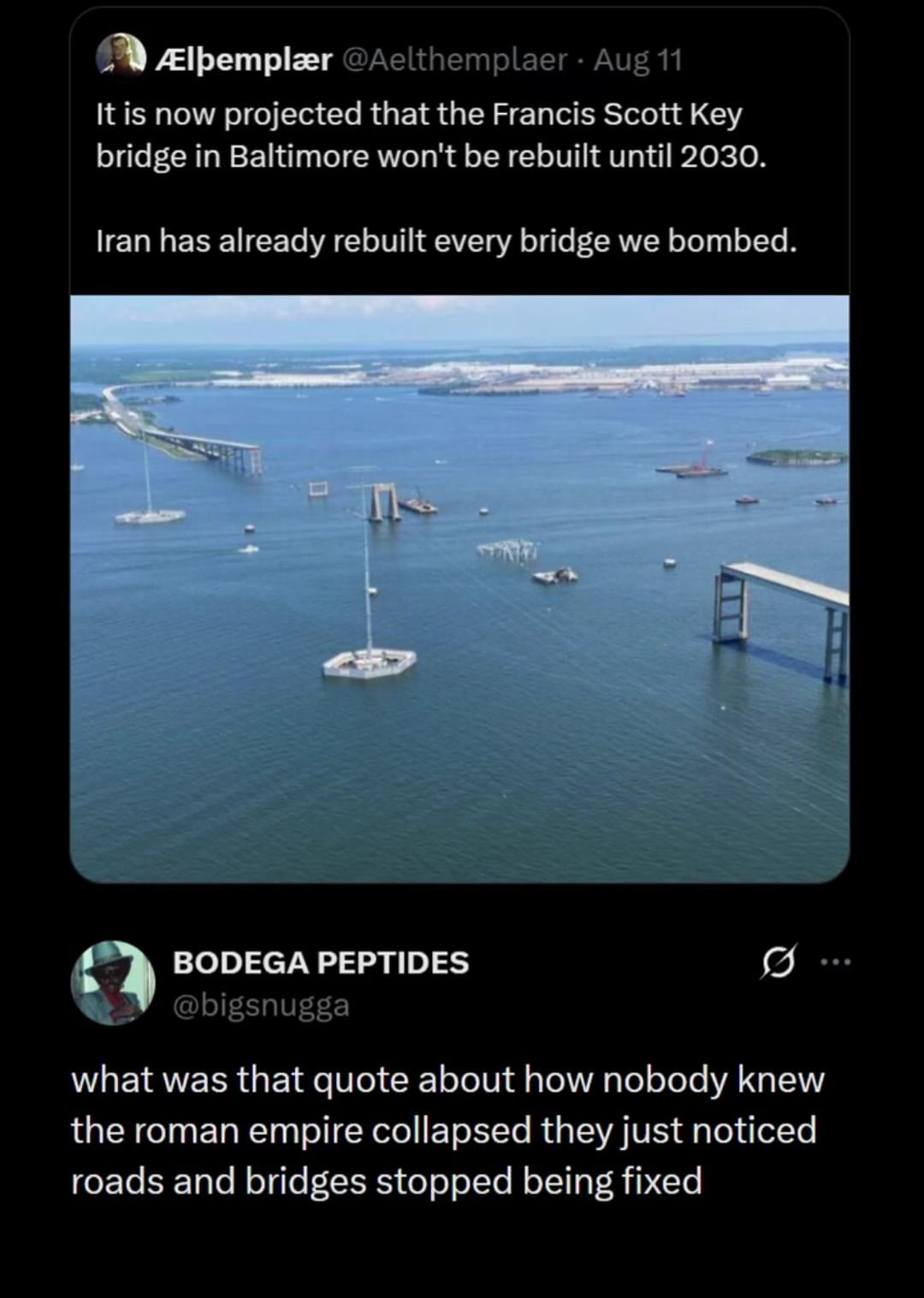
That would be funny but it’s pretty unlikely to be true. Fixing bridges has got to be fucking difficult.
That’s why it’s a war crime.
It’s hyperbole, but it does appear to be based on fact
https://www.msn.com/en-us/news/other/satellite-images-show-iran-is-rebuilding-fast/ar-AA28yvnd
It’s not as difficult as you might think. Or, more precisely, it’s a lot more difficult to destroy a bridge than you might expect. Look at how much trouble Ukraine has had trying to keep the Kerch Strait bridge out of commission. Or look at the hundreds of bombing runs the US did in Vietnam to try and knock out one stupid bridge.
It’s easy enough to temporarily shut a bridge down. Bombing its road deck is pretty easy. The deck is usually exposed to the sky, so bombs can be dropped right on it from above. And the deck is thin enough to be fairly vulnerable to bombing.
The problem is that bombing a bridge deck doesn’t actually destroy the bridge. At best you create a hole in the bridge deck a meter or two across. That can shut a bridge down temporarily, but it doesn’t actually damage the bridge’s structure. To repair the deck you do something like:
This can be done in a day or two. And on a multi-lane-bridge, traffic can continue to flow around the bomb site at reduced capacity.
If you actually want to destroy a bridge, you can’t just hit a random spot on the bridge deck. If it’s a big truss bridge, a direct hit on a key truss member could cause the entire bridge to collapse. But those are very precise targets to hit. And if it’s just a bridge deck sitting on beams sitting on piers, the only way to destroy the bridge will be to knock out the support piers.
The problem with destroying them is that bridge piers are both hard to hit and extremely resilient. They’re protected from above by the bridge deck, so to hit them you’ll have to glide a bomb in horizontally. And even if you manage to hit them, they’re utterly massive. They have to support the entire weight of the bridge above. Plus they’re often directly in a river’s channel. This means they’re built to survive the forces of water current and ice collision if the bridge is in a temperate climate. Plus they’re built extra thick to resist the corrosive effects of the river water. Now, if you do actually manage to knock out a support pier, replacing it will be a nightmare. But that’s a very difficult thing to do.
It’s actually a lot more difficult to destroy a bridge than people realize. Knocking a hole in a bridge deck is easy. But bridge decks are easily and quickly repairable.
This is kina dumb. Seeing how they can precisely land a missile on a car going 100kph on the other side of the world.
And yet, your gut feelings are incorrect. As has been clearly demonstrated by the well documented difficulties militaries have in keeping bridges down through air power alone. But sure, tell the literal structural engineer you know more about bridges than she does.
Now that we caught an actual structural engineer, here’s a question from a fellow engineer (but the wrong kind to know this):
I’m thinking of the top of my head that the forces and dynamics of a suspension bridge are very different from those of a more traditional bridge and thus that if the actual cables holding it are blown up at the anchor points, the whole suspended span just brings itself down as a whole leaving just the pillars.
Further, suspension bridges tend to be used for longer lengths of bridge were you can’t really have pillars in the middle (in this example in the US, the suspended spawn being there so that ships can cross under the bridge)
Note/Dislaimer: the information here is purely hypothetical and educational, discussing the limits of Air Power as a means of severing enemy transportation links. The Golden Gate Bridge is used as a familiar example when discussing the vulnerability of suspension bridges. But the author of this post has zero desire or intention to damage the infrastructure of the US or any other country. Nothing in this post should be taken as a threat or warning of any kind.
Your instincts are correct. The forces are very different. If one of the main cables on a suspension bridge is severed, the entire bridge deck will come down. You would be able to reuse the towers, foundations, and maybe some of the vertical cables supported by the main cable that wasn’t hit, but repairing such damage would be similar in difficulty to rebuilding the bridge from scratch. Demolition and restoring that bridge deck probably represents about 50% of the work of building a whole new bridge from scratch.
However, actually severing one of the main cables is lot more difficult than you might think. They’re not a giant rod of solid steel; they’re thousands of individual pencil-sized wires bundled together. At the anchorages, these individual wires spread out and embed themselves into a giant block of concrete. Here are the Golden Gate Bridge’s anchorages under construction.
Those steel elements are only a portion of the total, and after they were built, the entire volume was filled with concrete. The Golden Gate Bridge’s anchorages are giant hunks of heavily reinforced concrete. Imagine a cube of super-reinforced concrete 12 stories to a side. That’s the scale of what we’re talking about.
You can absolutely forget about destroying one of the anchorages directly. They would be trivial to hit. They’re giant hunks of concrete. But anything short of an atomic bomb would have trouble doing significant damage to them. While bunker-buster bombs exist, those are made to punch a hole through many feet of concrete and then explode in the air below the concrete. They’re not designed to turn a massive 30 meter cube of solid concrete into gravel. It takes a minimum amount of energy to pulverize something that large. And that amount of explosives just can’t be delivered by a plane or missile. And even if a bomb takes out a chunk of an anchorage, you’ve only managed to sever a few dozen of the thousands of wires holding up the bridge. Destroying the anchorages themselves would be even more impractical than destroying regular bridge piers.
So that leaves the cables themselves. You mentioned severing them at the anchorages, but it actually doesn’t matter where they’re severed. Imagine hanging a rope between two walls in the room you’re in now. It doesn’t matter where you cut that rope; anything hanging from that rope is going to fall. However, the best point to target would be right where the cables hang from the supporting towers. That is where the tensile forces in the cables are at their maximum.
I’m no expert in military ordnance. I have no doubt the Air Force has studied the problem extensively, but I really don’t know how effective bombs are at taking out suspension bridge cables. I don’t know exactly how precise the US Air Force is nowadays with their precision bombing, but I’ll take it for a given that they have the ability to reliably get a direct hit on one a 1-meter wide bridge cable. Unlike in Vietnam, I’ll assume we can actually hit the thing reliably.
You’re talking about a cable that is made of thousands of individual wires. The Golden Gate Bridge’s main cables are a meter thick. They look like this.
This isn’t the type of target most military bombs are designed to destroy. Broadly speaking, there are two main types of bombs. There are area weapons and penetrators. The area bombs subject a large area of ground to heat, shock wave, and high speed debris. Some bombs are designed to say, kill every unarmored person and any lightly armored vehicle within a hundred meter radius. These area weapons would be completely useless on bridge cables. Even with a direct hit, most of the explosive force would bounce off the cable and into the air. You’ll probably sever a few of the surface wires, but the vast majority of the cable’s capacity will remain intact. And those things are built with a factor of safety. The Golden Gate Bridge was built with a factor of safety of about 2.5. Which means in theory you could cut through more than half of both of each main cable’s cross-sectional area, at the point of maximum cable tension, and the thing would still stand.
That leaves the penetrators. Bunker buster bombs have already been mentioned. But what I’m thinking of are the shaped charge weapons designed to punch through things like tank armor. These weapons work by using an explosion to create a pencil-sized jet of superheated molten metal. This instantly drills a small hole through the armor of a tank. This is effective at destroying tanks, as that superheated stream of metal enters the tank cabin, rapidly expands, ricochets off the walls, and pastes everyone inside. And the resulting rapidly expanding gases can blow the turret right off some tanks.
But where my knowledge fails is how effective these shaped charges would be against a meter-thick bundle of steel wires. A shaped charge would certainly be capable of punching a hole, but if you want to sever the cable, you need to sever the entire cross section. A shaped charge may not have enough energy for that, or the stream of vaporized metal might just pass right through the cable, in one side and right out the other. I won’t say it’s impossible, especially if you designed a bomb specifically for targets like this. But whether a shaped charge that is designed to puncture tank armor can sever a big suspension bridge cable? I’m sure the Air Force knows, but that’s beyond my expertise. I’m sure it’s been thoroughly studied, and I’m sure those studies are classified to all hell and back. It’s possible there may be information on this publicly available, but I feel dicey enough posting about severing suspension bridge cables on a public forum like this. Even if such info is publicly available, I would rather not have some angry men in black suits show up on my front porch asking why I’ve been reading numerous papers on how to effectively sever the cables of giant suspension bridges. I don’t need that in my life right now. 😅
On the plus side, this actually makes big suspension bridges very resilient to terrorist attacks. A specialized shaped charge missile built by Lockheed Martin specifically to sever large suspension bridge cables could do the job. But you can’t destroy the Golden Gate Bridge by setting off a home-made truck bomb on it a al Oklahoma City. You would blow a hole in the bridge deck, kill a lot of people, maybe sever some of the support cables, and maybe damage some of the outer layers of the main cables. But if you set of a truck bomb right next one of the main cables, again most of the explosive force would just bounce off. A meter thick steel element is pretty damn resilient. I’m not aware of any incidents of a major long-span suspension bridge being taken down by terrorist bombs like this.
Thank for taking the time to write such a through explanation.
I had some awareness that suspension bridge cables were actually bundles of cables, but had no idea just how many there as in it and how tick it is. Also I had no idea they were made with such a large safety factors.
I’m from Lisbon in Portugal were there is a bridge pretty much like the golden gate bridge (photos), designed by the same people, so I’ve always been curious about how it.
That said, my question was more coming from the side of “maybe that’s the explanation for why that suspended span in that US bridge isn’t repaired” rather than “how easy it is to bring it down with air power” (though I found the points you made on that angle very interesting) - I was thinking that if the thing has a tendency to fail as a whole, it would be more costly to repair if it did than a traditional bridge.
I have extensively worked in Demolition. Salvage, and Scrap. Breaking shit is only hard when you are using the wrong tool for the job.
And unfortunately for the US Air Force, planes and bombs are the wrong tool to take down a bridge.
I’m going to assume that with a simple jackhammer or a few small shaped charges, some time to work, and a lack of concern for your own life, you could “proper tool” a bridge to the ground pretty easily.
Exactly. Give me a couple days and a big enough angle grinder and I can take the Golden Gate Bridge down. (Assuming I have no regard for my own safety.) But the big steel cables holding the bridge up can be cut just like any other steel. Of course, I don’t actually want to take down the Golden Gate Bridge. But even if I did, it wouldn’t be having the right tools that would prevent me from doing it. It would be the fact that if I tried it, I would probably be beaten to death by a crowd of angry people before the police could even arrive. You show up with a giant cut off disk and start going to town on the cables supporting a bridge holding up thousands of cars? You probably won’t even live long enough to see those terrorism charges.
That’s the problem with taking bridges out from the air. You can’t get up close and use the proper tools. You have bombs, missiles, and that’s it.
Blowing up a car is way easier than blowing up a bridge.
Depends on what you call fixed. Good enough to work, maybe. Back to original condition, I really doubt it.
Yeah, it’s not really a direct comparison. Bridges in Iran are generally badly damaged like this (real examples):
But the Francis Scott Key bridge is fully just gone for the entire load-bearing span and needs to be rebuilt.
That’s pretty easy to fix. The bottom image just has a hole in the bridge deck. Clean up the hole, epoxy in some new rebar, build some forms, pour new concrete, and you’re done.
The top image is worse, but it’s still not as bad as it seems. Look closely at that bridge. That looks to be a bridge made of precast concrete. Look how the whole fallen span seems to have come down in one big piece. It’s a very clean break.
When I say precast, I mean literally that. The beams for that bridge are not poured on site. They’re made in a factory and trucked in. A precast concrete plant could have a whole yard full of beams just sitting there, ready to go. How you build such a bridge:
In a bridge like this, often the only part that is poured in place is the bridge deck. To fix the bottom bridge, you would remove any debris, clean up the edges, drop in some new beams, build some forms, and cast a new bridge deck.
And what I’m describing is just typical precast concrete bridges. I’m describing what you can do even when you haven’t optimized your whole bridge construction sector for easy repairability. But Iran has been preparing for a US attack for a generation. The reason the US’s decapitation strike failed to cause a regime collapse was because Iran isn’t some tin pot dictatorship lead by one brutal despot. It’s an advanced nation that’s built its governmental system from the ground up with survivability in mind. There was an elaborate continuity of government plan in place, and as the US and Israel assassinated Iranian leadership, the conveyor belt just moved folks up to replace those killed. It’s a modern day governmental version of the ancient Immortals. Iran’s even granted a lot of their military forces a high degree of autonomy. There are a whole bunch of missile crews hiding in underground bases with standing orders to launch at pre-chosen targets if they don’t receive word from leadership after a certain amount of time. In short, Iran has gone to great lengths to make its government and military highly resilient to attack.
And if they did this for their government, why not their infrastructure? You can design bridges with quick repairability in mind. For example, you can standardize sizes as much as possible. Instead of custom designing everything, design your precast bridges to use only a small number of different beam sizes and standardized length. You tell your bridge engineers:
I have no idea what Iran is doing. But I do have a background in structural engineering. I’ve taken a literal course called “bridge design.” If you asked me to design a nation’s bridges to be extremely repairable, this is how I would do it. The piers are the hard part to replace, so you make those far, far stronger than they need to be. That way if a bomb blows off a chunk of a bridge pier, there’s still plenty of capacity left. Everything else? You standardize the hell out of it and then mass produce and stockpile replacement parts. If you only allow six beam sections and 6 beam lengths, that means there will only be 36 types of beams used across all of your bridges. You can then produce and stockpile huge numbers of these beams, allowing extremely rapid repair after an attack.
We typically don’t build bridges to this level of standardization. The problem with using few standard sizes is that you inevitably end up over-designing your bridge. You can’t design the perfect custom cross-section to carry your loads with the absolute minimum amount of material possible. So your bridges end up heavier and more expensive than they could otherwise be. But if you’re willing to pay a bit more for a much, much more resilient transportation system, standardization can accomplish this.
Again, no idea if Iran is actually doing this. But considering the lengths they’ve gone to make their whole regime resilient to attack, it wouldn’t be unreasonable to assume they’ve applied the same philosophy to their physical infrastructure. You don’t try to build an indestructible bridge. You just make your bridges easy to repair instead. If you do it right, repairing a bridge will be far cheaper than dropping a bomb on one.
Just to add to this, notice how low the water levels are. It’s summer, the river bed is practically dry, and most rivers have a dam upstream so the flow can be controlled. It kinda limits the impact of the bridge being down for even a few days or weeks, and my understanding is that it speeds up the reparation process.
Huh, thank you, this was extremely interesting!
Sure but if you took the billions and billions spent on attacking Iran and instead rebuilt the bridge it could have been done by now.
Straightfowardly, no, it couldn’t be. Bridge construction on this scale isn’t just a matter of throwing money or people at the problem. Like the old saw that says you can’t get nine women to make a baby in one month, a 1200’ span takes time. Foundations have to be built below water, piers have to be formed and given time to achieve design concrete strength, and each bridge segment has to be completed in sequence, including formwork, rebar, concrete pouring and setting, etc., in a careful sequence that keeps the cantilevered sections of the bridge in balance.
The US is no paragon of speedy infrastructure projects, but even in China cable-stayed concrete bridges are years-long projects. The Changtai Yangtze River Bridge, for instance, has spans similar to the Francis Scott Key bridge and it took fully 6 years from start of construction to completion, never mind design time.
I agree with you on the concept that it is a normal bridge with a reasonable budget. The Changtai Yangtze river bridge was from what I can find about 8.5 billion USD while the Iran war to date has cost 37.5 billion from what I can find with some saying over 100 billion.
At some point you can start forgoing concrete for much more expensive and exotic materials. The Francis Scott Key Bridge has been broken for over two years at this point with plans to have it replaced by 2030, meaning 1/3rd of the time to complete has already elapsed without construction. Building something in a third the time with over 10 times the budget doesn’t seem as unreasonable as asking nine women to have one baby.
In addition, it’s worth noting that the Key Bridge was built to lower standards than are acceptable today, so it has to be completely redesigned and rebuilt - we can’t just slap up another bridge of the same design. Plus, with the circumstances that caused it to collapse, you can bet that any replacement bridge will be very much reinforced against a similar incident, probably to the point where it’s almost too strong given the likelihood of another incident like that.
There are so many people on Facebook that seem to think it should have been rebuilt already. They think Maryland should already have had plans to rebuild it in the file…it’s likely they are the same people that also bitch about taxes every chance they get. I have the strong impression many of them aren’t even local; they’re just stirring the pot, trying to make Governor Wes Moore (a Democrat) look bad; they actually have no stake in the game and probably have never even been to Maryland.
this user bridges
And it’s over a very active shipping lane.
And the actual need for the bridge is marginal. I’t useful, but hardly ever busy. For non-hazardous, normal sized loads, there is a 4 bore super tunnel, for smaller loads there’s a two-bore tunel, Hazardous and oversized loads are hit hardest, but they just go the other way around the beltway. Coming south from 95 north of Baltimore to 95 south of Baltimore was a 40:60 shot between bridge and west beltway, longer but not unreasonable.
Shipping terminals in Dundalk used it as a primary exit to head south. Sparrows point isn’t the production powerhouse it once was. They’re going to drag their feet.
Depends on who’s doing the bombing.
The USA don’t answer to nobody.
Whether or not it’s enforced, it’s still a war crime. History will recount it as an atrocity, with footnotes that putting Trump in power was a bad thing, and we as a people should reflect on how to not do anything like that again.
I mean, granted, we try to live down the genocide of the first nations here in the US, or our economy depending on slave-run sugar and cotton plantations, but it keeps coming back to haunt us.
Depends who writes History.
That said, what’s going on in the US (not just now but for at least 1 or 2 decades) parallels the typical historical Fall Of Empire so much that it’s unlikely that those who write this part of History will be the current political forces in the US.
Since the twenty-first century, a lot of historical research is based on archeological data, a process vastly improved by the internet speeding up correspondence between experts. Now primary sources can ce accessed within hours instead of weeks.
And we’re now in an era in which events are recorded with audio and video, and if they’re particularly scandalous or violent, are posted to where the public can access it.
The Trump regime is trying hard to whitewash popular US history, but we have too many experts and they have the receipts.
ICEis now so renowned for lying and trying to cover up their brutality that Americans are conditioned to pull out their phones on the assumption there’s going to be drama. Before ICE we has a similar phenomenon rising with law enforcement in general, since police would escalate and then lie in court while they were given the presumption of regularity.
The future historians writing the history of the United States may be foreign, but the US has figured largely in the 19th and 20th centuries, so academics are likely to be determined to follow the data and get it right.
This isn’t to say there won’t be alleged experts looking to shape the facts to fit an agenda or an ideology. We’ve seen plenty of that regarding the histories of Greece and Rome, for instance, but I anticipate those will conflict with the data and each other, while good faith historians will (more or less) concurr with the consensus.
We’re seeing a similar phenomenon with biblical scholarship, even when there are efforts by ministries to capture and control biblical academics, to the point of organizing large orders of ideology-compliant academics, the fact-based consensus still prevails. (And still sees the bible as a historical text, neither inerrant, nor univocal, nor divinely inspired.)
Yet propaganda seems to be working just fine in the present day.
I bet it’s going to be like the story of how the Roma People were targeted for extermination by the Nazis and over 250 thousand of them were killed - some Historians will know it, as will a handful of curious people, but most people just think the Jewish People were the only ones being exterminated by the Nazis because of a mix of the people from that ethnicity being present in greater number and more influential in the top winner of WWII - the USA - and there being political forces - the Zionists - that wanted to leverage the plight of the Jewish People to further their own supremacist ends, so there are tons of books, films, museum exhibitions and official remembrances and similar formal occasions about it, whilst there are pretty much no such things for the plight of the Roma People (there are literally 14 films made about it, ever, in the whole world).
So one part of the story has been pushed so incredibly hard that it swamped away the rest of the story from the awareness of pretty much everybody who is not a WWII Historian and this wasn’t even done (as far as I can tell) to erase the other part of the story, just a mix of Racism, the differing presences of each ethnicity in some nations and certain supremacist political forces investing very heavily in promoting the part of the story that they could use to further their own end of creating and securing a land were their race is dominant.
*Dad voice - fixing bridges is a war crime?
But I’m actually a bridge engineer and you’re spot on, shit takes a shocking amount of time even for small, simple bridges. That’s why they last for 100 years.
Bombing bridges is a war crime?
But bombing humans is not? 🧐
Bombing humans is a war crime.
Bombs are supposed to be used to destroy the infrastructure that their military depends on.
Once you’re bombing to reduce population, you’re also doing what Sun Tzu says is an absolute last resort, and should be ashamed of your skills as a commander.
Okay yeah, that makes sense. But bombing bridges is also a war crime though? Sounds a lot to me like bridges are “the infrastructure that their military depends on”. Am I thinking about this wrong? 😅
If the bridges are in the theater, then yes. In fact they become strategic hot points and bombing them can be important.
But in the case of Iran, it was entirely air, missiles and drones, and so the US was hitting bridges just to inconvenience the civilians.
Granted, if the US invaded with troops and mechanized armor, then those bridges would be useful as the front line advanced, but we have improvised pontoon bridges for that.
Makes sense, thanks. I think every war action that is technically a war crime should be reported as such in the media. Why are the media so slack on this? Like even independent media.
This would open people’s eyes a little more, I would hope.
There’s more nuance to it. It mostly depends on skin color.
Ah yes, makes sense 🙃